


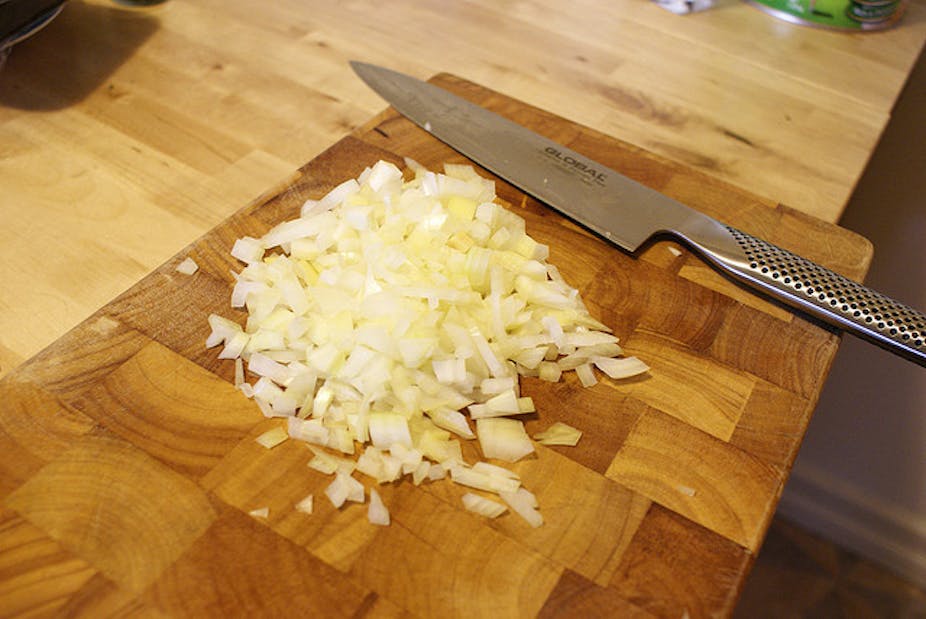
The cultivated onion, Allium cepa, is a savoury staple of cuisines around the world. Yet slicing up onions all too often leads to tears: you peel off the papery outer skin, start chopping and before long, your eyes are stinging and watering so much you can hardly see; your nose runs like crazy and you wonder why someone hasn’t found a decent way to prevent this torment.
Suggested solutions abound: chew gum, peel onions under water, use a sharp knife, make sure the onions are cold, light a candle nearby, turn on an exhaust fan, wear goggles, or use good chef’s technique to get the job done as quickly as possible. Best of all, get someone else to do it.
Before deciding which methods work best, let’s examine two fundamental questions: why do onions make you cry? And why do we cry anyway?
We generate tears almost continuously. Tears are made by the lachrymal glands located on the upper, outer surface of each eyeball. Although mostly water, tears contain a complex mixture of salts and organic compounds which together keep the surface of the cornea clean and lubricated.

Every time we blink, the eyelids sweep a film of tears across the cornea. A series of tiny glands (tarsal or meibomian glands) in the eyelids secrete a lubricant to prevent the eyelids sticking to the cornea. This process is known as basal tear secretion and is controlled by parasympathetic nervous pathways.
We don’t usually notice basal tear secretion, since it quickly drains away through a pair of lacrimal ducts in the inner (nasal) corner of each eye into the nasal cavity. If tear production increases much over basal rate, this drainage mechanism cannot cope, and teardrops overflow the eyelids. Your nose also runs, as the ducts drain as much fluid as possible from the eye.
Crying occurs in response to two main types of stimuli: chemical or emotional. In each case, the increased tear secretion is due to greater activity of the relevant parasympathetic nerves, triggered by subconscious neural pathways in the brainstem.
Emotional crying is mostly associated with a subset of extreme emotional states: sadness, elation, anger. Unless you are an actor, tear generation usually is outside conscious control, as are the characteristic facial expressions and vocalisations (sobs, wails, and so on).
Tears also help protect the eye from injury or irritation. Foreign material is detected by fine sensory endings of the trigeminal nerve in the cornea, which activate reflex tear generation, often accompanied by involuntary blinking. Thus, the offending material is washed from the corneal surface or out from under the eyelids.

When we slice onions, damaged cells release enzymes that break down to form a derivative of sulfenic acid. This is rapidly converted into a volatile gas (onion lachrymatory factor) by a further enzyme, lachrymatory factor synthase. The lachrymatory factor reacts with water on the corneal surface to produce a range of noxious compounds, including sulphuric acid and hydrogen sulphide.
Onions and garlic have another sulphur-containing compound, allicin. Along with the onion gas, allicin activates the TRPV1 receptors (also stimulated by noxious heat and hot chillies) and TRPA1 receptors (also stimulated by wasabi). Together, these compounds guarantee your eyes will sting and feel like they are burning. So we cry until the noxious agents are diluted and washed from our eyes.
So which methods work best to reduce tearing up? Sharp knives minimise tissue damage, but volatile irritants are still released. Keeping onions cold reduces vapour formation, whereas cutting onions under water or in a strong airflow from an extractor fan prevent vapours reaching your eyes. Goggles work even better, as long as you don’t mind how you look!
But breathing through your mouth or chewing gum has no effect: the tear stimulus is in your eyes, not your nose or mouth.
In principle, onions could be bred or genetically engineered not to express one of the enzymes that cause you to cry. But where would the challenge be then?