
Muscle testing (kinesiology): panacea or placebo?

Muscle testing, or kinesiology, has grown in popularity over the last 30 years. It’s a simple, non-invasive assessment tool used by many different kinds of health practitioners during examination or evaluation. It’s used to assess many different things – as broad as general health status and as refined…

Xzztt88h-1355793930
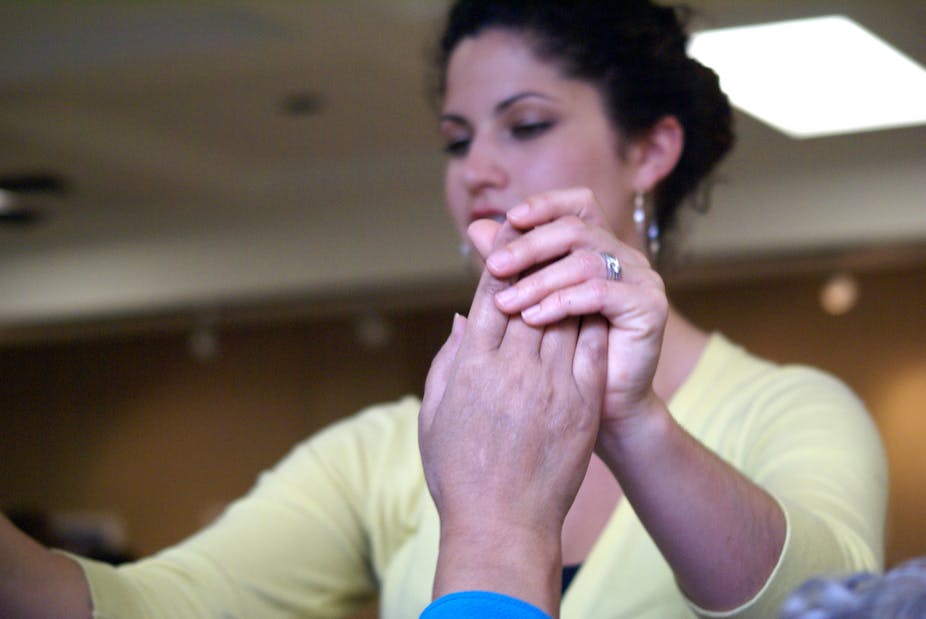
Muscle testing is used to gauge everything from general health status and specific supplement dosage. University of the Fraser Valley

Muscle testing, or kinesiology, has grown in popularity over the last 30 years. It’s a simple, non-invasive assessment tool used by many different kinds of health practitioners during examination or evaluation. It’s used to assess many different things – as broad as general health status and as refined as specific supplement dosage, and almost everything in between.

Different professionals use muscle testing in different ways, so there’s some confusion about the term itself, how the test is used and what the results mean. Because of this confusion, research evaluating the usefulness of muscle testing has been difficult to design and interpret.

A brief history

Muscle testing was first used in the early 20th century to measure muscle weakness in polio victims. Then, in 1949, Kendall and Kendall, two physiotherapists, described specific ways to test individual muscles for other neuromusculoskeletal conditions.

About 15 years later, a different use for muscle testing was developed by chiropractor George Goodheart. Goodheart’s technique is called applied kinesiology and it’s used by approximately 40% of American chiropractors.

It’s similar to the practice developed by Kendall and Kendall because specific muscles are tested. But Goodheart didn’t use muscle testing to evaluate muscular power alone, he was more interested in how well the nervous system controlled muscle function. So, while the different types of muscle tests looked very similar, the reason the tests were performed and the meaning of the results started to differ significantly.

A third form of muscle testing emerged following on from Goodheart’s work. I call this kinesiology-style muscle testing. This kind of muscle testing is estimated to be used in over 70 different techniques, and by over one million practitioners worldwide.

In kinesiology-style muscle testing, muscles are still tested but not as specifically as Kendall and Kendall did or as it’s done in applied kinesiology. Examples of techniques that use kMMT include, but are not limited to, PSYCH-K, total body modification (TBM), BodyTalk, neuro emotional technique (NET), and emotional release technique.

What does it mean?

The basic principle of kinesiology-style muscle testing is that when there’s some stress or abnormal nervous system input to a muscle, it “weakens”. During a muscle test, a practitioner applies a force to one muscle or group of muscles, with a particular intent in mind. The muscle is then labelled “weak” or “strong” based on its ability to resist this force.

What a “strong” test means compared to a “weak” test varies between techniques and applications. For example, kinesiology-style muscle testing is used to determine the state of organs and organ systems, to evaluate nutritional status and the need for supplementation, to detect imbalances in the meridians and chakras, to discover the presence of mental or emotional stress, and to identify chemical sensitivities and “allergies”.

Muscle testing and research

There are many different uses for kinesiology-style muscle testing in clinical practice, and many different ways that it could be studied, so it’s impossible to list them all here. And unfortunately, the amount of sound research on it is limited.

One study of kinesiology-style muscle testing found that a muscle stayed “strong” after a patient spoke true statements, and went “weak” after a patient spoke false statements. But it’s unclear from the study what biases may have been present to influence the outcome. While it’s generally accepted that all forms of muscle testing have some bias, little is known about how much actually exists.

Using applied kinesiology, another study found that experienced practitioners (five or more years’ experience) more accurately predicted muscle strength compared to inexperienced practitioners (less than five years' experience), with accuracies of 98% and 64% respectively.

Other studies of kinesiology-style muscle testing, have found that practitioners were able to determine if a spoken statement was true significantly more accurately than guessing whether it was true (69% correct for muscle testing, 49% correct for guessing, p of less than 0.0001). These studies found accuracy had no connection with practitioner experience.

In still other studies, kinesiology-style muscle testing was found to accurately predict low back pain and simple phobias, and applied kinesiology was found to accurately predict food allergies.

But further studies found that applied kinesiology was not able to predict nutritional needs, nutritional intolerance, thyroid dysfunction, exposure to practitioner-defined noxious stimulus, and chiropractic subluxation detection and correction.

How safe is muscle testing?

There has been no muscle testing-caused harm reported in the literature to date, but no formal investigation of the risks of muscle testing has been published either. If harm were to be linked to muscle testing, it’s likely that it would be indirect. A serious medical condition might go undiagnosed or untreated while someone opts to see a muscle testing practitioner. This delay might put an ill person at undue risk.

It’s generally accepted that most practitioner-applied assessment tools are rarely 100% accurate or entirely bias-free. But given the simplicity of muscle testing and its good safety record, together with its reasonable accuracy rate, muscle testing may be a reasonable addition to medical evaluation.

This is the ninth article in our series Panacea or Placebo. Click on the links below to read the other instalments:

Sign in to Favourite

Want to follow The Conversation?

Sign up to our free newsletter to get the day's top stories in your inbox each morning, with a special wrap on Saturday.

Spinner
Help evidence based journalism become the norm and donate

Join the conversation

14 Comments sorted by

  1. Sue Ieraci

    Public hospital clinician

    "muscle testing may be a reasonable addition to medical evaluation."

    Testing muscle power and grading it is already (and has long been) a standard procedure in physical examination of the nervous system and musculoskeletal system.

    It is used to evaluate both direct muscle wasting (for example, due to lack of blood supply, or wasting diseases, or systemic disease like hypothyroidism) and also for both upper and lower motor neurone lesions (together with testing reflexes).

    I understand that every article was a word limit, but the author has not explained a context for measuring muscle strength outside the context I've describied. Sure, testing muscle strength isn't harmful, but, other than as a test of muscle cell and related neurological function, what is its benefit?

    report
  2. Rachael Dunlop

    Post-doctoral fellow at University of Technology, Sydney

    I'm with you Sue. I'm not sure I see the point of this really. I note the author includes applied kinesiology which is used by shonksters to sell magic energy bracelets. You can see it in shopping malls and a lifestyle-fests. I'm confused.

    report
  3. Michael Vagg

    Clinical Senior Lecturer at Deakin University School of Medicine & Pain Specialist at Barwon Health

    Such a highly selective survey of the literature coming from a Doctoral candidate implies either lack of scholarship or deliberate disingenuousness. In case it is the former, allow me to point out that there are a number of systematic reviews about this type of muscle testing, including Haas et al who concluded that " the use of MMT for the diagnosis of organic disease or putative pre/subclinical conditions is insupportable." Link is here..(no paywall)
    http://www.ncbi.nlm.nih.gov/pmc/articles/PMC2000870/

    One hopes that Oxford's standards are not slipping...

    report
  4. Tim Scanlon

    Debunker

    Applied kinesiology has no support for efficacy, as Michael pointed out. The worst part about it is the way it is used to sell rubbish like Power Bands and Bioflow products. http://rationalwiki.org/wiki/Applied_kinesiology

    To have anyone taking this stuff seriously shows that either deliberate or unintentional confounding of actual muscle testing with the pseudoscience of applied kinesiology. If it is the former, then that is a shameful act, if it is the latter, then that is just lazy.

    report
  5. Gary Cassidy

    "During a muscle test, a practitioner applies a force to one muscle or group of muscles, with a particular intent in mind. The muscle is then labelled “weak” or “strong” based on its ability to resist this force."

    How does a practitioner know what the baseline strength should be? Normal healthy people have a large variation in strength depending on genetics, fitness, occupation, etc.

    report
    1. Sue Ieraci

      Public hospital clinician

      In reply to Gary Cassidy

      Gary - in standard tests of muscle strength within orthodox health care, nurses, doctors and physios have a standard grading for muscle strength, from one to five. (Or zero for no power at all).

      The person's power is compared against that of the tester, with normal power being graded as "5" - meaning that the person is able to overcome the tester's resistence. Here's a quick summary:

      Grades for quantitative assessment of muscle power

      Grade(0):-Total paralysis.
      Grade(1):-Visible or palpable…

      Read more
    2. Gary Cassidy

      In reply to Gary Cassidy

      Thanks Sue,

      It would seem the grading system used by orthodox health care is well defined and does not rely on excessive interpretation.

      Whether this is true of kinesiology (which seems like a broad term covering many forms of muscle strength testing) is not clear from the article.

      report
  6. Sue Ieraci

    Public hospital clinician

    Could the author, who is doing a PhD on evidence-based care, come back in and give us some evidence about the nature and validity of kinesiology?

    I also found the background confusing. The first part of the article talks about testing muscle strength, and the standardisation that occurred in relation to assessing polio victims. This is the way "testing muscle strength" is still understood and used daily in health care - by doctors, nurses, physios.

    The leap to "kinesiology", according to the article, came from chiropractic, and appears to represent something else altogether. But what is it, what does it mean, and what evidence is there that it is valid?

    If we are just talking about testing muscle strength as a way of assessing muscle and nerve function, then why do we need a special name? If we are talking about something different, what is it, and how is it valid?

    Could we give the author a few more column inches to explain?

    report
  7. Dan Smith

    Network Engineer

    Can we stop acknowledging "safety" as a useful metric in evaluating some of these CAM treatments? If someone gives you a drop of water in a pill, or prods you non-invasively a few times, then yes, chances are that it's going to be safe in that word's most trivial sense. But the author gets it right with this statement:

    "A serious medical condition might go undiagnosed or untreated while someone opts to see a muscle testing practitioner. This delay might put an ill person at undue risk."

    If…

    Read more
  8. Rosemary Stanton

    Nutritionist & Visiting Fellow at University of New South Wales

    The author quotes a single study supporting the idea that applied kinesiology can accurately predict food allergies. Sorry - that was a pilot study of 17 people in 1998. No blinding and such results can't be considered as any kind of 'proof'.

    Since then, several review papers have noted that applied kinesiology is not an accurate diagnostic method for food allergies.

    If you can read German, check a good review by Kleine-Tebbe and Hereld (abstract at http://www.ncbi.nlm.nih.gov/pubmed/20963379) or a good review by Gerez et al and available free in the Singapore Medical Journal (http://www.ncbi.nlm.nih.gov/pubmed/20963379). This review provides details of studies showing that applied kinesiology has been tested for diagnosing food allergies - and found to be useless.

    report
  9. Anne M. Jensen

    Doctoral candidate at University of Oxford

    Hello and thank you all for reading and commenting on my article. I would be delighted to give more details. First, understand that with a 700-word limit and limited referencing capabilities, it is difficult to describe "kinesiology" and its evidence as thoroughly as one would like. I am glad for the opportunity to explain salient points in more detail here.
    Yes, as most of you are aware of, there are a number of modalities out there that are called "muscle testing." I have identified three distinct…

    Read more
    1. Sue Ieraci

      Public hospital clinician

      In reply to Anne M. Jensen

      Wow - it's worse than I thought: a person provides resistance against the subject's muscle effort, and they decide a whole lot of things from whether they are lying to how their organs function from whether the person suddenly releases the muscle or not?

      How does one control for voluntary contraction and release?

      I am really puzzled by the assertion that use by only a million people world-wide, split amongst hundreds of applications, would suggest any sort of validity. ON the contrary - therapies…

      Read more