Not all community gardens are environmental equals

Food safety, availability and affordability are now global issues. Rapid urbanisation has increased demand for food in cities, where most people now live. Growing demand for food has been met by growth in industrial agriculture. Ultimately, this has led to a disconnection between urban residents and…

62d2jpxb-1354145672
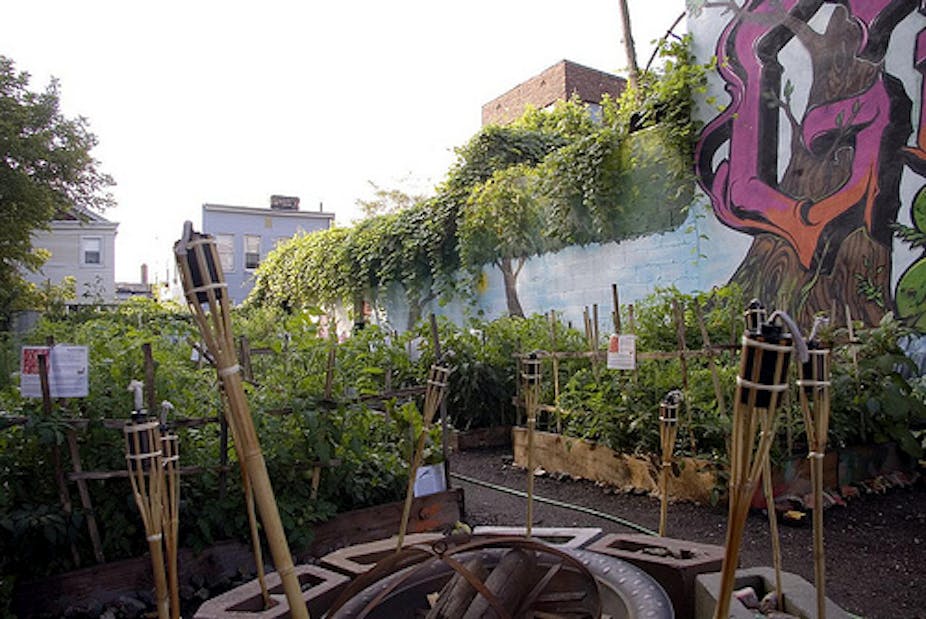
Community gardens are becoming a viable urban source of food. stc4blues/Flickr

Food safety, availability and affordability are now global issues. Rapid urbanisation has increased demand for food in cities, where most people now live. Growing demand for food has been met by growth in industrial agriculture. Ultimately, this has led to a disconnection between urban residents and where their food comes from.

Community gardens have more recently become a popular source of urban food, and many researchers, policy-makers and activists believe that community gardens are now part of an alternative food system.

Although much of the academic literature suggests that community gardens are an effective and environmentally sound way of producing food in cities, this claim has not been substantiated.

Very little is known about how people actually garden in community gardens. The term “community garden” has been widely used to refer to any type of garden, independent of gardening practices or the philosophy informing garden development, thus putting all the gardens in the same basket.

A recent study identified sixty-five academic papers describing original research on community gardens, mostly documenting the social benefits of gardens, such as health promotion and education, community building and resilience.

But what has so far been neglected by researchers is the environmental benefits of community gardens. These include the effective management of soil nutrients, sunlight, rainfall and biological resources, factors that are essential for their long-term viability.

How community gardeners add nutrients to the soil (fertilisers vs. compost), control pests (pesticides vs. companion planting/crop rotation) and use existing resources (tap water vs. collecting rain water in tanks) are important aspects of urban ecology that warrant closer scrutiny.

This is because different gardening practises can be both environmentally beneficial (composting or locally sourcing plants and materials), or environmentally harmful (through use of synthetic chemical pesticides or limited plant diversity).

Local research in Queensland

Our study examined 50 community gardens in two of the most rapidly urbanising cities in Australia – Brisbane and the Gold Coast, South East Queensland. South East Queensland is Australia’s fastest growing metropolitan region, with its urban population expected to grow from 2.8 million in 2006, to 4.4 million people by 2031.

The main purpose of the study was to obtain a clearer picture of how the general characteristics of community gardens might shape long-term garden viability, and how garden managers' motivations affect gardening practises, with a view to informing policy on future community garden development.

Garden managers were surveyed about who runs the gardens, their motivations, the cultural background of members, their gardening philosophy, their facilities, and their gardening practices (such as soil improvement, water and energy usage).

The gardens examined were either run by schools or by a range of not-for-profit organisations. Garden managers’ primary motivations for establishing these gardens were education, community building and sustainability.

State and local government provided land and other resource for nearly all gardens, with gardens collectively occupying 57,000 square metres of land. Gardens in general, but school gardens in particular, were surprisingly culturally diverse, with members from many national backgrounds.

Almost half of the garden managers reported Permaculture as the driving gardening philosophy. Most did not use any chemicals, but seven gardens reported using synthetic fertilisers and pesticides. The ones that didn’t use chemicals used alternative strategies for nutrient soil improvement and pest control such as homemade compost, mushroom compost, blood and bone, worm castings, companion planting, planting in season and climate, and crop rotation.

Permaculture is a system of agriculture that is designed to be environmentally sustainable, often by planting different crops together. niallmcnulty/Flickr

Only half of these gardens, mostly the Permaculture ones, actually recognised that it was important to maintain healthy soils in order to grow healthy vegetables. Permaculture gardens used lower-impact gardening practises than non-permaculture gardens.

We found that the gardens are in fact very different, and that many are not at all environmentally sound.

Looking forward

Ultimately, the long-term viability of urban food systems is dependent not only upon social factors such as motivations and governance, but also upon environmental and ecological factors, such as the type of gardening practises used and the types of plants grown in these gardens.

Governments should be aware of these differences in gardening practises, because when it comes to community gardens, one size doesn’t fit all. Promoting community gardening as a health intervention and and providing security of tenure by allocating land for gardens is an important function of government.

But policy-makers must also become more attuned to the environmental impacts of gardening practises. They should promote Permaculture community gardens for their environmental, as well as social benefits.

Permaculture integrates landscapes, ecological processes and people, it has enormous potential to provide sustainable food. Applying these principles and techniques can enhance human well-being and promote ecological resilience. A big advantage is that Permaculture is a well-established design system that is easy to follow.

Permaculture community gardens can green cities, feed people and foster healthy ecosystems. So don’t be a couch potato, put on your gloves, grab a hat and head to your nearest Permaculture community garden for a dose of happiness, good health and delicious veggies.

Articles also by These Authors

Sign in to Favourite

Want to follow The Conversation?

Sign up to our free newsletter to get the day's top stories in your inbox each morning, with a special wrap on Saturday.

Help evidence based journalism become the norm and donate

Join the conversation

23 Comments sorted by

  1. John Newlands

    tree changer

    I think community gardens should be staffed by volunteers with similar views on chemicals. If they involve conscripts such as work-for-the-dole and have to meet productivity benchmarks requiring chemicals then they will become sources of trouble.

    Some fast food restaurants have signs saying we need 8750 kJ of food a day. That is achieved by vast areas of farmland, massive machines burning diesel fuel, heavy use of strong chemicals, streamlined food preparation and preserving such as freezing…

    Read more
    1. Trevor S

      Jack of all Trades

      In reply to John Newlands

      "helps vary our diet. If we relied on community gardens we would have to accept less quantity and variety."

      Variety
      Why is it we need such a varied diet ? Is that healthy ? Are there any animals, aside from humans, with such a varied diet ?

      Quantity
      As to quantity, it also seems we have way to much of that if the obesity epidemic is a gauge.

      We live on a small rural plot (50 acres) and grow lots of our own stuff (excess we give away and feed to the chickens (eggs & meat) ), while trying to be mindful of the inputs, it's interesting to note I need water tanks, pumps (solar), a small farm dam, a diesel ute to go get horse manure from the neighbour. Ain't no way we're feeding the planet like this. way too many people for that approach.

      I do pee in the fertlizer water (a 60 l bucket with horse shit, chicken manure, human pee, nettles) though, so there is some waste recycling :)

      report
    2. Barry Robertson

      Retired

      In reply to Trevor S

      Many, if not all animals like a change in their diet.

      It is always fascinating to see sheep that have access to two paddocks, one full of lush green feed and another with short crop stubble and dust. The sheep will wander into the paddock in which there is to the normal person no feed and they will browse there for hours at a time. They do this for the change and also because any weeds that there are among the stubble are normally deep rooted ones that bring minute amounts of trace elements to…

      Read more
  2. Zo Zhou

    logged in via Facebook

    "[The Govt] should promote Permaculture community gardens for their environmental, as well as social benefits."

    Who do you propose the govt target? If it's true that most people go to community gardens for the social/community aspect, it might be more effective to work with the actual garden groups themselves to ensure environmental outcomes are met. Aside from the fact that community gardening is rarely promoted in any major way anyway.

    report
  3. Aden Date

    Manager of the Guild Volunteer Hub at University of Western Australia

    > Only half of these gardens, mostly the Permaculture ones, actually recognised that it was important to maintain healthy soils in order to grow healthy vegetables. Permaculture gardens used lower-impact gardening practises than non-permaculture gardens.

    > We found that the gardens are in fact very different, and that many are not at all environmentally sound.

    To be clear, did the studies find that those recognising permaculture principles are those that tend to be environmentally sound? This seems to be implied but ultimately the article is unclear in stating what seperates the environmentally sound from non-sound gardens.

    report
  4. Tim Scanlon

    Debunker

    I disagree with the idea of promoting permaculture. The promotion of unscientific and untested methodologies when we have perfectly good agricultural practices and research to draw upon creates even more of a divide between food production and people as it instils mythology in place of science and knowledge.

    Much of the methods needed for urban gardens is nothing more than standard horticultural practices. Promote and learn from them instead of promoting practices that are part myth.

    report
    1. Suzy Gneist

      logged in via Facebook

      In reply to Tim Scanlon

      It leaves me to wonder, Tim, if you've actually ever read the Mollison PC Manual? But then one can also extend that myth underlies all cultural expressions at some level, it's virtually impossible to leave the interpretive out of any knowledge.

      report
    2. Tim Scanlon

      Debunker

      In reply to Tim Scanlon

      Permaculture is not based on scientific principles.

      Agriculture is.

      There is no point trying to promote something that is unlikely to work. We have perfectly good agricultural science knowledge that can be brought to the table for any garden or farm. Please don't dismiss science in favour of idealism, it just never works out well.

      report
    3. Suzy Gneist

      logged in via Facebook

      In reply to Tim Scanlon

      Sorry, Tim, but a statement like that just shows your ignorance of permaculture. Since it is a form of agriculture, your argument negates itself. Science is based on experimentally attained knowledge. Permaculture agriculture works just as well as other agricultural practices.
      As an aside, in what way is science not a product of idealism?

      report
  5. Ewen Peel

    Farmer

    Interesting article and good to see more interest in where our food comes from.
    I agree with Tim about the Permacutlure slant of the article. While it has its place there are many and varied ways of producing food and it is a foolish grower who uses the all the eggs in one basket approach.
    The next bit will be the "Best Practice" methodology. I have lost count of how many times i hear of people using and promoting best practice, only to have total U Turn a couple of years later and do it a totally different way.
    Diversity is the key and it sounds like a lot of the community gardens are currently achieving this. Use what methods best work in the local environment and grow the sort of things that people will want to eat.
    Don't get the blinkers on and think that a certain method of production is the only way. Don't be afraid to experiment ask for the opinions of others as well.

    report
    1. Tim Scanlon

      Debunker

      In reply to Ewen Peel

      I love terms like "best practice". Such a non-concept.

      My favourite example is in weed control. Radish is a huge problem in broadacre cropping, but with best practice it shouldn't be. You can actually get terrific control and stop radish from having any real impact. The problem is that you have to spray at exactly the right time (leaf stages of both weed and crop) and get a proper dose to the weeds, miss that by half a leaf stage and it doesn't work. Even a small cropping enterprise will have had a change in leaf stage just trying to cover the ground with the spraying, so best practice doesn't work in the real world.

      report
    2. Suzy Gneist

      logged in via Facebook

      In reply to Ewen Peel

      Again, first permaculture is interpreted as an 'all eggs in one basket' approach with little understanding of its principles, it seems to me, since then you go on to stress the importance of many of its core principles (diversity, local adaptation, experimentation...)
      I think some deeper understanding of permaculture and its principles may surprise how applicable it is to a variety of situations, climates, settings.

      report
    3. Tim Scanlon

      Debunker

      In reply to Ewen Peel

      Suzy, I think some deeper understanding of agriculture and agricultural science will show you just how flawed some of the principles of permaculture are and how there are much better options available from agricultural science.

      report
    4. Suzy Gneist

      logged in via Facebook

      In reply to Ewen Peel

      The only difference between agriculture and permaculture is the basic set of ethics that the latter is based on as opposed on those ethics used by conventional agriculture. These ethics define what can/cannot be reasonably applied within this specific agricultural practice (i.e. permaculture). Therefore the applications differ and use alternative methods where appropriate.
      You seem to think permaculture is some entirely metaphysical practice with no basis in real knowledge? Otherwise I cannot understand your argument.

      report
    5. Barry Robertson

      Retired

      In reply to Tim Scanlon

      If you are talking about the agricultural and horticultural practices that have as support in excess of eight thousand registered chemicals to help in their production methods then I believe that Suzy Gneist has put up a valid argument in favour of permaculture.

      I was involved in the horticultural industry in four of the Australian states for 16 years and the amount of chemicals I saw used and abused amazed me. I have also seen food rot on trees, vines and in paddocks as it could not be picked…

      Read more
  6. TCLynx (Aleece) Aquaponic Lynx LLC

    logged in via LinkedIn

    While I do agree that not all gardening practices are created equal. When it comes to growing ones own food in a back yard, on a patio or in a community garden, I say do it and I don't care that much the practice. Anything you grow yourself is going to be better than industrial food trucked around the world and over processed food.

    I do favor non chemical growing methods and feeding the soil and the least toxic pest controls appropriate to the situation as well as composting and water wise gardening…

    Read more
    1. Tim Scanlon

      Debunker

      In reply to TCLynx (Aleece) Aquaponic Lynx LLC

      Actually you will find that the opposite is true. Farming is more efficient with inputs because it has to be to remain operational on a global economic platform. The gardener does not have to contend with this and is notoriously prone to inefficient use of water and overuse of all inputs. Put another way, gardeners don't have to produce food to pay off their water or fertiliser bill, so they don't eek out every ounce of produce they can for each unit of input.

      So the only real advantage of growing…

      Read more
    2. Suzy Gneist

      logged in via Facebook

      In reply to TCLynx (Aleece) Aquaponic Lynx LLC

      Industrial agriculture is only more cost efficient as long as fuels, transport and packaging are cheap and environmental costs are externalised. Once we don't just talk about profit (money) as a measure of effectiveness, but improved soil, air, species benefits, health and life quality, this argument doesn't hold any longer. I would argue that these are benefits outside the "only real advantage" you can see.

      report
    3. Tim Scanlon

      Debunker

      In reply to TCLynx (Aleece) Aquaponic Lynx LLC

      Suzy, you are quite wrong. If you actually believe that a farm is less efficient at producing food than gardening then you are flying in the face of 10,000 years of scientific progress in the field of agriculture.

      This is essentially the difference between professionals and amateurs.

      As to your statements about profits and costs of fuel, packaging, etc, these are wrong as well. A farm doesn't operate on a one year turn-around. Farmers are in it for the long term, so they have to manage the environment as part of resource management for future ability to farm. You may have heard of Landcare, started by farmers in WA; just one example. You listed a bunch of "costs" that aren't farm costs, but retail costs, and nothing to do with the farmgate management decision. On farm fuel is an input, part of producing food, just like labour, water, fertilisers, etc. Of course, most hobby gardeners don't count any of these costs, which is why they are inefficient at their utilisation.

      report
    4. Suzy Gneist

      logged in via Facebook

      In reply to TCLynx (Aleece) Aquaponic Lynx LLC

      I made no reference to "gardening" or "hobby farming" as you imply.
      I did, however, refer to the entire cost of food production (incl. growing, harvesting, packaging, transporting - the whole system of which farming is only a part) and not just to "farming" (i.e. growing/harvesting) as you seem to imply.
      Your comment does not relate to external costs at all, which was the point I made that differentiates the practices of conventional and permacultural agriculture.
      You seem to think that permaculture…

      Read more
  7. Ryan Farquharson

    Research Officer

    I think one of the great opportunities of urban food production (that Tim has missed) is in recycling resources that would otherwise go to waste. Collection of rainwater, use of grey water, composting, worm farming all work fabulously well in my backyard. Companion planting and very small scale rotations (that can't be done on a commercial scale) also keep chemical use to minimum. There are actually quite a few overlaps between 'permaculture' and horticulture. I take the best from both worlds.

    report
    1. Tim Scanlon

      Debunker

      In reply to Ryan Farquharson

      I didn't miss those, as most of agriculture is rainfed and all farms use "composting" to some extent (the most common in broadacre cropping being stubble retention).

      I agree that food production has to close the loop on waste management. Currently there is no direct return of nutrients from waste to the point of production. Biosolids aren't processed enough to remove heavy metals and are not able to be efficiently transported nor spread, but a refined product along these lines needs to be developed to return those nutrients to the soil where they were mined by the plants.

      report
  8. Comment removed by moderator.