
Power prices and the carbon tax: when will the sky fall in?

With several weeks having passed since the introduction of the carbon tax, the place to look for the most immediate effect is in the national wholesale electricity market known as the NEM.

It’s early days yet, but NEM prices are certainly up. To what extent can we attribute the rises to the carbon tax? And will the sky fall in?

If we compare the NEM prices over the first two weeks of July with previous years we see a surprisingly large rise. For instance, in Victoria the early July 2012 prices were up by about $60 on the same time period for each of the previous three years.
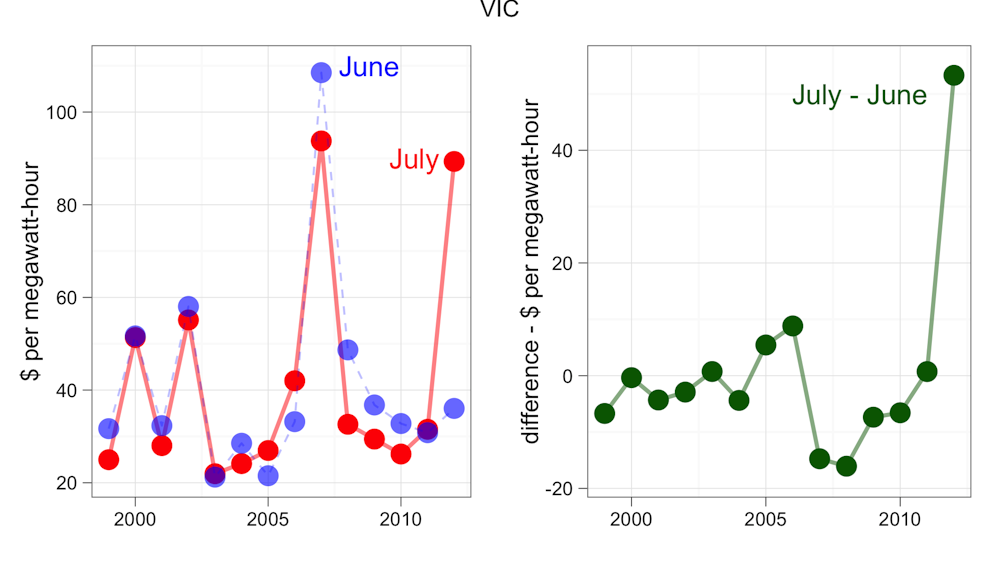
Volume weighted wholesale prices for Victoria for the first two weeks of July (in red) and first 2 weeks of June (in blue) by year. The plot on the right shows the difference (in green) between the July and June prices in a given year. The difference is typically less than ± $10, with the exception being the $50 difference this year. The question is how much of it is due to the carbon tax? Note that even though July 2012 prices are exceptional, they are still lower than in the winter of 2007. Data from AEMO, figure by Mike Sandiford

New South Wales and Queensland prices were also up, but not quite so much at about $40 each.

With wholesale prices varying for a range of reasons, on timescales from the seasonal to the hourly, a better comparison maybe between time periods immediately pre- and post- carbon tax implementation.

Victorian prices in the first two weeks of July were up about $50 on the first two weeks in June in 2012. In both New South Wales and Queensland the price differential was about $35. In South Australia it was almost $60.

Given that about one tonne of CO2 is generated for about each megawatt-hour of coal-fired power, these price jumps are significantly more than expected for a $23 per tonne carbon price.

So what gives?

To work out what is going on, it’s useful to look at how average daily prices have changed over the last two months.
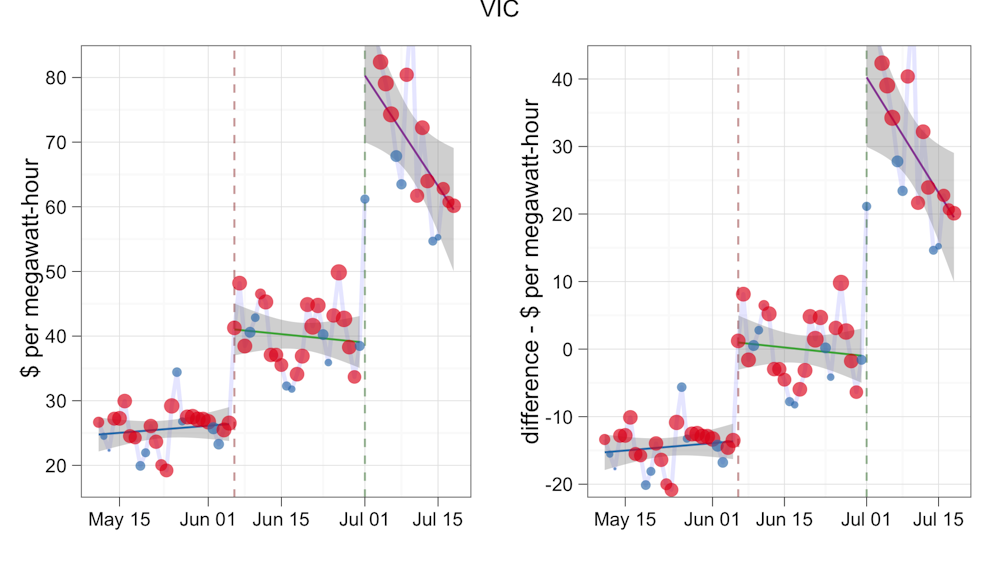
Daily volume-weighted wholesale prices for Victoria for the two months mid-May to mid-July (red circles are weekdays, blue circles are weekends, circle sizes scale to total daily demand). Left panel shows absolute prices, right panel shows prices with the mean of June 6th to 30th subtracted. June 6th corresponds to the onset of Yallourn pit flooding due to failure of the Morwell River diversion. Data from AEMO, figure by Mike Sandiford

Up until June 6th, daily prices averaged between $25 and $30 per megawatt-hour across the NEM. On June 6th prices jumped by around $10 across all NEM jurisdictions.

That price jump was largely due to the reduction in output at TRUenergy’s Yallourn power station following the Morwell River diversion collapse on June 6th. The flooding in the open-cut mine and damage to the conveyor system that delivers coal to the power station caused power output to reduce by over one gigawatt.
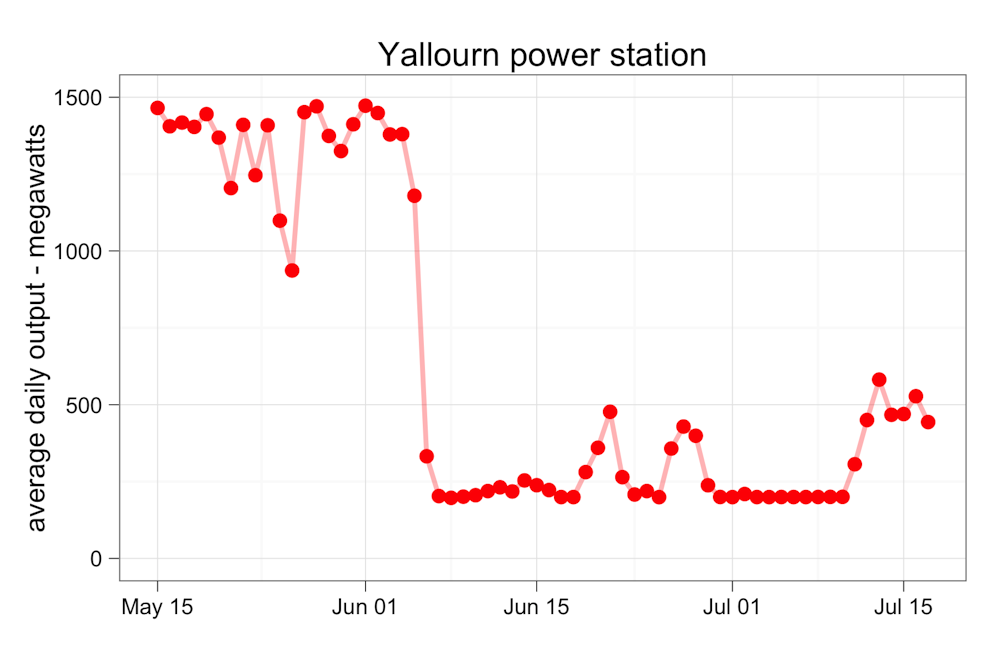
Yallourn power station output for the two months mid-May to mid-July spanning the Yallourn pit flooding due to failure of the Morwell River diversion on June 6th. Data from AEMO, figure by Mike Sandiford

You might think the effect would have been largely limited to Victoria. However, interstate power flows allow the price signals of such outages to propagate right across the NEM. In fact, there was little difference in the price impact of the Yallourn outage between Victoria and the other mainland states connected to the NEM.
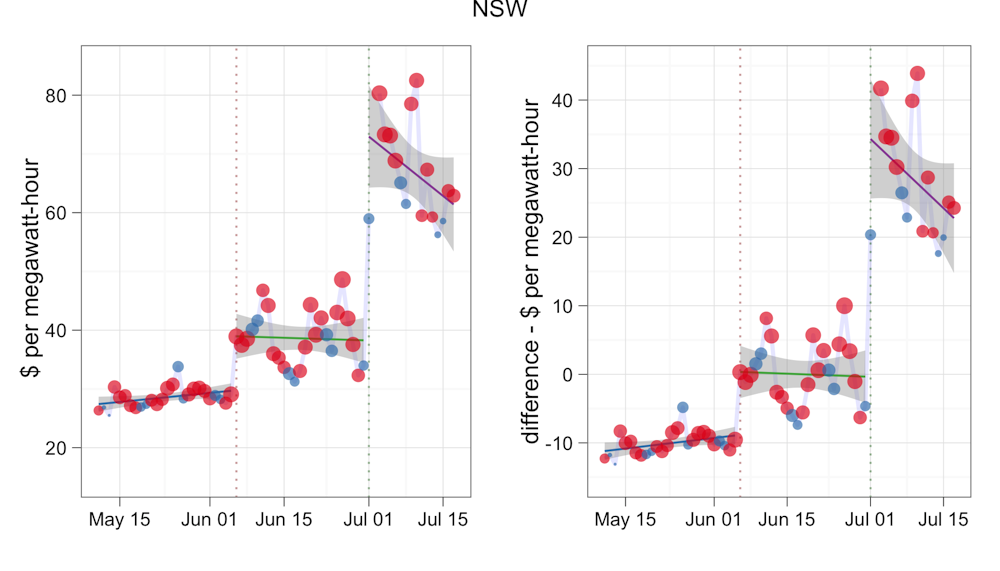
Daily volume-weighted wholesale prices for New South Wales for the two months mid-May to mid-July. (red circles are weekdays, blue circles are weekends, circle sizes scale to total demand). The plot on the left shows absolute prices, while the plot on the right shows prices with the mean of the period June 6th to 30th subtracted. Data from AEMO, figure by Mike Sandiford

If we factor out the price impact of Yallourn, we see the price hike in early July was initially about $35-40 per megawatt-hour. However prices have dropped back considerably since the first week of July and are now only about $25 above late June prices. And the trend still appears to be heading downwards.

The initial carbon price hike at the beginning of July seems to have been a bit of an overshoot. Perhaps the generators were being somewhat “conservative” in their bidding strategy in the brave new world of carbon pricing. If so, market forces appear to be quickly pulling them back into line.

If and when Yallourn comes back to full prodcution, we could expect prices to drop back another $10 or so, and settle at around $50-$55 per megawatt hour. In a historical context, that not much more than the $47 annual wholesale price averaged over the last 10 years when adjusted to 2012 dollar terms.

In the bigger picture, the overall impact of the carbon tax will have been significantly cushioned by the very low wholesale prices over the last few years. Those low prices reflect the general state of oversupply on the NEM as discussed in my last post.

In spite of the issues at Yallourn, and the impost of the carbon tax, wholesale prices have not yet reached the heights of the winter of 2007, and do not look like doing so. The sky didn’t fall in 2007 and won’t be doing so now. Unless of course we have another Yallourn-like incident on the NEM.

Wholesale prices are up, but the trend in prices since early July suggests they will stabilise at only a few dollars above the long-term average adjusted wholesale prices. And that is with the cost of the carbon tax.

Join the conversation

56 Comments sorted by

  1. Berthold Klein

    Civil-Environmental engineer

    There is no "creditable experiment " that proves that the Greenhouse gas effect exists. If the greenhouse gas effect does not exist then to reduce the CO2 in the atmosphere to reduce "Mann-made global warming" is totally stupid!!!!
    Here is the experiment that proves that the "greenhouse gas effect does not exist.
    This experiment has been reviewed by not less than 4 Ph.D physicists and many other Ph.D.'s.
    There are many comments on other posting on this same subject, when are the academics going…

    Read more
    1. Stuart Purvis-Smith

      Clinical Cytogeneticist (retired)

      In reply to Berthold Klein

      Oh dear! Please tell me how an article about wholesale prices of electricity in Australia following the introduction of a carbon price relates to this stream of impenetrable drivel. Is this a conversation or just an opportunity to push an agenda? And if you are going to give us lessons in elementary chemistry, please get your facts right - Nitrogen dioxide (NO2), a brown, pungent, toxic gas is not the same as laughing gas (N2O) which is used medically. This, among many factual errors and omissions I find quite laughable.

      report
    2. Lorna Jarrett

      PhD candidate, science education; Physics teacher

      In reply to Berthold Klein

      Moderators,

      Surely a paste job like this deserves its own section in "report abuse"?

      IMO it's profoundly rude at the very least. Correct me if I'm wrong, but a "conversation" involves people constructing arguments in response to the arguments of others - not just copying and pasting huge tracts from elsewhere.

      report
    3. Berthold Klein

      Civil-Environmental engineer

      In reply to Lorna Jarrett

      Lorna: for one that is supposed to be a physics teacher , you should be reviewing my experiment, then ask me some questions if you don't understand that basic physics proves that the "greenhouse gas effect does not exist."
      This is where real conversation is about. You have the attention of the author and the person that has done the experiment that proves that the "greenhouse gas effect" does not exist.
      The fact that this experiment and many other papers by others shows that the "greenhouse gas…

      Read more
    4. Berthold Klein

      Civil-Environmental engineer

      In reply to Stuart Purvis-Smith

      Hello Stuart Purvis-Smith: Lets discuss the insignificant of whether we're talking about NO2 or N2O , both are found in the atmosphere and are formed by many reactions. Lightning forms many different oxides of Nitrogen as well as any combustion process. Usually to cover all possibilities they are stated as N(x) O(x). The real issue is that non of the forms of Nitrogen oxides are “greenhouse gases. Another important factor is that plants need nitrogen for growth, the cycle of nitrogen is studied by general science students and horticulturist.
      Now lets get to your innuendo- ­” This, among many factual errors and omissions I find quite laughable” lets get to some details: give us a list of “factual errors” and the scientific references why they are “error”. Back up your words.

      report
    5. Lorna Jarrett

      PhD candidate, science education; Physics teacher

      In reply to Berthold Klein

      Berthhold,

      "Lorna: for one that is supposed to be a physics teacher , you should be reviewing my experiment"

      Sorry, but you think you've got a right to expect me to trawl through those pages and pages - which were obviously copied and pasted from somewhere else? If you can' be bothered to write anything fresh, then why do you expect others to be bothered reading it?

      Tell you what - re-write your argument in under 300 words and I'll find the time to look at it.

      I can't help wondering though - there are plenty of politicians, lobbyists etc. who oppose measures to reduce CO2, describe climate change as "crap" etc. etc. - in addition to scientists who're actually qualified in the field and who would gain instant fame from a credible refutation of the mechanism of the greenhouse effect - why aren't THEY jumping on your work, validating it and waving it from the rooftops? I don't think you can claim conspiracy theory here.

      report
    6. Gary Murphy

      Independent Thinker

      In reply to Berthold Klein

      "The IRag’s did absorb IR but did not “heat” the gas (an important clue!)."

      Congratulations - you have proved the greenhouse effect. (and it is an important clue).

      No - the GHGs do not absorb the IR and immediately heat up - they return the IR to the earth/ocean where it is thermalised and increases heat - and then transfers some of that heat back into the atmosphere through conduction.

      So Berthold - if the GHE does not exist as you claim - how do you explain the increased heat in the earth's atmosphere and oceans?

      report
    7. Glenn Tamblyn

      Mechanical Engineer, Director

      In reply to Berthold Klein

      Berthold

      Some simple questions for you. Forget all your long and rather turgid descriptions of balloons full of gas.

      How did you cool your various balloons to different, substantially lower (like 40-70 Deg C colder) temperatures to provide an adequate test of the GH Effect - without doing this your experiment isn't evenly remotely replicating temperatures in the upper atmosphere and therefore can't even begin to model the GH Effect?

      Here is a link to an example of what the Earth;s IR Spectrum…

      Read more
    8. Berthold Klein

      Civil-Environmental engineer

      In reply to Lorna Jarrett

      Lorna Jarrett commented:

      "Berthold, "Lorna: for one that is supposed to be a physics teacher , you should be reviewing my experiment" Sorry, but you think you've got a right to expect me to trawl through those pages and pages - which were obviously copied and pasted from somewhere else? If you can' be bothered to write anything fresh, then why do you expect others to be bothered reading it? Tell you what - re-write your argument in under 300 words and I'll find the time to look at it. I can't…

      Read more
    9. Lorna Jarrett

      PhD candidate, science education; Physics teacher

      In reply to Berthold Klein

      Berthold,

      "Lorna: I guess you can't comprehend anything with more than 300 word"

      No, Berthold. It's common in academic literature to supply an abstract, usually 300-odd words, as a summary. Most academics(myself included) don't have the time to read entire papers on the off-chance that they are relevant to their research or contain the information they need. Every type of academic writing - thesis, book, conference paper or journal article - requires an abstract, usually of a specified length…

      Read more
    10. Berthold Klein

      Civil-Environmental engineer

      In reply to Lorna Jarrett

      Lorna after reviewing the “Experiment that Failed ***” you are correct that an “Abstract” WOULD BE A BENEFIT to more readers. ( below) In addition is another “cut and paste of the abstract from the paper by Gerlich and Tscheuschner with whom I have communicated. They have reviewed one or more editions of the experiment. They are part of the team at “Slaying The Sky Dragon”. Many others at STSD have reviewed the “Experiment that Failed ***”
      I would hope that after reviewing “Experiment that…

      Read more
    11. Lorna Jarrett

      PhD candidate, science education; Physics teacher

      In reply to Berthold Klein

      Berthold,

      After identifying the part of the above post that actually was your abstract, I've had a look.

      I conclude that you conducted an experiment that failed to demonstrate the greenhouse effect. You also think that "BS has engulfed the world" and that the work of Einstein and Bohr are an integral part of your experiment (why else would they merit a place in the abstract?).

      What I haven't learned from reading the abstract is anything at all about what you actually did or what your results were. These are significant omissions, as they mean that no-one can evaluate your work based on the abstract.

      You might think that's of no relevance, and that everyone should be prepared to read your report in full. Thing is, you'd be wrong. No other researcher expects potential readers to have to go through their full report (possibly through a paywall) just to find out the nature of the experiment they carried out.

      report
    12. Stuart Purvis-Smith

      Clinical Cytogeneticist (retired)

      In reply to Berthold Klein

      Berthold,
      In order to inform my own understanding of where writers are coming from, I like to look into their credentials and publishing history. I note that you studied at the Case Institute of Technology in Ohio and describe yourself as an environmental engineer. I would expect that since 1961 you would have a body of peer-reviewed publications in your area of expertise but have not been able to find any so far. To assist my efforts, could you please point me to any peer-reviewed publications in which you have been an author or co-author?
      Many thanks

      report
    13. Glenn Tamblyn

      Mechanical Engineer, Director

      In reply to Lorna Jarrett

      Berthold

      Since you didn't reply to my comment further down, let me jump in here. I will post my comments as a reply to Lorna to avoid the excessive nesting of Comments that happens here at The Conversation.

      Some comments and observations about your 'proof'

      From the size of the ballon and height above the ground your report, from a point on the blcak surface directly below the balloon, the ballon subtends a solid angle of 0.4266 Seradians, out of a total 'sky' visible from that point of 2…

      Read more
    14. Berthold Klein

      Civil-Environmental engineer

      In reply to Lorna Jarrett

      Lorena: Thank you for the critic on the abstract. Here is a revised abstract but it is now 432 word however I do not intend to reduce it at this time. The major changes are bracketed[-]
      It appears that you do not understand the significance of the reference to Bohr Model , well as I learned my basic physics as a freshman and advanced physics including an introduction to quantum (including The Bohr Model)& nuclear physics as a sophomore more than 50years ago I'm surprised that you do not understand…

      Read more
    15. Berthold Klein

      Civil-Environmental engineer

      In reply to Stuart Purvis-Smith

      AS a working design engineer working on water & wastewater treatment plant I have not spent my time publishing.
      You will find many posting on other web-site where Information I have supplied has shut them down with facts that could not be denied.This has been during during the last4 plus years.
      Since when has the ablity to get publised proved the facts based on existing physics ?

      report
    16. Lorna Jarrett

      PhD candidate, science education; Physics teacher

      In reply to Berthold Klein

      Berthold,

      " Complete procedure of the experiment are presented ,results , interpretation and the appropriate physics."

      Well, one should pretty much hope so, for any experimental paper, so this statement is redundant. The point is you need to summarise your procedure, not just state that it's in the paper.

      Also, you don't get to over-run the word limit. That's lazy. You need to take out the stuff that doesn't serve a purpose.

      As for this:

      "I learned ... advanced physics including an introduction to quantum (including The Bohr Model)& nuclear physics ... I will supply several papers by “cut and paste” to educate you and the rest of the audience".

      That demonstrates misconceptions not only of what constitutes "advanced" physics (at least where I come from), but also what constitutes "education".

      report
    17. Glenn Tamblyn

      Mechanical Engineer, Director

      In reply to Lorna Jarrett

      Berthold

      Just a small observation on your references to the Bohr model of the atom. Tthat model, with its electron orbitals, different quantised energy levels and so on lies at the heart of understanding Atomic Spectroscopy - the spectra produced by single atoms. However the reasons for the spectra of molecules is far more complex, with a range of different mechanisms applying in different wavelength bands.

      In the wavelength band of interest wrt the GH Effect, the spectra observed actually…

      Read more
    18. Glenn Tamblyn

      Mechanical Engineer, Director

      In reply to Berthold Klein

      Berthold

      You claim that the GH Effect has never been experimentally confirmed. This is not true. It was the subject of extensive research during the 1950's and 60's, as part of the growth in understanding of Radiative Heat transfer in the atmosphere that was oiccurring during that period, largely as a result of Cold War research programs.

      Here is how the process worked.

      By 1952, in Goody et al 1952, the mathematical basis for understanding how radiative transfer in gases occurred had been…

      Read more
    19. Berthold Klein

      Civil-Environmental engineer

      In reply to Glenn Tamblyn

      Your last rant about only GH molecules giving off IR radiation is absolutely wrong. You just failed physics.
      http://climaterealists.com/5783
      ALAN SIDDONS   HEADLINE STORY   JOHN O'SULLIVAN   NASA  
      NASA in Shock New Controversy: Two Global Warming Reasons Why by John O'Sullivan, guest post at Climate Realists

      NASA covered up for forty years proof that the greenhouse gas theory was bogus. But even worse, did the U.S. space agency fudge its numbers on Earth’s energy budget to cover up the…

      Read more
    20. Gary Murphy

      Independent Thinker

      In reply to Berthold Klein

      Berthold - you still haven't answered my question. How do you explain the warming?

      Still think it is the sun? Here is a graph of solar irradiance vs global surface temps:
      http://en.wikipedia.org/wiki/File:Changes_in_mean_solar_irradiance_and_mean_global_surface_temperature_on_Earth_since_the_year_1978.png

      See any correlation?

      Here is a graph of CO2 vs global surface temps:
      http://en.wikipedia.org/wiki/File:Atmospheric_carbon_dioxide_concentrations_and_global_annual_average_temperatures_over_the_years_1880_to_2009.png

      See the correlation there?

      BTW both of these graphs are from http://en.wikipedia.org/wiki/Attribution_of_recent_climate_change if you want to check the sources.

      report
    21. Berthold Klein

      Civil-Environmental engineer

      In reply to Gary Murphy

      Your conclusions are nonsense. There is not enough energy in the 400ppm of CO2 in the atmosphere to heat the surface of the ocean by 0.0001 degree if it reached the surface. The whole concept of the "greenhouse gas effect " has not and can not be proved by "creditable experiment"
      The references from Glenn Tamblyn obviously were not very good otherwise there would not be the controversy today.
      Your reference to an NOAA graph is circumstantial evidence at best, I could plot the number of illegal aliens entering the US against the temperature rise and get just as good a correlation. It also has been proven that NOAA has been corrupting the temperature data for many years - actual temperature data shows that the earth's temperature has been level or going down.

      report
    22. Berthold Klein

      Civil-Environmental engineer

      In reply to Gary Murphy

      If the sun can warm the earth as it rotates by 20 to 50 degrees every 12 hours, why isn't it responsible for "climate change"?

      report
    23. Glenn Tamblyn

      Mechanical Engineer, Director

      In reply to Glenn Tamblyn

      Berthold. Again I will reply to myself to stop the comments nesting too deep.

      First reaction to you response! Madre de Dios! Somehow you are equating whether or how GH gas molecules radiate IR with temperatures on the Moon?

      Dealing first with your supposed 'revelations' about NASA's 'cover up' of ... well... something or other. Which I note you just simply copied & pasted.

      The assumption you seem to be criticising is that the surface of the Moon can be treated as behaving approximately like…

      Read more
    24. Berthold Klein

      Civil-Environmental engineer

      In reply to Glenn Tamblyn

      Glenn : I said you failed physics, now you fail web research!

      Is the Stefan-Boltzmann equation applicable to a three dimensional world ?

      Inconvenient truth of IPCC's AGW theory | Climate Clash
      http://climateclash.com/?p=1123
      Feb 13, 2012 ... The limits of carbon dioxide's influence on world temperature → ... 3. Planck response based on Stefan-Boltzmann law. In 1976, Cess obtained .... numbers equation is not applicable to a three dimentianal configureation why …

      arXiv:1009.3974v4…

      Read more
    25. Gary Murphy

      Independent Thinker

      In reply to Berthold Klein

      "It also has been proven that NOAA has been corrupting the temperature data for many years"
      "actual temperature data shows that the earth's temperature has been level or going down."

      You got any evidence to back up those claims?

      Your experiment is nonsense. Shouldn't you have insulated the mats and kept them separate? Of course on the scale and timeframe you were doing it any extra heat would dissipate long before it became measurable even if you did.

      Couple that with the idealogically-driven ranting all the way through which clearly demonstrates a complete lack of objectivity (something that is important when conducting experiments).

      report
    26. Glenn Tamblyn

      Mechanical Engineer, Director

      In reply to Berthold Klein

      Berthold

      Your last post was simply too voluminous to respond to all of it, particularly since it is rather disjointed.

      So, commenting on one thing first. Please reply to that

      "Jun 18, 2010 ... "Stefan-Boltzmann never intended for his numbers to be applied to a ... equations were not intended to be applied to ... a 3 dimensional rotating planet, ... the Stefan-Boltzmann black body equation is applicable to planets and "

      A quick Google search brings up a few variations of this text. Notably…

      Read more
    27. Berthold Klein

      Civil-Environmental engineer

      In reply to Gary Murphy

      Garry Murphy and all reader: There are so many references , you will not find them on AGW sites, so here are just a few places to look. I know that because you believe in the AGW fairy tale, you will not believe these web-sites but here goes.
      This list is from www.climatedepot.com each has a hyperlink to get to the actual web-site. The web-site www.climatedepot.com has a good search engine to find the specific subject- start with NOAA changes data. You should get 8-10 reference.
      Tom Nelson
      Joanna…

      Read more
    28. Berthold Klein

      Civil-Environmental engineer

      In reply to Glenn Tamblyn

      Glenn I got a responce from Joseph Postma Astrophysicist from the STSD team. He was on vacation and replied by I phone. There are some typo's so I prefer to wait till he can get back to his computer.
      My initial reaction is his info is way over my head so its better to wait and get correct info.

      report
    29. Berthold Klein

      Civil-Environmental engineer

      In reply to Berthold Klein

      Gary: I was wrong on the number of references listed to the subject "NOAA changing data" on the Climatedepot web-site . Without actually counting it appear that there are just under 100 dating back to 2006.

      report
  2. Gerard Dean

    Managing Director

    Good Professor Sandiford

    I use it, you use it, hospitals use it, schools use it, universities use it, shops use it, factories use it, poor people use it and even the mis- named Melbourne Energy Institute uses it (they also use tonnes of JetA1 fuel to fly to international conferences, but that is a discussion for another time).

    It's called reasonably priced electricity, and I cannot work out just what you - as head of the Melbourne Energy Institute - has got against the 95% of our power that is made by burning our brown coal.

    Did you get electrocuted as a child? Or do you remember how your mother cried like mine did when the SEC connected the power so we didn't have an old generator and batteries and dull, yellow 32 lights to read by.

    At the very least, could you change the name of your institute to say, the "Melbourne Bugger All Energy Institute", so it reflects the institutes ethos more accurately.

    Stick with it Professor.

    Gerard Dean
    Glen Iris.

    report
    1. John Holmes

      Agronomist - semi retired consultant

      In reply to Mike Hansen

      I that constancy of out put is monetarily recognized by those who hope to gain from preserving their health destroying industry. Moot point which kills /affects more, the nuclear or coal energy industry per kwh. Also include the reductions in crop yields from the SE Asian smog cloud.

      report
    2. John Holmes

      Agronomist - semi retired consultant

      In reply to John Holmes

      Opps, no form of editing here - bit hard on dyslexics.

      Should have been

      "I wonder if constancy of output is monetarily recognized by those who hope to gain from preserving their health destroying industry. Moot point which kills /affects more, the nuclear or coal energy industry per kwh. Also include the reductions in crop yields from the SE Asian smog cloud."

      report
    3. Gary Murphy

      Independent Thinker

      In reply to Gerard Dean

      "...I cannot work out just what you - as head of the Melbourne Energy Institute - has got against the 95% of our power that is made by burning our brown coal."

      Really?

      What exactly is you argument Gerard?

      report
    4. Gerard Dean

      Managing Director

      In reply to Mike Hansen

      Mr Hansen

      Again, you ignore my factual arguments and resort to name calling and ridicule to attack me.

      What is it about JetA1 fuel that draws so many red ticks on The Conversation?

      Can the next person who ticks red on this comment tell me what I have got factually wrong about the use of JetA1 fuel. If you are right, I will go away.

      Thank you

      Gerard Dean
      Glen Iris

      report
    5. Gerard Dean

      Managing Director

      In reply to Gary Murphy

      What is my argument?

      The Professor is the Director of the Melbourne Energy Institute, setup by the University of Melbourne.

      A position with that firepower should display a reasonable degree of balance vis-a-vis the provision of power for Australia.

      Sadly, the professor's comments and the output from his institute display a bias against existing power generation that borders on zealotry.

      Gerard Dean
      Glen Iris

      report
    6. Mike Hansen

      Mr

      In reply to Gerard Dean

      This is a quote from Faith Birol, the International Energy Agency's Chief Economist.
      http://www.worldenergyoutlook.org/
      “On planned policies, rising fossil energy use will lead to irreversible and potentially catastrophic climate change”….
      “Delaying action is a false economy: for every $1 of investment in cleaner technology that is avoided in the power sector before 2020, an additional $4.30 would need to be spent after 2020 to compensate for the increased emissions.”

      Add to that the world's science associations and climate scientists all saying the same thing.

      Are you saying that these people are zealots?

      report
    7. Mike Hansen

      Mr

      In reply to Gerard Dean

      Gerard. As I have said before you have a valid point about the carbon footprint of air travel. But copying and pasting the same argument into every article about renewable energy or sustainability (over 20 at last count) is trolling. Many commenters have patiently discussed your concerns previously but discussing with you is like groundhog day. Whatever you concede in one discussion you immediately retract when the next article appears and the debate begins again from the start.

      It is clear to me (and I suspect to the people who give you a red tick) that you are not interested in a rational discussion of a complex and difficult problem but in using your posts to disparage renewable energy. I think anyone reading your post below where you accuse the Mike Sandiford and the Melbourne Energy Institute of zealotry will have a fair idea of the climate science denialism behind your arguments.

      Stop trolling and I will stop calling you a troll.

      report
    8. Gerard Dean

      Managing Director

      In reply to Mike Hansen

      Oh deary, deary me, Mr Hansen

      Rolling out Mr Faith Birol from the International Energy Agency is desperation indeed. Mr Birol is a political analyst who pleases every energy sector including oil companies, gas frackers, renewable energy industries and those calling for the end of energy poverty in the free world.

      As well the comment you highlighted, check out some others:

      "Oil security remains a cornerstone of the IEA, with each member required to hold oil stocks equivalent to at least 90…

      Read more
    9. Mike Hansen

      Mr

      In reply to Gerard Dean

      I can only repeat what Gary stated above

      "What exactly is your argument Gerard?"

      report
    10. Gerard Dean

      Managing Director

      In reply to Mike Hansen

      Mr Hansen

      No longer quoting the IEA's Faith Birol I see.

      You ask what is my argument. This is my argument.

      Those who lecture us to live sustainably should endeavour to do so themselves. As a first step, they should publicly acknowedge they use irreplaceable resources to do their work. Although this may weaken their argument a fraction, it builds credibility. The next step is to actually do something THEMSELVES, instead of childishly blaming politicians for the lack of will. The Melbourne Energy Institute should be housed in a sustainable campus, thereby building credibility further. And finally, their work should be world class.

      The first two criteria, acknowledging resource use by the MEI and building the Sandiford Sustainable Campus are straightforward. Unfortunately, expecting world class reseach from the institute will be very difficult to achieve if the recent Beyond Zero Emissions/Zero Carbon Australia 2020 report on Stationary Energy was

      report
    11. Gerard Dean

      Managing Director

      In reply to Gerard Dean

      any thing to go by. (Apologies: typing on a laptop in the dark in London and hit the upload key)

      The ZCA2020 report is so weepingly bad it makes me cringe. It lacks intellectual rigour, it lacks evidence of cross checking, it quotes Al Gore, and it lacks input from hard nosed realists who would balance the report and bring it much needed credibility.

      It makes me sad to write the above, especially when my daughter obtained such a wonderful education in the arts and medicine and my son in commerce at the University of Melbourne.

      In closing, I ask Professor Sandiford to apply the blowtorch of reality to the ZCA2023 report on Transport due out shortly.

      The Melbourne Energy Institute cannot afford another Year 10 level report - it must be world class.

      Gerard Dean
      Glen Iris

      report
  3. Lorna Jarrett

    PhD candidate, science education; Physics teacher

    Thanks Mike,

    To get at least vaguely back on-topic, I think it's interesting to note that the drop in power output from Yallourn hasn't caused the sky to fall either.

    Looks like we can muddle along without those coal-fired plants after all. Factor in the huge potential for wind-power to take up the slack and those plants are looking potentially obsolete.

    No wonder the fossil-lobby is so determined to see renewable energy killed off before it gets established.

    report
    1. Mike Sandiford

      Director, Melbourne Energy Institute at University of Melbourne

      In reply to Lorna Jarrett

      Lorna,

      That is pleasant surprise, to actually read a comment on the topic at hand.

      The rather moderate wholesale price response to the reduction in Yallourn output simply highlights the fact that the NEM is somewhat oversupplied at the moment, largely because demand has fallen unexpectedly over the last few years (see my last post).

      That oversupply is now about a gigawatt or so of base-load capacity, so the Yallourn outage has taking us back (almost) to the sort of historical balance…

      Read more
    2. Lorna Jarrett

      PhD candidate, science education; Physics teacher

      In reply to Mike Sandiford

      Thanks for that explanation, Mike.

      I was under the impression that coal-fired electricity is rather heavily Government-subsidised, and I'm wondering how low-cost it actually looks when those subsidies are factored in, if they're not already - and also when externalities such as air pollution, damage to agricultural soil and water resources through mining etc. are factored in.

      Possibly I'm unrealistically optimistic about renewables - but I'm just back from a trip to Scotland via the Netherlands, where wind turbines are mushrooming both onshore and offshore (I even saw PV panels in Inverness!). Seems to me that somebody's rather deluded about the potential of renewable energy to replace fossil fuels - could be us, could be them. But we can't all be right...

      report
    3. Mike Sandiford

      Director, Melbourne Energy Institute at University of Melbourne

      In reply to Lorna Jarrett

      Lorna,

      you can have a look at our assessment of the levelized costs of electricity for PV, wind, solar thermal at the following URL, and where they are headed at

      http://www.earthsci.unimelb.edu.au/~rogerd/Renew_Energy_Tech_Cost_Review.pdf

      There are of course many others covering a range of other technologies, including ATSE's, whichI would recommend. A good listing can be found at

      http://energy-ecology.blogspot.com.au/2012/03/levelized-costs-of-electricity.html

      The reference frame is provided by the current wholesale prices inclusive of a carbon tax which I expect to stabilise at around $55 per megawatt hour, when Yallourn comes back to full output.

      report
    4. Lorna Jarrett

      PhD candidate, science education; Physics teacher

      In reply to Mike Sandiford

      Thanks Mike,

      I'm guessing that in Europe, the costs of wind and PV would be about the same as here - the difference is that they don't have cheap coal anymore - is that remotely right, or are there other factors? My background in Economics is I don't have one.

      I don't know how electricity costs compare between Europe and here - although I notice that "fuel poverty" is a much more commonly used phrase in Scotland than here. And wood-burning stoves are apparently making a comeback due to the increasing costs of other forms of heating.

      Meanwhile in the Outer Hebrides they are still digging the ground up, drying it out and burning it to keep warm. How they get it dry I have no idea...

      report
    5. Mike Sandiford

      Director, Melbourne Energy Institute at University of Melbourne

      In reply to Lorna Jarrett

      Lorna
      In Europe, there has been far more political consensus on the need to curb emissions, and so the incentives needed to build more costly low emissions technologies have been firmer, and more consistently applied than here in Australia. For nuclear or for renewables not only is the levelized cost higher than for gas and coal but so is the up-front cost (gas and coal have relatively high operational costs due to fuel which can comprise up to 80% of cost over the lifetime, compared to nuclear at around 15% and wind and solar at essentially nothing). So project financing is difficult, and any perceived risk make sit all the more difficult. Things like feed-in-tarrifs, mandatory targets, and loan guarantees are important to securing project financing for low emission technologies, and for the risk, most important of all is policy certainty.

      Mike

      report
    6. Lorna Jarrett

      PhD candidate, science education; Physics teacher

      In reply to Mike Sandiford

      Thanks again Mike - it's very helpful to have the economic aspects explained. It will be interesting to see how the ongoing economic situation in Europe will impact the rollout of renewables.

      report
  4. Berthold Klein

    Civil-Environmental engineer

    Glenn: While I'm getting the answer to your question on the Stefen-Boltzmann equation ,I have a question for you.
    As a mechanical engineer have you ever designed or specified for use a Low temperature IR heating system?
    For others that read this the Low temperature IR heating technology is used in small room heaters to high bay factories , bus stops, food warmers in restaurants and other applications. The most important feature of this heating system is that it sends out IR radiation that travels…

    Read more
  5. Berthold Klein

    Civil-Environmental engineer

    Glenn: While I'm getting the answer to your question on the Stefen-Boltzmann equation ,I have a question for you.
    As a mechanical engineer have you ever designed or specified for use a Low temperature IR heating system?
    For others that read this the Low temperature IR heating technology is used in small room heaters to high bay factories , bus stops, food warmers in restaurants and other applications. The most important feature of this heating system is that it sends out IR radiation that travels through the atmosphere ,does not heat the atmosphere inspite of the CO2 and other IRags there. The IR radiation then hits the subject- people,machinery, walls of rooms, heats them which then heats the atmosphere by conduction. In the process people in the rooms are much more comfortable without heating large volumes of "air'.

    The low temperature IR heating systems LTIRHShave been in use for more than 60 years, The ealiest I know about was the Corivac Company.
    The fact that the LTHS

    report
    1. Berthold Klein

      Civil-Environmental engineer

      In reply to Berthold Klein

      The previous entry was not complete> Here is the total statement.
      Glenn: While I'm getting the answer to your question on the Stefen-Boltzmann equation ,I have a question for you.
      As a mechanical engineer have you ever designed or specified for use a Low temperature IR heating system?
      For others that read this the Low temperature IR heating technology is used in small room heaters to high bay factories , bus stops, food warmers in restaurants and other applications. The most important feature…

      Read more
    2. Glenn Tamblyn

      Mechanical Engineer, Director

      In reply to Berthold Klein

      Berthold, sorry for the delay in replying.

      I was familiar with the use of various temperature electrical IR lamps for process and space heating, food warming etc but I hadn't encountered the gas burner based design from Corayvac; a clever bit of engineering.

      However I think you are misunderstanding how they operate.The IR part of the spectrum covers a huge range of wavelengths, from 0.74 microns at the edge of the visible ranges to over 300 microns. GH gases absorb primarily in one part of…

      Read more
  6. Berthold Klein

    Civil-Environmental engineer

    Gary Murphy repeated the AGW stupid statement that the Sun does not have an effect on global warming/climate change-here is a recent report that proves that the AGW crowd can not be trusted to tell the truth.

    http://hockeyschtick.blogspot.com.au/2012/07/paper-finds-climate-is-highly-sensitive.html

    "The results of this study demonstrate that Earth’s climate system is highly sensitive to extremely weak perturbations in the Sun’s energy output, not just on the decadal scales that have been…

    Read more
  7. Berthold Klein

    Civil-Environmental engineer

    Hello Glenn : This is a very elaborate piece but two or three suggestions:
    A: when referencing to “wavelengths” its more appropriate to use long or short instead of small because “small” could be construed to refer to amplitude.
    B: While I don't elaborate as extensively as you I and most Climate deniers have a very good understanding of the physics especially those with Ph.D.' s in physics.
    C. You’re correct that a low temperature IR heating system primary temperatures is above 200 o F but…

    Read more