
In the electricity game, the “poles and wires” have become the big issue. Even the Prime Minister has starting pointing the finger at excessive investment in the electrical power grid.
So what is it with the grid that has suddenly got the Prime Minister, and just about everyone else in the electricity game, so fired up?
The background to the debate is provided by the rising cost of retail electricity. Retail electricity prices have been rising much faster than inflation over the past few years.
With the carbon tax now in place, the cost of electricity is a very hot political issue, so reducing pressures on electricity price rises is a key objective of the government’s offensive. In emphasizing the “pole and wires” the Prime Minister is pointing the finger at the grid as a key driver of recent price rises. It is the way we distribute electricity, rather than generate it, that dominates retail prices, so the argument goes.
In particular, the Prime Minister and others have begun to highlight policies that have encouraged over-investment in, or gold-plating, the electricity grid. With utilities receiving a guaranteed rate of return, grid investment has been something of a “no-brainer” for them, even if demand hasn’t fully justified it.
And now electricity demand is changing the way we utilize the grid in quite unprecedented ways.
To get some sense of the challenges, we need to look at those changes in the context of past forward projections that have guided recent and current investments. From 2000 to 2006 average demand on the National Electricity Market – or NEM – grew at about 2.2% annually. Growth varied by state, lower than average in the south (1.7% in Victoria) and higher in the north (3.8 % in Queensland).
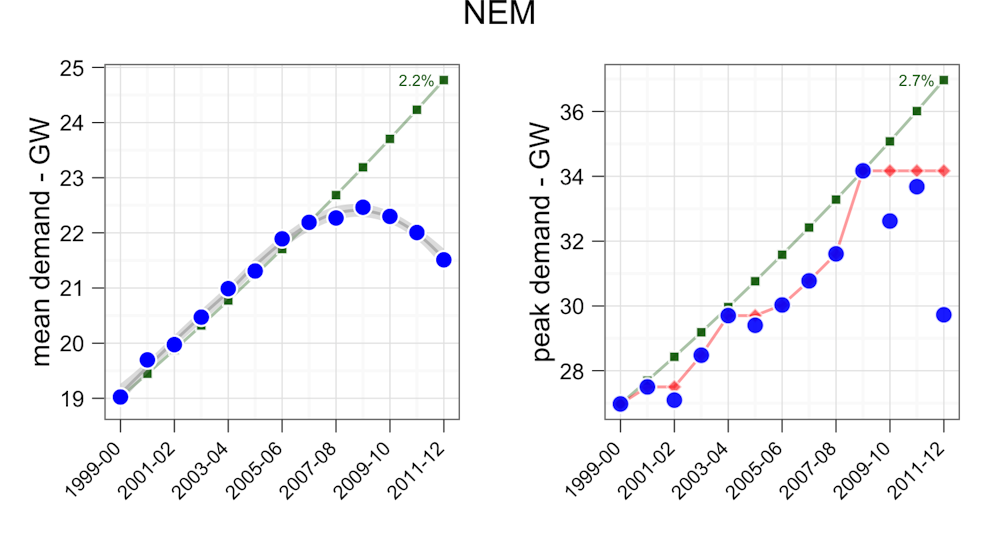
That all changed about 2007, when the rate of growth in demand started to decline. By 2009, actual demand started to decline. In real terms, demand for electricity has fallen across the NEM by 900 megawatts or 4%. Compared to forward projections of 5 years ago, demand is down 3 gigawatts, or about 14%.
That demand reduction necessarily means our grid is now distributing far less electrical power than had been planned for as recently as 2009. It necessarily means our grid is being utilized less productively. To understand by just how much it is necessary to look at the expectations for peak demand growth.
Compared with average demand, peak demand has grown faster, more erratically and for longer. Across the NEM peak demand growth averaged about 2.7% between 2000 and 2009 when it culminated at 34 gigawatts. There was considerable variability by jurisdiction. In Victoria peak demand grew at a rate of 3.4% or about twice the average demand. In Queensland, peak demand growth was higher at 4.4%, but only 15% greater than average demand growth.
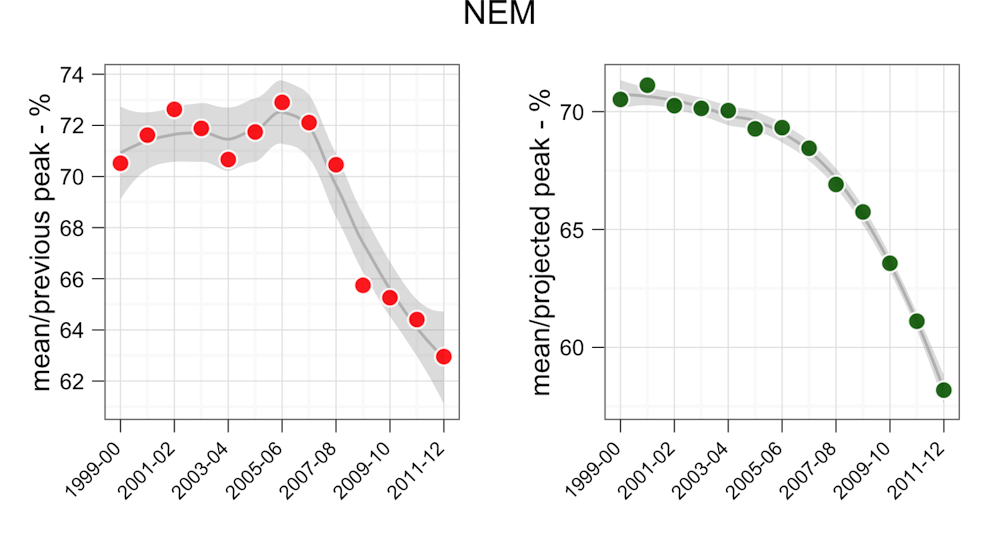
Peak demand is quite sensitive to seasonal weather effects, so there is considerably more variability from year to year when compared to average demand. Nevertheless, the ratio of average to peak demand remained relatively constant at about 70-73% through the period 2000-2007. Notably, the ratio was significantly lower in the south (50-55% in South Australia) and higher in the north (73-75% in Queensland).
Like average demand, annual peak demand has also fallen in the last few years. In 2011-12, peak demand across the NEM was down over 10% on the record 34 gigawatt high of 2008-09. The lower peak demand in the last few years can be attributed in part to the La Nina weather cycle, which has resulted in relatively cool and wet summers, with few extended heat waves.
Since the grid must be scaled to carry peak power loads, the ratio of average demand to peak demand provides one metric of how effectively we are using the grid. The higher the ratio, the higher the utilization rate.
In reality, the grid utilization rate depends the capacity of the grid, which varies in both space and time. The grid must be sized to carry the highest past peak, and each year it is extended to meet any anticipated growth in peak.
Wary of the risk of blackouts, governments have provided conducive conditions for network operators to make the necessary investments in grid capacity. That worked well for governments when demand was growing, but is now proving to be something of a nightmare.
Who knows just how many air conditioners there are out there in suburbia that have never been turned on? And that’s the rub for government and utilities. When our weather cycle breaks back into the El Nino conditions and summer temperatures start to soar, who knows what demand we will likely expect?
So how efficiently are we using our grid, and how has it changed?
The ratio of average demand in a given year to the past peak demand gives an upper limit on how effectively we are using the grid. That ratio has fallen by around 9% over the five years since 2006-07.
The ratio of average demand to projected peak growth gives a measure that accounts for likely grid investment in recent years. That ratio has fallen even faster, by a total of about 12% since 2006-07, and by about 2.5% in the last financial year.
Comparing average to expected peak demand provides only one relatively crude measure of just how we are utilizing our grid. A more comprehensive view is provided by looking into the details. For example, by asking how much of the time are we using the grid above a certain proportion of its capacity?
In Victoria, where we have seen projected peak demand rise at almost twice average demand, such an analysis leads to some worrying insights. Back in 1999-00 the grid was utilized for around 210 days at the 65% capacity level and above. In the last financial year, it was only being utilized at that level of projected capacity for about 6 days. That is a fall in utilization at that level of 97%. At the 75% capacity level, utilization of the Victorian grid has fallen over the same period from almost 71 days to about ¼ of a day.
It is important to note these numbers are based on an estimated projected growth scenario, and will necessarily remain just estimates until the grid is next pushed to its limits. That is not likely until the next record breaking summer heat wave occurs, and in the face of falling average demand may not occur for many years to come.
With the caveat that we don’t have an absolute gold standard measure of the present capacity, these estimates do however confirm we are witnessing quite staggering reductions in the way we utilize the grid. And we are necessarily paying an increasing price to maintain the capacity of the grid in the expectation of what are very rare and increasingly uncertain peak demand events.
With all the trends heading in the wrong way, further falls in demand will necessarily reduce our utilization of the grid. So too will any further investment in grid capacity in the expectation of further peak demand growth.
It is fair to say this fall in average demand has blind-sided the power utilities, governments and market operators alike. None anticipated it, and all have taken a long time to acknowledge it, given it is now into its fourth or fifth year.
There is little to be done to turn around absolute demand, but various measures are available to curb peak demand growth. They include time-of-use pricing and distributed generation within the grid. More efficient standards on air conditioning will be essential. We will need to recognise that the cost of measures that push up peak loads, such as air conditioning, necessitate a grid upgrade. The cost of that upgrade is paid by all electricity consumers, and not just those who buy the air conditioners.
Perhaps there is hope in the reinvention of the power utilities themselves. In the face of falling demand, the utilities will need to realign their business models around energy services, rather than just electrical power. In an energy service model, managing the flow of electricity across the poles and wires will be crucial to enhancing profit margins. Gold-plating will be out of the question.
Such measures will provide the tools necessary to get some productivity back into the grid. If we don’t, then the problems in the grid will only get worse.
Fred Pribac
logged in via email @internode.on.net
Fine article and answered a few questions that had occured to me in regard to restructuring the energy markets to take account of distributed renewable generation of electricity.
As for the fear that an escalation of latent summer peak energy demand could bring down the whole edifice - will increased uptake of more efficient house designs also result in a reduction peak summer power demand to mitigate this problem somewhat?
Stephen Maher
Investment Banker
Professor Sandiford,
Please correct my understanding. But in essence (or at least a core part of), is the reason for the large increase in power prices due to the fact that the pricing regulators deem a return on assets (as a % of the RAB) to distributors? The return on assets is thus a fixed dollar amount that is to be recouped from the customer base. And if customers use less power, then the price per unit of power has to be increased to match the targeted return.
Gerard Dean
Managing Director
Fred
Your thought that more efficient house designs may result in a reduction in peak summer power demand is apt to Professor Sandiford's article.
It is correct, if we make our houses more efficient, then our power use will fall and we don't need such a large power grid.
Unfortunately, and this is the BIG unfortunately, us humans don't work like that. Let me illustrate by painting a word picture of how homes in my beloved Glen Iris don't conform to the Melbourne Energy Institutes rose coloured…
Read moreDavid Arthur
n/a
Thanks for this, Prof Sandiford.
Average:peak demand ratio usefully illustrates the effect of infrastructure construction in electricity tariff increases, and is useful in communicating the perpective of power generators and suppliers.
If we turn it around, and look at peak:average demand ratio, then we see where there may be an opportunity for power generators and suppliers to transform themselves, as you suggest, into energy service providers.
For example, an energy retailer could install solar panels on your roof, including retaining ownership of the panels; they'd then be selling the power generated by those panels, and if the peak panel output matches your peak demand profile, then they have supplied your power demand without additional transmission infrastructure.
David Arthur
n/a
The model could be extended to other utility providers: a water retailer could install a rainwater tank at your house, and plumb your lavatory cisterns, washing machine to it via a water meter.
The same retailer could also install domestic waste water treatment at your place for irrigation, also metered.
It is true that these are high cost options relative to centralised water supply and wastewater treatment, but there would be savings in terms of infrastructure that need not be built.
Luke Weston
Physicist / electronic engineer
"For example, an energy retailer could install solar panels on your roof, including retaining ownership of the panels; they'd then be selling the power generated by those panels, and if the peak panel output matches your peak demand profile, then they have supplied your power demand without additional transmission infrastructure."
But how do the very high costs of small-scale rooftop photovoltaics compare with the costs of larger-scale clean energy generation that is more centralised plus the…
Read moreDavid Arthur
n/a
Thanks Luke.
Arguments for and against rooftop PV for meeting peak demand will be considered by energy retailers as and when they consider becoming energy service providers.
Arguments for and against rooftop PV for achieving power independence will be considered by individual home owners as and when relative costs change.
David Osmond
Wind Engineer
Hi Luke, I find your comments on capacity factor a bit misleading. Just because a technology has a capacity factor of 20%, it doesn't mean that there is a remaining 80% that needs to be "filled in". A typical house may have an average power requirement of 1kW, and a peak requirement of 5kW. If it had its own "perfect" power plant to provide its needs, then that power plant would only have a capacity factor of 20% (ie, a peak output of 5kW, but average output of 1kW).
Similarly, base-load power stations with capacity factors close to 100% cannot solely provide our electricity needs. They need to be supplemented with flexible providers (most likely with low capacity factors) that can ramp up during peak periods.
I'm not trying to suggest that PV is anywhere near a "perfect" power supplier, however the argument that low capacity factor is bad and high capacity factor is good is overly simplistic.
Gerard Dean
Managing Director
What? (Said loudly)
Professor Sandiford, CEO of the Melbourne Energy Institute, University of Melbourne, DOESN’T want us to upgrade the power grid, claiming that falling power usage means that “Gold-plating will be out of the question.”
Next month, the Professor's institute unveils its next production, the Zero Carbon Australia 2023 Transport Plan. The report's authors, Messrs Wright and Hearps, have promised that Australia can replace most of its road transport with either renewable electric…
Read moreMike Hansen
Mr
What is this Gerard. You are concerned about the cost of the grid. But only a few hours ago you were predicting the end of the world if renewable energy was introduced - surely in your survival bunker, surrounded by tinned food and bottled water the grid would be the last thing on your mind.
In fact your claims are right here.
http://theconversation.edu.au/we-know-why-power-prices-are-up-but-what-should-we-do-8717#comment_62622
"Death on the operating tables ,No hospitals ,No lights ,No power…
Read moreGerard Dean
Managing Director
Ahhh Mr Hansen
So nice of you to drop in! I do appreciate you cutting and pasting my work in your comment, it reminds me that I write well. And again, such powerful and factual arguments from yourself, I like the "time running backwards' line - yes, that's my favourite. ( That will be traded with you on future comments)
Now, to business. I am afraid that Professor Sandiford has placed himself between a very small grid and a very large grid.
The energy world is atwitter with anticipation…
Read moreDavid Arthur
n/a
Gday Mr Dean,
the future of transport fuels will be liquid fuels, which is Good News for those who have invested in petrochemical refining infrastructure and in combustion-powered vehicles.
The future of transport fuels is in oil harvested from vast vats of photosynthetic algae. While this is Good News for biotechnologists, it is Bad News for owners of mineral petroleum assets.
For more information, I suggest you have a read of Georgianna & Mayfield's Review article in Nature 488, 329…
Read moreMarc Hendrickx
Geologist
A wonderful reposte Mr Dean, earns a blue tick from me.
Mike Hansen
Mr
Yes Gerard, Marc. You are right. This is a serious matter and I should not be flippant.
Gerard's prediction (apparently confirmed by Marc) is that the introduction of renewable energy will cause the collapse of civilisation. Given that SA now gets 30% of its electricity from renewables (from the AEMO), I would expect 30% collapse of civilisation in SA. I have read this morning's "Addy" and the best I can come up with is a story of a cat sleeping with a dog. Apparently planeloads of South Australians are leaving but they are all going to the footy.
Give us something Gerard. South Australians want to know when they should begin the evacuations
Gerard Dean
Managing Director
Hello Mr Arthur
You have made some valid points, however I have reservations about biofuel - big reservations.
I read the article you recommended in Nature, "Exploiting diversity and synthetic biology for the production of algal biofuels". It is holds hope for future, however it states that there are huge technical and scientific advances that are required before the process can feasibly supply the world's liquid fuel requirements.
Assuming that 50% of Australia's transport can be diverted…
Read moreGerard Dean
Managing Director
Oh, I forgot something.
A big thanks to Mr Hendrickx for the blue tick.
I will wear it with honour.
Gerard Dean
Gerard Dean
Managing Director
Flippant! Surely not Mr Hansen.
SA only gets 30% of its power from renewables because most Crows and Port Adelaide supporters don't know how to turn the light switch on.
No, seriously, I love driving over to South Australia and crossing the border with the sign, "Remember to adjust your watch back- 30 YEARS"
No, even more seriously, my sister lives in Adelaide and if she finds out I have written the above, I am a dead man walking.
No, even, even, even more seriously, it is a good thing South Australia are embracing wind energy. They have a lot of flat land with out Victorian Nimbys who claim they want renewable power then scream when a wind farm is built on the horizon. Still I guess I would sook if they put up a wind farm in Glen Iris.
I gotta go to work.
Gerard Dean
Neil Gibson
Retired Electronics Engineer
If,and it is a very big if, electric vehicles become viable it would be a great boon to renewables as intermittent energy sources would be much more useful with off-peak charging smoothing the demand curve and providing system storage so lacking at the moment. This will require the development of suitable storage cells, not the modified torch batteries running electric vehicles at the moment.
David Arthur
n/a
Thanks Mr Dean.
Agreed, algae tech is a fair way off, as yet; however, the urgency of the climate problem demands that addition of geosequestered carbon to the climate system ceases as soon as possible. This includes coal-to-oil conversion, all coal use, all oil use, and all use of CSG, LNG, whatever you want to call it.
My expectation is, as the penny drops about this necessity, the R&D effort will intensify. I might add that biofuel production is a way of getting the oil industry to stop funding Climate Change Denialism.
John Robert Davidson
Retired engineer
I suspect that a lot of the charging of electric vehicles will be done off-peak. Sure we may get to the point where there is a need for extra generation and/or grid up grades - but I wouldn't start gold plating the power system in anticipation.
John Robert Davidson
Retired engineer
The liquid fuel of the future may actually be something like ammonia. Ammonia can be made from air, water and clean electricity. (The water can be replaced by clean hydrogen from sources other than electrolysis of water. Liquid ammonia can be stored at pressures similar to those used for LPG and can run internal combustion engines.
It may be a lot smarter way of storing clean energy than batteries.
David Arthur
n/a
Hydrazine (H2N-NH2, essentially aminated ammonia) is already used as rocket propellant.
David Godden
retired
quoting David Arthur: "maybe we should minimise the transport of large volumes of commodities around the world. That would also cut fossil fuel use, (and do wonders for Australia's domestic economy) at least until we get algae-based fuels." Two comments: (1) this proposal wouldn't do much for those parts of the domestic economy that depend on exports, particularly agriculture and mining (nor imports, come to think of it); (2) minimising things generally doesn't get us the best outcome - what we want to do is optimise transport, and probably the best way of doing this is to ensure there is a global system that accounts for the greenhouse costs of carbon-based fuels.
Gerard Dean
Managing Director
Finally, some gentlemen who are talking practically. Not practically for today, but liquid fuels for the future. If we tried to run the trucks and cars on batteries, Bolivia's lithium supplies would last about 2 years and our landfill would be full of lead and nasty stuff for centuries.
I see the only way we will be able to move 12 billion humans around will be use nuclear power, part of which generates a liquid fuel, possibly along the lines you mention - hydrogen from water.
Naturally, the downside is radio active waste, a problem that doesn't appear to bother the French, which prompts the question, "why do so many Australians bag nuclear power, when we are loaded with uranium?"
In fact, many Australians who are passionately against nuclear power also love to fly to France to sip cafe lattes on Paris' left bank, where they are blithely unaware of the irony of their actions.
Good stuff gentlemen
Gerard Dean
David Arthur
n/a
Thanks Mr Godden.
There's another imperative that will emerge this decade, and that's the widespread recognition that fossil fuel exploitation must cease altogether in order to minimise adverse effects of climate change.
1. Studies of climate millions of years ago have already established that atmospheric CO2 already exceeds anything since the Pliocene Epoch (5.3 to 2.6 million years ago) when polar glaciation was somewhat less than present and sea levels were perhaps 10-20 metres higher than…
Read moreDavid Arthur
n/a
Thanks Mr Dean.
The Good News is, if the world does get to a population of 12 billion people, they will be constantly on the move around the world - hunting every last morsel of edible food.
Shortly thereafter, there'll be negligible human numbers to move around.
Regarding nuclear power, The big problem I see with applying nuclear power in Australia is its water demand. There is just not enough fresh water anywhere in Australia for it to just be wasted away up a cooling tower. This includes…
Read moreLuke Weston
Physicist / electronic engineer
Synthetic biology and biotechnology? I can hear FOE and Greenpeace protesting already.
John Robert Davidson
Retired engineer
The irony is that the peak air conditioner power demand problem could be eliminated by inserting cold/heat storage between the air conditioner and the building being cooled or heated. This change would allow these air conditioners to be moved to some form of of peak power.
The modified circuit might look like a system being produced by PCP Australia. (See http://www.pcpaustralia.com.au/hetac.html ) The heat/cold storage tank uses phase change materials (PCM's) to allow the heat/cold to be stored in a small tank. (Like ice/water PCM's use the latent heat of freezing/melting to store heat or cold. The key difference is that they melt at different temperatures than ice.)
Glenn Tamblyn
logged in via Facebook
The economic impacts of this might create some interesting opportunitiesand market changes.
If the need to cater to peak demand stays high or keeps rising as average demand drops, the grid needs to be able source power at peak demand levels from possibly remote locations. However the local connections are usually sized for what peak demand from that many homes might be.
An alternative that businesses might start exploring more strongly is local energy storage. Certainly Lead-Acid batteries…
Read moreDavid Arthur
n/a
There's an item on Science Daily website describing work on smart control of local energy storage systems (17 August, "As Smart Electric Grid Evolves, Engineers Show How to Include Solar Technologies", http://www.sciencedaily.com/releases/2012/08/120817203903.htm).
According to the story, the paper by Arghandeh, Onen & Broadwater, "Distributed Energy Storage System Control for Optimal Adoption of Electric Vehicles", describes an optimisation algorithm that assumes a system of storage batteries connected to network transformers.
These smart storage systems would go a long way to resolving mismatch issues between intermittent power sources and variable demand, in turn alleviating perceived need for "baseload power".
John Browne
John Browne is a Friend of The Conversation.
Surveyor
"Perhaps there is hope in the reinvention of the power utilities themselves. In the face of falling demand, the utilities will need to realign their business models around energy services, rather than just electrical power."
Maybe we should move away from Fred Hilmer's "competitive" model for the electricity industry (centralised generation, transmission and retailing through the NEM)) and bring back the localised County Council model again. So we have local reticulation, mid-scale generation (solar thermal, wind, mid-scale PV and even gas) and retailing in a distributed model.
Zvyozdochka
logged in via Twitter
Real reform in energy use won't be achieved until it's sale per unit is ended and we have a new generation of energy system engineers.
For example; we live in a Passihaus design with solar hot water, solar PV, a small wind turbine, a small slow combustion wood heater (for winter hot water) and water treatment. We're in credit for our energy use. Our daily excess (notionally) goes to our neighbours. When we need electricity - yes everyday renewable 'critics' - we buy it from process excess from…
Read moreGerard Dean
Managing Director
Questions, questions, always questions.
Firstly , forgive my ignorance, but what are 'massively expensive NPPs?
Secondly, what is the 'process excess from local co-gen?
Thirdly, do you fly?
Gerard Dean
James Hill
Industrial Designer
I find Gerard Dean has too much ego invested in his comments.
Naturally this is very tedious for other readers.
More than twenty years ago an article appeared in the national newspaper describing a 10KWhr solar engine for a motor car. It had a phase change material to store solar heat and some sort of turbine drive reliant on a expansive material. No gears like steam cars. This took place in WA and the engineer, from Italy, died shortly after the article was published.
Secondary process Bio-diesel exists and uses waste such as might come from the management of eucalypt forests to avoid bush fires.
As with the forest wardens set to manage the Conservation Parks or hunting grounds of the Norman Conquerors of England. They produced charcoal. Secondary process Bio fuels made from waste have already been proven as aviation fuels. Do not reply please Mr Dean.
Gerard Dean
Managing Director
"Do not reply please Mr Dean" That's an interesting request! Is that because you are worried I might take issue with your comment.
Well I do. And for good reason. Firstly you car story. I imagine you mean the car had a 10 Kilowatt motor because KWhr is a definition of power produced over an hour. A 10Kilowatt motor is minuscule, it could barely move a small car which are rated at 60KW at a minimum. As for 'a phase change material to store solar heat and some sort of turbine drive reliant on an…
Read moreMark Goyne
Lawyer
Electricity supply is an enabler function to allow the productive and employment creating industries to get on with it, and create the intellectual property industries to be created, and should be cheap.
This solution of intelligent metering sounds wonderful. But why do people use most power in peak times say 1800-1900 at night etc. That is when they have to use it. Cooking, bathing children etc. I don,t intend getting up at 2am to do the family washing and having my shower.
Intelligent metering is just a clever subterfuge to increase revenue, dressed up as helping the environment. It is the same subterfuge being used to justify congestion tolls in CBDs. Why are people driving into CBDs from say 0700-1000am. Because that is when working hrs start. If they really wanted to reduce congestion at peak periods they should be discussing altering working hours, but they won,t as no increase in revenue.
Gerard Dean
Managing Director
Professor Sandiford
Less than 6 weeks to go until the Zero Carbon Australia 2013 Transport Plan is unveiled.
I, and my 7 litre V8, cannot wait.
Gerard Dean
Christine Black
Director
Professor Sandiford - an excellent article which supports our local community campaign arguing against the building of a new 66kV electricity terminal station in East Brunswick (www.nobrunswickterminalstation.org). Our local community has been in uproar at the proposed fourfold expansion of this site for the past 2 1/2 years, firstly because of the arrogance of the power companies in proposing a 26m pylon forest using an air-insulated system in a residential area right alongside the environmentally…
Read more