
Robots will be FIFA champions – if they keep their eyes on the ball

We already know robots manufacture cars, work in factories, even vacuum our homes – but could they form a world-beating soccer team? The question seems like ripe pickings for a movie mogul, given Hollywood’s long-standing fascination with robots. Some movies portray a utopian picture of the future…

Qr4yyfjd-1355282750
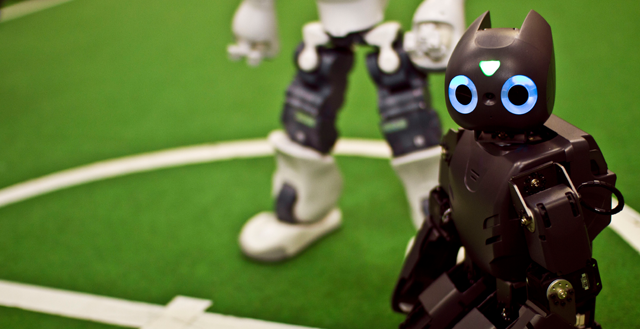
The DARwIn-OP humanoid soccer-playing robot may look like a toy, but is a platform for groundbreaking artificial intelligence research. David Budden

We already know robots manufacture cars, work in factories, even vacuum our homes – but could they form a world-beating soccer team?

The question seems like ripe pickings for a movie mogul, given Hollywood’s long-standing fascination with robots. Some movies portray a utopian picture of the future, where robots and humans live in perfect symbiosis; robots selflessly perform the mundane tasks required by their human masters, leaving society free to indulge in more rewarding activities. Others portray quite the opposite.

But in the real world it is undeniable that we are in the middle of a robotics revolution.

Soccer robots?

In case you haven’t heard of it, RoboCup is an international robotics competition formed in 1997, with the official aim that:

by mid-21st century, a team of fully autonomous humanoid soccer players shall win the soccer game, complying with the official rule of the FIFA, against the winner of the most recent World Cup.

Although this aim remains unchanged, RoboCup now includes a wider variety of robotics challenges, namely:

Each of these challenges consists of a number of individual competitions addressing different aspects of the overarching RoboCup goals. These include both low-level hardware issues (such as creating life-size robots capable of walking or running like a human), and high-level behaviour issues (how to make a robot strategise and cooperate in a team environment).

Some RoboCup competitions remove the restrictions of physical hardware (such as cameras, sensors and motors), allowing complex team strategies to be developed and tested via simulation (this is the focus of my current research with the CSIRO ICT Centre).

Others encourage the complete development of complex humanoid robots, ranging anywhere from 30cm in height to the size of an adult human.

The RoboCup soccer games work in much the same way as a regular kickabout, except the human players are replaced with robots. Teams of four from different nations around the world compete to reach the finals and become the champion.

These robots are completely autonomous – not controlled by humans at all. This means they have to be programmed to carry out the many different functions needed to be successful on the field, including movement, kicking, recovering from a fall, and recognising the ball and other players.

Different size leagues exist, with the eventual goal that these robots will become technologically advanced enough to face humans.

But during my three years with the University of Newcastle’s NUbots RoboCup team, my focus was something different – the development of systems and algorithms for computer vision.

Computer vision

A computer vision system (at least in the context of RoboCup) involves two main steps: object detection, and placing where the object is in the environment. An example could be a robot seeing a soccer ball (object detection), and then determining exactly where it exists in relation to the field of play (object localisation).

As the name suggests, object detection involves the processing of the robot’s vision stream (a set of images arriving from the camera at 30 frames a second), and searching every frame for the presence of any salient features.

In a typical RoboCup scenario, these salient features may include: the ball, goal posts, landmark beacons, field lines, penalty marks, the centre circle, other robots (both teammates and competition), and any miscellaneous obstacles (such as the legs of a referee).

The robot then knows a number of objects are around it – specifically their pixel coordinates, and any information specifying their orientation and size.

How a robot sees the world. Correctly detected balls are indicated by a blue circle, for both the simple unobstructed case (left), and the obscured case – something is in front of the ball (right). David Budden

In terms of “object localisation”,“ it may be well and good for a robot to know the pixel coordinates of an object – but unfortunately, the robot doesn’t actually reside in a 2D image plane.

In order to interact with its environment, the vision system must therefore contain methods of object localisation – the ability to project the pixel coordinates given by the ‘bot detecting the object into field coordinates – where the object exists in a 3D space.

In this stage, the robot learns the physical position and orientation of a set of objects relative to the robot. With this information, the robot can chose the correct action – whether it be to kick the ball, dive, or take up a defensive position.

These two steps may seem straightforward, but there are a lot of complications.

One issue is computational efficiency. A single image may contain as many as two million pixels, and must be searched for every possible object in less than 30 milliseconds (to maintain a frame rate of 30 frames per second, allowing the robot to remain responsive to quick soccer events).

Another issue is how to write algorithms to deal with the notion of colour. As humans, we’re used to dealing with high level concepts such as “red” or “green” in our everyday lives.

A robot just sees a pixel as a set of numbers, with each pixel taking one of 16.8 million possible colour values. How can we convert easily (and efficiently) between these two models? This is an especially important question in RoboCup, where features are traditionally colour-coded.

Robotics takes you places. The University of Newcastle’s world champion RoboCup team – the NUbots – at Teotihuacan, Mexico. David Budden

Taking a step back

In my recent paper (awarded “best student paper” at the recent 25th Australasian Joint Conference in Artificial Intelligence), I address a number of these issues – specifically in the context of ball detection.

The system takes a step back from common ball detection methods, which use the knowledge that a ball will appear circular in the image a robot sees.

This makes sense conceptually, but assuming a ball will be circular in an image is error-prone when confronted with noise to the signal the robot’s receiving (such as lens distortion or motion blur). These sorts of algorithms are also relatively inefficient.

Instead, domain specific knowledge (or the known features of the environment the robot will operate in – in this case, things like the colour of the ball and goal posts) is integrated into a straightforward series of steps: the application of machine learning algorithms to locate candidates for balls, followed by refinement via basic trigonometric operations. In other words, if an object on the field is the size and colour of a ball, it must be a ball – independent of shape.

How does this system perform? Quite well! In addition to allowing for the majority of the ball to be hidden behind other objects, the algorithm is twice as accurate at detecting the ball (even if partially hidden), and yields a 300-fold decrease in execution time over compared methods.

This is just one example of science favouring simplicity, and the benefits of “thinking outside the square” (or circle, in this case), rather than accepting the common textbook methodology for solving a well-known problem.

In their own way, advances in robotics are contributing to the enhancement of the beautiful game.

Articles also by These Authors

Sign in to Favourite

Want to follow The Conversation?

Sign up to our free newsletter to get the day's top stories in your inbox each morning, with a special wrap on Saturday.

Become a friend of The Conversation and donate

Join the conversation

12 Comments sorted by

  1. Kim Peart

    Researcher & Writer

    This article is a real hoot David.

    Considering that there are working robots active now in Second Life, I can but wonder about the prospect of using the virtual world to train robot soccer players.

    We have just started a youth grid in Open Sim, called StarGate Youth, attracting a number of Korean students and I wonder if I should raise this as a challenge.

    The real future of robotics will dawn, when androids have direct access to the unlimited energy of a star and automated factories in…

    Read more
  2. Jonathan Marshall

    Founder

    Agreed - hats off for some brilliant work.

    Question how long perhaps until we get robots doing much of the back breaking working required in Agriculture in sometimes rather demanding weather conditions ?

    Next Question then what will 3 billion people do who used to work in back breaking rural work - cannot go into manufacturing as that is already being done by robots, cannot go into or the accounting as that is also being done by very capable AI ...even jobs low end services jobs at McDonalds will be done by friendly and effective robots ..what is left for a planet soon to be inhabited by 9 billion people (not building robots as there will be robots who do that as well I dare say)

    report
    1. David Budden

      Graduate Researcher at University of Melbourne

      In reply to Jonathan Marshall

      Thanks for the questions, Jonathan!

      Personally, I am a fan of the idea of robot-human symbiosis. The idea that, when humans and robots find ways to work constructively together, the result is far greater than the sum of its parts.

      This idea is captured by a lot of recent research, including FoldIt - a "game" that combines human creativity with a computer's ability to crunch numbers. The technology has brought upon many recent discoveries and advancements in bioinformatics, and has increased…

      Read more
    2. Jonathan Marshall

      Founder

      In reply to Jonathan Marshall

      Hi David,

      I think the future potential for robots is unlimited and that is my point - they can and probably will be better than most humans in most areas. They will not be limited to just the dangerous or the laborious work - they will become creative once we master how to develop machine learning. They will become better companions than most aged care workers, more skillful surgeons than only the very best humans.

      Unless we start to genetically engineer humans many will be left behind - they…

      Read more
    3. Alex Cannara

      logged in via LinkedIn

      In reply to Jonathan Marshall

      Jomathan, let's first put into perspective what a few fortunate, of our 7 billion, humans presently benefit from -- the energy equivalent of burning ~3 cubic miles of oil each year.

      Or, to be more to our scale, that's 116 trillion Olympic-champoin athletes pumping generators 24/7. Divide by 7 billion.

      If we give those 116 trillion slaves 8-hour shifts, we need 348 trillion.

      If we feed them -- oops.

      So now imagine the services performed by robots, also needing energy, beyond our favorite…

      Read more
    4. Alex Cannara

      logged in via LinkedIn

      In reply to Jonathan Marshall

      David, "robot-human symbiosis" -- we've had that ever since we learned to throw things, especially when we invented projectile launchers, like the bow or slingshot.

      Why? Because we exploited the natural behavior of mass, & gravity, coupled with machines to focus our power -- the bow, slingshot...

      The 'robots' (shaped rocks, feathered arrows...) were primitive, but behaving in ways we learned how to predict. Babbage's first 'computer' for building math tables was simply a more complex, precisely…

      Read more
    5. Kim Peart

      Researcher & Writer

      In reply to Jonathan Marshall

      Jonathan Marshall ~

      The Luddites were a bit worried about this problem during the Industrial Revolution, but the modern world rolled out and now we are living in it.

      In the 1960s we heard the mantra that automation would lead to greater recreation, but the sad reality has been the shrinking of the number of workers compared to the work happening, longer hours for many in work and often without those happy holidays that were once predicted.

      Considering the pattern of the last two waves of…

      Read more
  3. Alex Cannara

    logged in via LinkedIn

    Robots don't "already manufacture cars".

    Engineers spend vast time designing the car parts, the assembly station, the materials used, the robot's electromechanics, and the vast software controlling the whole operation.

    Robots do just what they're designed and programmed to do, unless they break.

    And, like any computerized systems, the may not do the right things -- Apple Maps!?
    ;]

    report
    1. Jonathan Marshall

      Founder

      In reply to Alex Cannara

      The thing is that technology is getting more accurate and more effective everyday and it requires less and less human man power.

      People may design the cars the parts etc.. but you do not need that many of them.

      Factories and farms do not require many people these days (unless the labor is so cheap it is more cost effective to use than machines but that will change as labor costs everywhere increase and machine costs come down).

      So again what do 9 billion people do - lets say 100 million for designing all the cool stuff and another billion working in schools and hospitals (though even here technology will play and ever bigger role)

      What do the rest do ???

      report
    2. Alex Cannara

      logged in via LinkedIn

      In reply to Alex Cannara

      Jonathan -- "What do the rest do ???" Repair robots.
      ;]
      If you're not an engineer, then you may not get the hype that gets put out every year, especially since the deployment of workable computers 50 years ago. Devices aren't like organisms -- they don't heal themselves; and they don't protect themselves from the wide variety of environmentall stresses & attacks.

      Each of our 10 trillion cells, for example, does a DNA correction each second -- 10 trillion/sec for life.

      Engineering such a system at the micron level for complex, human-designed devices is a whole other scale of both knowledge & effort.

      We don't even have a computing theory that matches how a worm's 'thinking' functions. In other words, having been an engineering grad student during AI's '60s heyday, I can vouch for the desperate lack of understanding we still have for how 'wet' intelligence works.

      IBM's Watson demonstrated that via its external human dependence.

      report
  4. Ian Clarke

    Director, Pacific Strategy Partners

    Thanks for sharing David.

    Of course, in the real world, FIFA will just change the rules...

    report
    1. David Budden

      Graduate Researcher at University of Melbourne

      In reply to Ian Clarke

      That's definitely a limiting factor. FIFA champion soccer players are worth far more than these robots will be, and there's little-to-no chance of them being allowed to compete against a team of fearless metal robots.

      That being said, people are proud by nature. Even if the FIFA champions themselves aren't permitted to play against robots, there will be those that do nonetheless; and in the meantime, society can enjoy the advancements and breakthroughs in technology that emerge from the pursuit of these goals.

      report