


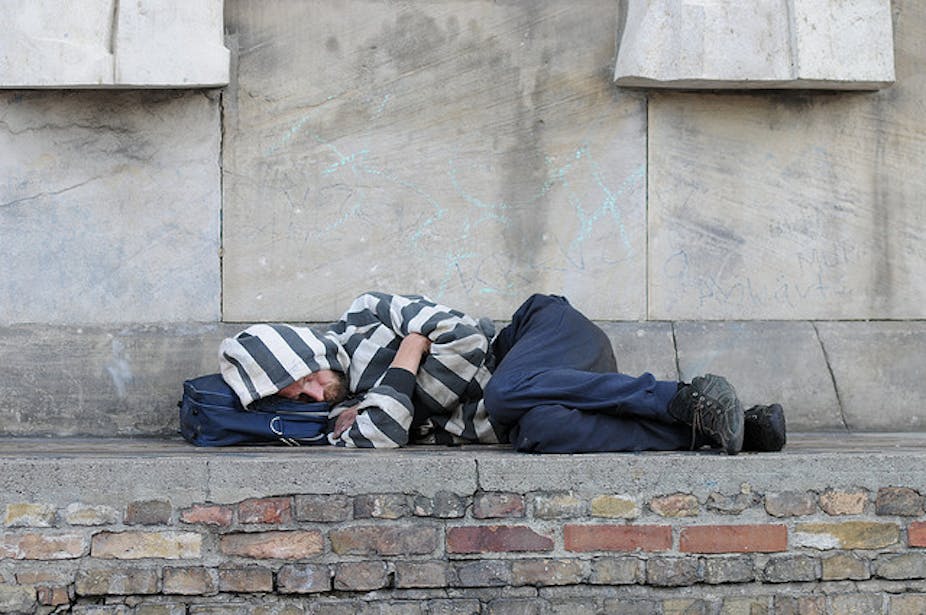
The number of Australians who were homeless on census night increased by 17% to 105,237 in the five years to August 2011. When adjusted for population growth, the increase the increase is still worryingly high, at around 8%. It’s clear we need a stronger commitment to address this significant social issue.
The census data, released this week by the Australian Bureau of Statistics (ABS), continues to shatter the stereotype of homelessness: the middle-aged alcoholic or drug-addicted man sleeping in a park.
Rather, 60% of people experiencing homelessness were under 35 years old, and an incredible 17% were aged under ten. The ABS acknowledges that census methodology is likely to underestimate youth homelessness, so the number is probably higher than the estimated 44,083 Australians under 25 currently recognised as homelessness.
As subsequent research from the Australian Institute of Health and Welfare shows, these young people will be more likely to be involved in child protection and juvenile justice services, further entrenching their disadvantage.
Almost half (44%) of homeless Australians were women; with women and children the fastest growing group seeking assistance from specialist homelessness services. This number, however, does not include women and children remaining in unsafe housing and continuing violent relationships. The ABS recognises that data sources other than the census must be used to better understand the incidence of family violence and the consequences on housing security and homelessness.
In welcome news, the number of people “sleeping rough” (in improvised dwellings, tents or sleeping out) decreased from 7,247 in 2006 to 6,813 in 2011. But more people are sheltered in such substandard overcrowded housing as to warrant being classed as being homeless; this group increased from 31,531 in 2006 to 41,390 in 2011.
The homelessness rate grew by more than 20% in New South Wales, Victoria and Tasmania, with a gob-smacking 70% rise in the ACT. Meanwhile, the largest fall was in the Northern Territory, which still has (by far) the highest proportion of people experiencing homelessness (731 people per 100,000 population, compared with a national average of 48.9).
The ABS has acknowledged it has further work to do to understand and measure homelessness experienced by Aboriginal and Torres Strait Islander people, which goes a long way to explaining the NT’s massive homelessness rates.
The ABS report has been the subject of significant media coverage, much of it couched in terms of the failure of governments to reduce homelessness. But given the social and economic changes since 2006, it’s surprising that the growth wasn’t higher.
Rather than whacking governments, the ABS data shows a need for governments to continue their efforts to address homelessness.

Committing to end homelessness
The Commonwealth’s 2008 white paper on homelessness, The Road Home, boldly aims to halve homelessness by 2020 and offer accommodation to all rough sleepers. Similarly, states and territories have introduced bold and targeted action plans to address homelessness.
These commitments have been underpinned by important agreements between the Commonwealth and the states and territories. The National Affordable Housing Agreement (NAHA) focuses on early intervention and prevention strategies, better assistance for people with multiple support needs, and providing ongoing assistance to ensure stability for clients post-crisis. The National Partnership Agreement on Homelessness (NPAH) outlines funding arrangements for specific projects and commits partners to addressing agreed outcomes through program delivery.
But these agreements end in June 2013, making the next few months a vital time for the agreements to be renegotiated. At his address to the National Press Club this week, Housing Minister Brendan O’Connor committed to providing half the funds required for another year while the NPAH is renegotiated.
The states are yet to meet this commitment and are seeking additional resources from the Commonwealth. Details will be discussed at today’s meeting of housing ministers in Brisbane.
In addition to resourcing, more work needs to be done to ensure homelessness services are sufficiently funded and effectively delivered. To achieve this, we need to establish a monitoring system with nationally consistent, evidence-based measures to assess the effectiveness of homelessness services. This will allow us to focus on the outcomes of people experiencing or at risk of homelessness, rather than just on the number of people being provided with services.
As the ABS figures show, homelessness continues to be a social crisis in Australia today. Governments, and the broader community, must redouble their commitments to address, and ultimately end, this significant social policy challenge.