


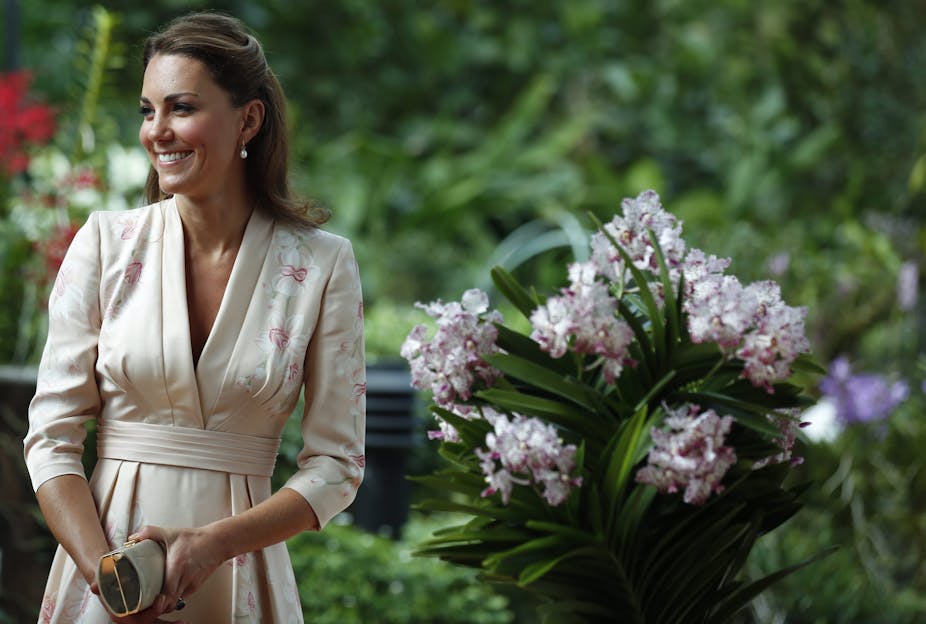
After weeks of speculation about the contents of her uterus, it was revealed overnight that Catherine Middleton, Duchess of Cambridge, is indeed pregnant.
However, Catherine is in the early weeks of her first trimester. It seems that the announcement was made only because she was hospitalised with hyperemesis gravidarum (severe pregnancy sickness).
For many women, the announcement of a pregnancy to friends and family is an important milestone. Making a big pregnancy announcement has become so normalised that women can now officially designate that they are expecting a child on Facebook in the friends and family section of their profile page.
The key question is when is the most appropriate time to do it?
In Australia and elsewhere in the West, announcing a pregnancy around the 12 week mark is a social norm. From a medical viewpoint, pregnancy at twelve weeks is considered to be “safe” - a woman is less likely to have a miscarriage (loss of a fetus before the 20th week of pregnancy).
Indeed, in my own research, pregnant women in Melbourne told me they were inclined to keep quiet about their pregnancies until they had an early ultrasound scan to rule out any fetal abnormalities. They couldn’t fathom the idea of announcing a pregnancy to friends and family and then having a miscarriage, even though approximately one in four pregnancies end this way.
But why is it taboo to talk about fetal loss in public?
As feminist anthropologist Linda Layne has argued, women are trapped in the midst of contradictory cultural forces.
From one perspective, we are grappling with the increasing prominence of the fetus in public culture. New reproductive technologies and the changed medical management of pregnancy have altered the ways in which women construct the personhood of their fetuses.
Early ultrasound scans, abstaining from drinking alcohol or eating soft cheeses, buying pregnancy guidebooks, and speculating about the sex of the fetus all confirm the “realness” of a pregnancy for a woman. In this way, fetuses are constructed as “babies” and women as “mothers” earlier than ever before.

Ironically, as soon as a woman experiences a miscarriage, she faces another set of cultural forces. Unlike pregnancy, fetal loss is not a topic for conversation and our society is not especially attentive to a woman’s needs at this time.
The highly anticipated 12 week pregnancy announcement is, in many ways, a precarious perch from which 25% of women will fall without a wide safety net of support. Outside of the individual support of friends and family, there are very few support services available for women who experience fetal loss.
This may be attributed to the fact that a miscarriage is routinely portrayed as merely a “failed” pregnancy and not as a death to be grieved. Friends and family may say that they are “sorry” but then encourage a woman to “move on” and to “try again” in the same breath.
Recent research has shown that women often experience intense emotion - sadness, anger, and distress - around the loss of their “babies” and their roles as “mothers”. The loss of a first pregnancy is especially traumatic.
Most people do not recognise that women are not only mourning the loss of a “baby”, they also may be mourning the loss of the very idea of raising a child and becoming a parent.
So we have this dilemma - we are a culture that loves pregnancy but seemingly cannot cope with pregnancy loss.

The statistics show that miscarriage is a common occurrence, but most women do not know just how common it is and they suffer in silence.
British pop singer Lily Allen is one of the few celebrities to talk about the unimaginable grief associated with her losses of pregnancies at four months (2008) and again at six months (2010). Her courage to share her story opened up a powerful conversation among women around the world who had experienced similar losses and never felt like they could talk about it.
What this tells us is that society needs to change its attitude, acknowledging that pregnancy does not always end in a live birth. We not only need to collect more comprehensive statistics on pregnancy loss, we also need to treat miscarriage as an important social phenomenon that affects most women.
Like any woman’s path to motherhood, Kate Middleton’s could take unexpected turns. We need to be ready to support her, no matter the outcome and give her the freedom to talk about her experiences on her own terms.