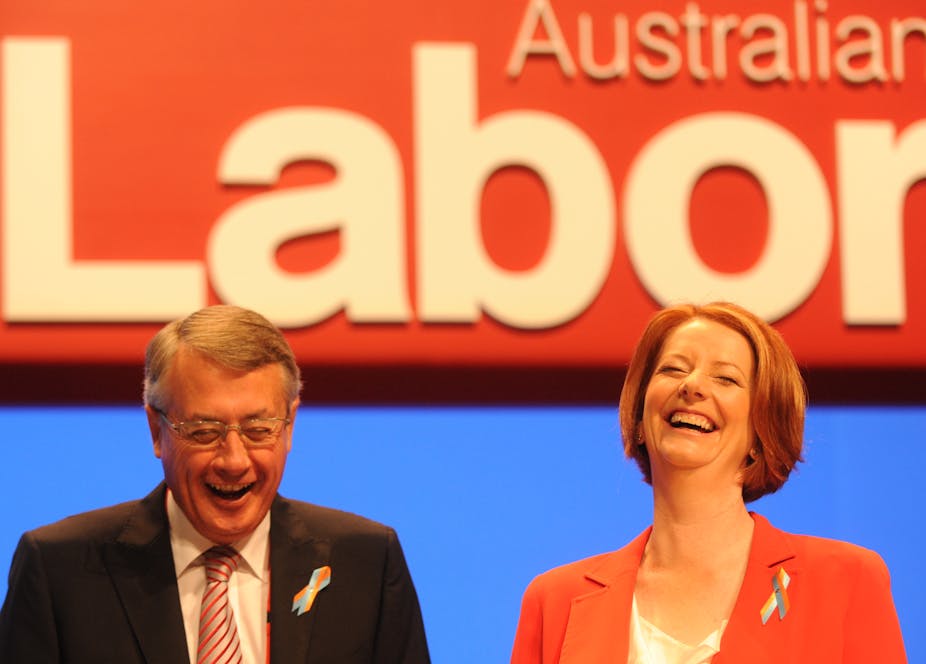
In recent days, Treasurer Wayne Swan has been prosecuting a puzzling assault on a few billionaire mining magnates. Commentators have struggled to come up with a plausible explanation for his political strategy. Many have resorted to the idea that it is an appeal to “the ALP base”.
But is there still a base to hear the appeal?
Base, class and inequality
The idea of a “base” hints at the existence of a working class that has interests in common. It suggests a broader political project to reduce inequality and the disadvantage caused by wide disparities in wealth and income. Class and inequality, however, are concepts that few modern ALP leaders would dare to mention in polite company.
When I was growing up in the 1960s, our family was very much of the base. One of our articles of faith was that the worst ALP government was better than the best Coalition Government. The ALP was our party, the party of the workers. The Liberals were for the bosses and, as my mother warned, even the good bosses will throw you out on the street when it suits them. The divide was clear.
In two major speeches on the ALP given by Prime Minister Gillard in 2011 the words “equality”, or for that matter “inequality” were not mentioned. Gillard’s campaign speech in 2010 also made no mention of equality and inequality. By way of comparison, Whitlam’s famous 1972 campaign launch speech mentioned “equality” 17 times, “inequality” seven times and “inequalities” five times.
The ALP’s rhetoric has changed to reflect the declining relevance of the unionised blue-collar working class.
The collapse of blue-collar unionism
Union membership and union density have been in steady decline in Australia since peaking in the late 1940s or early 1950s. It fell far more sharply in the 1990s. Between 1986 and 2008, union density fell from 45% to 19%.
Union density did not drop below 40% between 1913 and 1992, and was usually much higher. In areas of blue-collar employment, the union density figure was closer to 75% at its peak levels in the 1950s and the blue-collar working class consistently made up two-thirds of the workforce between the 1890s and the 1950s.
By 1981, white-collar workers made up almost 40% of the workforce compared to 28% in 1969. The typical union member today is female, university-educated and working in a professional role in a service industry, particularly health, education and community services.
A study done for UnionsNSW in 2003 found that more highly qualified employees (i.e. in terms of educational attainment) were more likely to hold positive views about unions, and that employees with lower or no formal qualifications were more likely to think Australia would be better off without unions.
A new base?
The collapse in the old base was partially offset during the past few decades by a new urban middle class concerned with rights-based issues and the environment. In recent years, this new base has been deserting the ALP for the Greens.
ALP branches started to attract white-collar members in the late 1940s. During the 1960s, the ALP began to draw increasing numbers of teachers and other tertiary educated professionals. By 1981 blue-collar workers comprised just one-quarter of employed branch members in the Victorian ALP.
Unions affiliated to the ALP, mostly blue-collar, have felt the full effects of the collapse of union membership. Big unions covering university-educated professionals like the Australian Nursing Federation (ANF) and the Australian Education Union (AEU) have been far more successful in maintaining high unionisation rates.
Unions like the ANF and AEU remain outside the ALP and have not been included as part of a new base. Former union officials still dominate the federal ALP caucus, but very few of them come from these more successful unaffiliated unions.
Despite many internal reviews, the ALP has yet to change its structure to attract a new, or broader, base.
Suburbanisation
Inner city areas where people supported the ALP with loyalty and intensity broke up as post-war generations headed out of the terrace rows for more distant quarter acre blocks.
In some of these new suburbs, cultures have grown up characterised by aspiration, mega churches and self-employment. They live in big houses and drive big cars. But there are also lost suburbs of congregated social disadvantage where hundreds of thousands of children grow up in homes where no-one has ever had a full-time job.
The sense of tribalism that underpinned the old ALP unionised blue-collar base has dissipated during the suburbanisation process.
A fractured picture
There is no longer a clear divide, and no base held tightly together by shared work, union and community experiences. The ALP left its old blue-collar base as the traditional working class was collapsing. Now, the it faces the more difficult challenge of winning support from a range of social groupings that share much less in common.
Sentimental appeals to the world of 50 years ago are unlikely to do much to unify the ALP’s fractured base.
Russell Hamilton
Librarian
"Sentimental appeals to the world of 50 years ago are unlikely to do much to unify the ALP’s fractured base"
It didn't strike me that way: the article is very much of today in comparing what has happened to the shrinking middle class in the U.S., with our situation in Australia. That links in with our greater notions of community and "a fair go".
To argue that "allowing vested interests to distort the shape of economic growth for their own narrow advantage is not only bad for our democracy and our community, it is bad for our economy" isn't a sentimental argument either.
If you have access to the latest issue of Political Quarterly, read the article by Roy Hattersley - he's also writing on the left revisiting the equality idea.
Dale Bloom
Analyst
I really can’t understand the actions of Wayne Swan. He should be out there trying to get these mining magnates to invest their money in a variety of projects in Australia.
They seem to like making money, and if they did invest in Australia, it would be a win/win situation for everyone.
Instead he annoys them, and they could now invest their money elsewhere.
Trevor Cook
Recently awarded doctorate at University of Sydney
Thank you for the pointer to the Hattersley & Hickson article. For me this passage is the key: "It (equality) means more than equality of opportunity. Social democracy, contrary to the claim of several New Labour ministers, is not about meritocracy. A meritocratic society in which everyone has the ability to compete to become unequal is
Read morenot a desirable goal for social democrats. It does not make sufficient allowance for socially disadvantaged starting points and creates inequality of opportunity…
Gareth Shaw
DBM
A very interesting article, particularly the point about the affects of suburbinisation on traditional base of the ALP. Its interesting to speculate that the UK's much tougher land regulation which effectively prevented American-style suburbs such as developed here from taking place and preserved those geographically tight-knit communities, explains why Labour in Britain retained so much of its traditional character right up until the 1990's.
I think it should be pointed out that a fractured base should be nothing new to the ALP, after all their base demographic was irreparably split for twenty years from the 1950's to the 70's.
I agree that the article is hardly a new foundation for the Party but least it begins to grapple with what those foundations should be and perhaps begin to build a credible narrative for a Party that, to me at least, seems to have been sorely lacking one since its embrace of neo-liberal values in the 1980's.
Trevor Cook
Recently awarded doctorate at University of Sydney
Rodney Cavalier talks about these demographic changes and their community impacts, and consequences for class and party in his book Power Politics
Lorna Jarrett
PhD candidate, science education; Physics teacher
It seems pretty obvious - and reasonable - to me that by decrying the actions of the 0.01% mega-rich, the base he's appealing to is the 99.99% non mega-rich ie: preactically everyone else in Australia.
The point Swan is making is not about a blue-collar working-class (sentimentally-portrayed or otherwise) vs. a middle class at all. It's about a handful of billionaires vs. the overwhelming majority of Australians.
Plot incomes on a graph and you'll see the 99.99% merge into a blob at the bottom - $258K p.a. medicare-rebate whingers, $150K p.a. battlers, minimum-wagers, pensioners and all.
The problem is the delusion of the reasonably well-off 99.99%ers that we somehow have ANYTHING in common with the billionaires, and that policies which benefit the billionaires have any chance whatsoever of benefiting us.
While I'm here, quick gripe about the phrase "politics of envy". Honestly, you think we envy people like Gina Rinehart and Clive Palmer??
Trevor Cook
Recently awarded doctorate at University of Sydney
Lorna
I think that Swan's attack on three rich business people is a cop-out, while he claims the other 99% of business people are doing the right thing. I think his distinction here is very selective. Is the gambling industry (incl. clubs and Packer) doing the right thing, is the tobacco industry and so on. As Alan Kohler points out in a great column on the ABC site today, the people who damaged the govts mining tax were the Minerals Council (BHP et al, with assistance from some ex ALP staffers…
Read moreLorna Jarrett
PhD candidate, science education; Physics teacher
Trevor - I didn't think his Monthly article was aimed solely at *those* three - my reading was that they were held up as the most obvious, rather than the only examples. Also Gina Rinehart was most certainly active in the campaign against the mining tax - complete with infamous pearl necklace and megaphone as I recall.
I agree that the Govt has not behaved notably differently from the Libs regarding middle-class welfare and inequality. I think you've addressed the main reason why this is, in your final paragraph.
Thing is, it requires the middle-class to (a) realise that they're NOT actually struggling and (b) it is in their direct interest that those at the bottom of the heap get a bigger share of the wealth.
I'd add advertising executives and the general consumption machine to the list of blame-recipients regarding the outbreak of affluenza.
Trevor Cook
Recently awarded doctorate at University of Sydney
Except that Swan says: "I know that 99% of businesspeople want the best for Australia, and that most people want us to remain the nation of the fair go. I talk to business owners from coast to coast and am constantly impressed by their forward-looking and can-do natures."
Graeme Orr
University of Queensland
Trevor, I don't doubt your analysis of 'the base'. There is still a strong correlation between safe Labor seats and either trad manufacturing areas, or the professional-salaried class, which proves the now well established two-wing theory for social democratic parties.
I think Swan thinks he is appealing to both. The post-materialists (to borrow from Clive H) are mostly likely to 'care' about excess and inequality.
Plus, Swan is from Queensland, where Clive P is so over-exposed he is a figure of caricature. Even the Courier-Mail online, which attracts a conservative core, goes into ridicule mode when stories about him are opened for comments. If Swan were from WA he'd probably tread more lightly.