
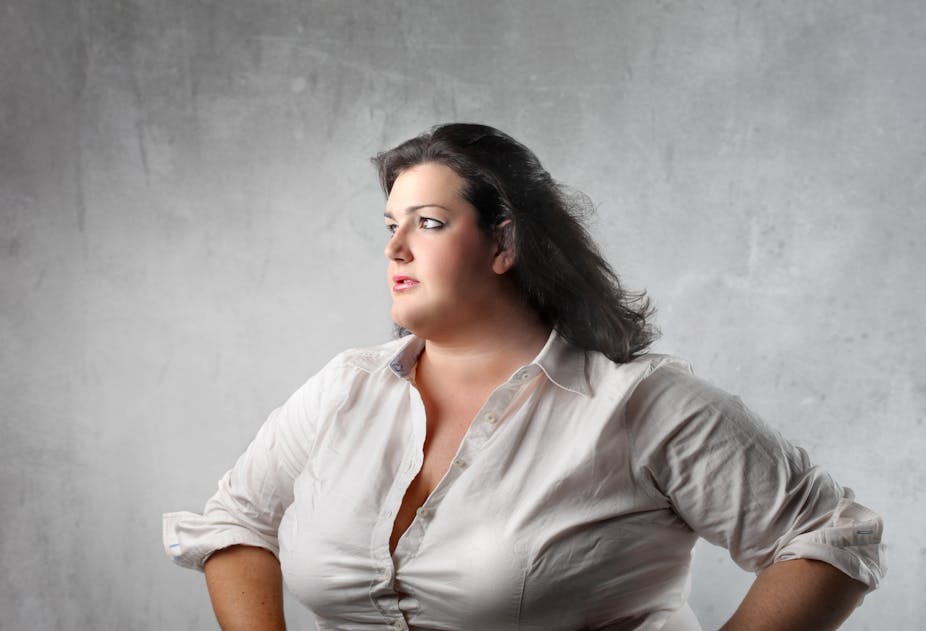
What does fat discrimination look like?

People who are deemed overweight or obese (as the medical terms have it) or fat (as many fat activists prefer to call their body size) suffer discrimination, prejudice and humiliation from several fronts. Television programs such as The Biggest Loser hold them up to contempt and public shaming. News…

Ktn39xzq-1352335975
Fat discrimination is rife and considered completely acceptable. Shutterstock.

People who are deemed overweight or obese (as the medical terms have it) or fat (as many fat activists prefer to call their body size) suffer discrimination, prejudice and humiliation from several fronts.

Television programs such as The Biggest Loser hold them up to contempt and public shaming. News media reports on obesity constantly display photographs of fat bodies with their heads cropped off – the “headless fatty” representation – and commonly use derogatory expressions ranging from “lazy” and “flabby” to “fat arses” and “unsightly slobs”.

Weight stigma has significant effects on fat people’s lives. Compared with others, fat people are statistically more likely to live in poverty, earn less income or be unemployed, have lower education levels, be employed in lower status jobs and experience lower living standards. Women in professional occupations are particularly discriminated against in the workplace if they are overweight, failing to reach the higher echelons compared with thinner colleagues.

In social terms, fat people receive less respect from others and are often subjected to derogatory humour and pejorative comments from co-workers, friends and family members and, in public settings, from strangers. Health care workers openly admit to being “repulsed” by fat people.

Children can face social isolation or bullying over their weight. Shutterstock.

Fat children are subjected to greater harassment and prejudice than other children, and experience ostracism, teasing and bullying to a greater extent. Remarkably, even their own parents may favour their thinner children over their bigger ones.

In a society in which most people understand that discriminating overtly against social groups such as women, people of minority ethnic or racial groups, gays and lesbians and people with disabilities is wrong, and where such discrimination is legally prohibited, fat people are apparently fair game.

Why this hostility and lack of compassion towards fat people? Why this apparent urge on the part of many to shame and blame people who are deemed to carry too much flesh?

Perception of fat bodies

Fat bodies are culturally represented as inferior, deficient, ugly and disgusting. These meanings have developed over centuries, derived from the Judeo-Christian idea that the disciplined body is closer to God. An ascetic self-control over such bodily urges as hunger and sexual desires is evidence of moral superiority and relative lack of sin.

While we live in a more secular society today, these moral assumptions still dominate in our understandings of the value of self-discipline and how it is reflected in our body size and shape.

Perceptions of obesity as an expensive health crisis have increased stigma. Shutterstock.

Added to these meanings are the newer ideas derived from medicine and public health, intensifying in the late 1990s, that an obesity epidemic has emerged in many countries that it is predicted will lead to higher rates of disease and premature mortality. Intensive mass media coverage of this issue has led to the idea that fat people are not only ill-disciplined but also inevitably sick and physically unfit, regardless of where they fall on the body weight spectrum.

Unlike other attributes that commonly attract discrimination and marginalisation such as skin colour, gender or disability, fat people are viewed as deserving of their fate because of their apparent lack of self-control. They are also often represented as threatening others by attracting higher health-care costs. This reasoning is used to justify fat stigmatisation, even though others who may need higher levels of health care are not treated to such revilement.

Ironically, fat people often avoid attending medical appointments because of their concerns about being judged negatively by the doctor. This means they may not receive early preventive treatment for medical conditions they may have.

Fat equals failure

People who identify as fat or overweight are highly aware of the moral failure that their bodies represent. Research with fat people has identified the shame they may feel about their bodies, and the social humiliation to which they are often exposed by others. In an English study, for example, one man spoke about his emotional distress at being laughed at by some young men while sitting in the sun in his shorts while on holiday:

“…they could see me and they were laughing and joking and carrying on and it was only as they got past that I realised that they were laughing at me, about how fat I was. And er, I mean, it hurts.”

Fat people often express highly negative thoughts about their bodies. As a weight-loss blogger who wrote about her weight gain explained: “I felt ashamed. I felt ugly. I felt like some sort of animal.”

Even grocery shopping can be confronting for bigger people. Stocky Bodies.

Fat people often feel very self-conscious about going out in public, particularly eating out or grocery shopping. They are highly aware that others are examining and making judgements about what and how they’re eating. They feel out of place, open to mockery and very exposed. As one fat woman commented, for her, “even grocery shopping is an exercise in courage.”

Given the discrimination to which fat people are subjected, it’s not surprising they’re more likely than others to suffer from depression, anxiety and low self-esteem, which in turn may lead to a greater likelihood that they will eat for comfort. Medication taken for these mental health conditions may also lead to gaining weight.

Whether or not socioeconomic disadvantage leads to fatness, or whether fatness itself causes poverty and other forms of social and economic disadvantage is a point of debate.

The lower socioeconomic status of fat people in itself is more likely to cause health problems. The combination of living in poverty, experiencing stigma based on body weight and accompanying diminished social status causes continuing stress.

In conjunction with poor living conditions and the lack of opportunity to exercise and consume a high-quality diet, disadvantaged people’s exposure to stress may result in illness and disease. These medical conditions in turn may not be treated effectively because of lack of access to high quality medical care.

Lack of compassion

People who discriminate against fat people or consider it appropriate to use fat-shaming terms when talking about or to them don’t seem to view fat people as real human beings who are hurt and humiliated by their actions and may be struggling with significant socioeconomic disadvantage or mental health conditions.

Or perhaps they simply don’t care about this in their belief that fat people deserve punishment for their supposed inability to control their urges and their lack of conformity to idealised notions of physical attractiveness.

In a supposedly modern and compassionate society such as Australia, shouldn’t fat discrimination be viewed for what it is? It is a kind of bigotry and represents a lack of understanding, compassion and tolerance for bodily difference.

It shouldn’t just be fat people who call attention to fat bigotry and fat phobia. All of us are implicated if we accept the negative concepts of fatness that currently circulate in our culture and tolerate fat discrimination from others.

Deborah Lupton is the author of Fat (Routledge, October 2012)

Join the conversation

95 Comments sorted by

Comments on this article are now closed.

  1. Paul Richards

    strategic foresight

    Deborah Lupton wrote; "It is a kind of bigotry and represents a lack of understanding, compassion and tolerance for bodily difference."

    As you say our values are linked to the "Judeo-Christian idea", the belief of human regression from a perfect state in the Garden of Eden. This unevolved creationist regression idea is linked to the need and 'right to bear arms', righteous fear over a government not guided by God / 'Socialist', among many other similar entrenched dogma. While we embrace certain Anglo/American values above tolerance and understanding we will not evolve through this mythic order of things.

    This is a very deep and complex issue, that as you know will take generations of resolution. Thank you for raising the level of awareness on this specific type of widespread discrimination.

    report
    1. Matthew Erskine

      logged in via Twitter

      In reply to Paul Richards

      It seems to me that the counter argument to those who claim that 'being fat is a choice' is that it often isn't, it can be a medical condition or a mental condition.

      Therefore, being fat is either an unhealthy life choice, or the symptom of a medical or mental illness. My issue that this article fails to address the point that, obesity, in none of these cases is a choice, and therefore should be treated as unwanted.

      Should it maybe be stigmatised, without being discriminated against? Advising the people to simply accept people as overweight and unhealthy is surely similar to saying we should merely accept mental illness, or disease, no need to look for a cure, just accept that some people suffer from depression, or cancer?

      report
    2. Judith Olney

      Ms

      In reply to Paul Richards

      You raise a good point about values Paul, and those values are linked to the culture we are immersed in.

      I've often found it interesting to look back through our human history to find the roots of certain beliefs that seem to have little basis in fact, but come from perceptions of moral good.

      For example, I am not a person that likes to rise early in the morning, I find that I do my best and most enjoyable work at night. This is seen as being morally bad according to some people I know, and…

      Read more
    3. Paul Richards

      strategic foresight

      In reply to Paul Richards

      Judith Olney wrote; "if this post seems a little rambling and incoherent,..." No you write well, and the observation that discrimination is subjective is clearly going over many heads. I liked your point about carried over values; "that idle hands, or minds" One of many truism or meme, used frequently by authoritarian thinking. The irony is the next stage of human development, focus is on material pleasure and physical training is inclusive. Can you just imagine what the general population of an…

      Read more
    4. Paul Richards

      strategic foresight

      In reply to Paul Richards

      Mathew Erskine wrote; "Therefore, being fat is either an unhealthy life choice, or the symptom of a medical or mental illness." This worldview is interesting, but still narrow. It really would be good if this extremely complex issue was as simple as that.
      Matthew Erskine wrote ; "Should it maybe be stigmatised, without being discriminated against?"
      Neither, in answer to your rhetorical question.
      Matthew Erskine wrote ; ".... unhealthy is surely similar to saying we should merely accept mental…

      Read more
    5. Judith Olney

      Ms

      In reply to Paul Richards

      Thanks for your reply Paul, I enjoy reading your posts a great deal.

      Here's another little idea that I would be interested in your views on.

      I have noticed that when people are discriminated against, whether that be because they are different to the norm because of skin colour, sexuality, body size, or smoking, or whatever the difference is, they will tend to withdraw from the people that discriminate, not seek their advice or company.

      I have noticed this within my own circle of friends…

      Read more
  2. Mike Swinbourne

    logged in via Facebook

    ".... discriminating overtly against social groups such as women, people of minority ethnic or racial groups, gays and lesbians and people with disabilities is wrong, and where such discrimination is legally prohibited, fat people are apparently fair game...."

    There is a difference. Being a woman, gay, or a member of an ethnic minority it not a choice - being fat is. And please don't give me any nonsense about people not having a choice; that it's genetics, or growing up in a fat household or trying everything and still being unable to lose weight. People are fat because they eat too much and do not exercise enough. Full stop.

    There are "negative concepts of fatness" for the simple reason that being fat is not a good thing.

    report
    1. Rosco Hamilton

      logged in via Facebook

      In reply to Mike Swinbourne

      I'm inclined to agree with Mike here. Being fat is a choice.
      I definitely have a perception of being fat as a negative quality. As such I probably discriminate subconsciously against fat people.

      Rather than simply pointing out that fat discrimination exists, would it be possible to address why fat discrimination is unfair?

      I agree with the notion that overweight bodies are unattractive. It would be hard to change my mind otherwise. But I would be interested to have any prejudices regarding laziness, being a drain on public health, being greedy etc addressed.

      While on the topic of fat discrimination, is there a risk that being accepting of obesity will only encourage poor health? Is stigmatising obesity really any different to stigmatising smoking?

      report
    2. Paul Richards

      strategic foresight

      In reply to Mike Swinbourne

      Mike Swinbourne wrote; There are "negative concepts of fatness" for the simple reason that being fat is not a good thing.
      'not a good thing' - Neither are life conditions e.g past generations tribal beliefs, inherited microbiota, and an industrialised food system driven by exponential profit.
      This issue of discrimination is a very complex issue, as Australia and the global community is on many stages of human development. It would be great if it this issue was as 'simplistic' as
      "People are fat because they eat too much and do not exercise enough. Full stop."
      This kind of 'discrimination' is precisely Deborah Lupton's premiss, thank you for demonstrating it.
      We can only hope you evolve through this level of thinking.

      report
    3. Paul Richards

      strategic foresight

      In reply to Mike Swinbourne

      Rosco Hamilton wrote; "........ would it be possible to address why fat discrimination is unfair?

      Deborah Lupton, did point out it was unfair. Unless you feel making people feel negative about themselves and others who do not enjoy your life conditions have value.

      Is that not what 'discrimination' is? How many areas does this apply to? Discrimination covers many areas of the human condition, skin colour, birth place, schooling, employment, family history, schooling, wealth, even a choice to be a cyclist.

      report
    4. Sree Pramod Pinapati

      Student - Freelance Journalist - All around good guy

      In reply to Mike Swinbourne

      "People are fat because they eat too much and do not exercise enough. Full stop"

      Far too simplistic Mike, I certainly agree that a large proportion of those who are classified as obese or overweight comes from poor eating habits and lack of exercise however you fail to acknowledge that there are diseases that do contribute to weight gain and can make it hard to lose weight.

      report
    5. Robert Tony Brklje

      retired

      In reply to Mike Swinbourne

      However the focus on appearance is marketing driven. So the real question is whether marketing should be held far more accountable for the harm it causes to society. The every waking moment saturation marketing which inevitably distorts psychological state of all people who are exposed to it and not to their benefit but in fact to their detriment and all in the vain attempt to sate the insatiable greed of people selling the most useless crap imaginable.
      Ruthless peer pressure attack campaigns, the distort human social interaction and create the problems.
      It really is time to seriously review marketing techniques in all forms of advertising and start to ban adds that are meant to manipulate behaviour negatively.

      report
    6. Leonie Price

      logged in via Facebook

      In reply to Mike Swinbourne

      So, Mike, you believe that because being overweight is avoidable a fat person is fair game for abuse and discrimination? Really?

      Ok, lets for one insane minute assume that they deserve all the abuse and discrimination they get. Say we have a person who is 40 kilos overweight, and they diet and exercise and do all the things necessary to lose this weight. At which stage do they gain the right to again be treated like a human again?

      Bear it mind it can take a couple of years of extreme discipline to lose a large amount of weight. Probably more discipline than most thin people exercise on a daily basis.

      report
    7. Mike Swinbourne

      logged in via Facebook

      In reply to Mike Swinbourne

      Paul Richards wrote:

      "This kind of 'discrimination' is precisely Deborah Lupton's premiss, thank you for demonstrating it. We can only hope you evolve through this level of thinking."

      Your welcome. Now how about you actually do some critical thinking. Being fat is a choice and fat people are fat because they eat too much and do not exercise enough. That is a fact that no amount of 'poltical correctness' will ever change. Of course there are reasons why some people gain weight more easily or…

      Read more
    8. Sue Ieraci

      Public hospital clinician

      In reply to Mike Swinbourne

      Paul Richards - you say:
      "'not a good thing' - Neither are life conditions e.g past generations tribal beliefs, inherited microbiota, and an industrialised food system driven by exponential profit."

      So, does that mean that we should continue to tolerate the tribal beliefs and exponential profit of "industrialised food systems", or should we work towards better choices for good health?

      report
    9. Rosco Hamilton

      logged in via Facebook

      In reply to Mike Swinbourne

      James I'm not trying to make a point about public health and obesity, just asking a question.
      Do any commonly held prejudices against obesity hold true?

      After all, I'm hardly the sort of person that would hurl insults at anyone for being fat. I dont see any sense in making someone feel bad for being big.
      When I speak to a black man, I dont assume that he is going to rob me. When I speak to a homosexual, I dont go thinking he will be a paedophile. Yet those used to be common preconceptions…

      Read more
    10. Paul Richards

      strategic foresight

      In reply to Mike Swinbourne

      Mike Swinbourne wrote ; ".... Your welcome. Now how about you actually do some critical thinking. Being fat is a choice and fat people are fat because they eat too much and do not exercise enough."
      Hmmm ..... interesting thanks, a cultural truism.
      We understand you vehemently disagree with the author Deborah Lupton's premiss on discrimination. Your values are respected as most of us once held similar views and they are within our interior. So the position taken is understandable, but your opinion.
      Mike Swinburne wrote; "There are "negative concepts of fatness" for the simple reason that being fat is not a good thing." Another truism, profound observation.
      Can you please explain how 'discrimination' contributes to fat peoples well being and health?
      Since you are an avid critical thinker, your opposing perspective to Deborah Lupton's could be interesting.

      report
    11. Geoffrey Edwards

      logged in via email @gmail.com

      In reply to Mike Swinbourne

      "But yes, it IS ok to disciminate. We discriminate every day - every time we make a choice."

      Thus spake Humpty Dumpty

      'When I use a word,' Humpty Dumpty said, in rather a scornful tone, 'it means just what I choose it to mean — neither more nor less.'

      report
    12. Mike Swinbourne

      logged in via Facebook

      In reply to Mike Swinbourne

      Paul Richards wrote (in reply to me):
      "Being fat is a choice and fat people are fat because they eat too much and do not exercise enough."
      Hmmm ..... interesting thanks, a cultural truism."

      Well Paul if you disagree with my point about fat being a choice based on calories in exceeding calories out, then perhaps you can explain why.

      "Can you please explain how 'discrimination' contributes to fat peoples well being and health?"

      I never said it did. Is that a rhetorical question or are…

      Read more
    13. Paul Richards

      strategic foresight

      In reply to Mike Swinbourne

      Mike Swinbourne wrote; "....Well Paul if you disagree with my point about fat being a choice based on calories in exceeding calories out, then perhaps you can explain why?"
      Firstly, the question posed was not a 'strawman' argument, but it can be if you feel it works, up to you.
      I wrote; "can you please explain how 'discrimination' contributes to fat peoples well being and health?"
      Mike Swinbourne wrote; "Well Paul if you disagree with my point about fat being a choice based on calories in exceeding…

      Read more
    14. Mike Swinbourne

      logged in via Facebook

      In reply to Mike Swinbourne

      Paul, I am not sure why you are asking me (again) to explain how 'discrimination' [exclusion, bigotry etc.etc.] contributes to fat peoples well being and health? It is not a claim I have made.

      But I suppose that (surmising here) that discrimination is a form of negative reinforcement (operant conditioning if you like) and that you can change behaviour through the application of such conditioning.

      Now whether or not that works is something that can be debated - but it is the basis for much…

      Read more
    15. Paul Richards

      strategic foresight

      In reply to Mike Swinbourne

      Mike Swinbourne wrote; "However, I make no claims about whether or not this is appropriate. ....Is that what you are after?" That works, we are purporting to be critical thinkers on this argument.
      Your opinion stands.
      Your 'why' you 'judge them' is crystal clear.
      Your 'how' we help them by 'discrimination' is, you are unsure.
      Appreciate your candor in a public forum. Your 'defence' of discrimination has not been offensive personally, wishing you well this year and many more.

      report
    16. Paul Richards

      strategic foresight

      In reply to Mike Swinbourne

      Rosco Hamilton wrote "it would be most effective to tackle societies prejudices with a bit of evidence." Very true.
      Since the issue of discrimination is an interior issue, how skewed would the evidence be? Discrimination is largely un-falsifiable and this is why this forum is so emotive.
      It would all be better if our culture humanised cities and put the motor vehicle off the top of the transport pyramid. But that issue is off topic.

      report
    17. Paul Richards

      strategic foresight

      In reply to Mike Swinbourne

      Sue Ieraci wrote ; "So, does that mean that we should continue to tolerate the tribal beliefs and exponential profit of "industrialised food systems", or should we work towards better choices for good health?"
      From your perspective you can see it that way, that's ok.
      The application of understanding could be inclusive and demonstrate a tolerance of others values. The late Fred Hollows modeled an evolved set of values in the application his knowledge, do you think he worked toward better choices?

      report
  3. Sue Ieraci

    Public hospital clinician

    There is another aspect of the body image not mentioned here: the thin "ideal" is both culturally and historically isolated.

    In historical times - and current impoverished societies - being thin is a sign of poverty. For some cultures, growing a paunch is a sign of prosperity. In peasant societies, thin brown bodies reflected outdoor physical work, white plump bodies reflected a life of ease and wealth.

    Even within the previous generation of my own family, having a plump baby or wife meant to some people that you were doing well.

    Having said that, though, severe obesity does affect long-term health in many ways. In this era of increased awareness of preventative health, sensible weight control (not appearance) should sit alongside not smoking, moderation of alcohol consumption and judicious exercise. These are not moral or ideological issues - they are evidence-based health issues.

    report
    1. Geoffrey Edwards

      logged in via email @gmail.com

      In reply to Sue Ieraci

      "These are not moral or ideological issues - they are evidence-based health issues."

      Actually Sue, as soon as you offered prescriptions, telling people what they oght to do, you entered the realm of morality.

      Your reasoning relies on the evidence, but you cannot escape the fact that reasoning about what course we should take is moral reasoning.

      The globe is warming. Science, the 'is.'
      We ought to prevent this? Morality, the 'ought.'

      report
    2. Sue Ieraci

      Public hospital clinician

      In reply to Sue Ieraci

      No, Geoffrey Edwards, giving advice about behaviour that improves health is not moralising.

      I am not saying that people who smoke or drink to excess are "bad" people. Many smokers, for example, self-treat anxiety with cigarettes. Should I, as a health care practitioner, not assist them in modifying one of their major health risks?

      report
    3. Sue Ieraci

      Public hospital clinician

      In reply to Sue Ieraci

      James - that issue has been discussed in another thread here, on 21 Dec: Obesity's paradoxical impact on trends in life expectancy

      That article gives various explanations for the apparent findings. One of the confounding factors is that many sick people are abnormally thin.

      But yes, the health effects of obesity do depend on severity as well as duration. Effects on blood pressure and weight-bearing joints, for example, occur over many years. That is not to say that every very obese person is "unhealthy" at a single point in time, just like not every smoker is "unhealthy" (until they become so).

      report
    4. Geoffrey Edwards

      logged in via email @gmail.com

      In reply to Sue Ieraci

      "I am not saying that people who smoke or drink to excess are "bad" people."

      I don't suggest you are, but moral reasoning is not limited to establishing whether people are good or bad, which is the sense in which you seek to avoid the criticism of "moralising"

      Moral reasoning is much broader and relates to nearly all questions about what we "ought" to do.

      "Should I, as a health care practitioner, not assist them in modifying one of their major health risks?"

      See - a moral question! should…

      Read more
    5. Sue Ieraci

      Public hospital clinician

      In reply to Sue Ieraci

      Geoffrey Edwards - if my job is to promote good health, and people consult me for my opinion, then my advice is no more moral advice than if I consulted my mechanic because my clutch was worn out or brake pads gone, and they advised me to stop riding the clutch or brakes.

      Advice about modifying one's behaviour to achieve a better result is not all about morals or value judgments - no more than sport coaching or piano lessons are moral.

      If your saxophone teacher suggests you stop smoking to be able to play better, are they giving moral advice?

      "Should I do X or Y?" is not necessarily a moral question. It could mean "does the evidence tell me it is better to be up-to-date with tetanus vaccination or not?"

      If one goes to the extreme and calls every choice between alternatives a moral one, then the meaning of the word "moral" is lost. "Better" need not mean "more worthy" - but "likely to yield a more acceptable outcome".

      report
    6. Geoffrey Edwards

      logged in via email @gmail.com

      In reply to Sue Ieraci

      Sue,

      A piece of advice is not moral - but the conclusion that one is required to act in a certain way because of that advice is.

      You can advise someone that the result of consuming too much alcohol are conditions X, Y, and Z. But if you then add "you should not drink too much alcohol" you have added a moral dimension.

      It is the fact / value or the Is / Ought dichotomy

      "Advice about modifying one's behaviour to achieve a better result is not all about morals or value judgments"

      No…

      Read more
    7. Sue Ieraci

      Public hospital clinician

      In reply to Sue Ieraci

      Geoffrey Edwards - you have gone to an awfully long effort to press your point.

      You ought to drop it now.

      That's not a piece of moral advice - just a practical one.

      report
    8. Sue Ieraci

      Public hospital clinician

      In reply to Sue Ieraci

      "No. It just has a different meaning to what you think it does".

      Nope. It doesn't.

      mor·al
      /ˈmôrəl/
      Adjective
      Concerned with the principles of right and wrong behavior and the goodness or badness of human character.

      mor·al
      [mawr-uh l, mor-]
      adjective
      of, pertaining to, or concerned with the principles or rules of right conduct or the distinction between right and wrong; ethical: moral attitudes.

      adjective
      concerned with the principles of right and wrong behavior and the goodness or badness of human character

      report
  4. Mark Carter

    logged in via Facebook

    Using the language of human rights and anti-discrimination to defend a largely voluntary behavior is shameful. To put people who simply make persistently bad life choices on a par with genuinely vulnerable and oppressed groups is an abuse of language and undermines social progress in the long run.

    Despite hard efforts by the media to tell fat people what they want to hear, obesity is completely preventable in almost all cases.

    A true friend of the obese wouldn't make excuses and encourage a culture of victimhood- they would help the obese cure themselves through eating right and exercising...

    report
    1. Geoffrey Edwards

      logged in via email @gmail.com

      In reply to Mark Carter

      "Using the language of human rights and anti-discrimination to defend a largely voluntary behavior is shameful."

      It is not "defending behaviour", it is merely upholding the right of everyone to be treated with decency and respect.

      Your right not to be abused, insulted and humiliated is not forfeited because you are overweight. Is it really that hard to understand?

      report
    2. Paul Richards

      strategic foresight

      In reply to Mark Carter

      Mark Carter said; "A true friend of the obese wouldn't make excuses and encourage a culture of victimhood" Good point mark, but only as as part of the process.
      Critical thinking requires us to look at both sides.
      So how does 'discrimination' help discourage a culture of victimhood?
      It could be interesting to hear your perspective.

      report
    3. Mark Carter

      logged in via Facebook

      In reply to Mark Carter

      I doubt anyone here is condoning the deliberate bullying or belittling people because of their weight, but a lot of the time we are talking obese people take offense when a medical professional tells them they must prioritise loosing weight.

      A health professional friend of mine has been accused of misconduct by a patient for advising weight loss to deal with a serious health complaint. The patient said she felt judged and that even being told she was obese was offensive- basically demanding that medical reality be changed to spare her feelings.

      Sometimes we all need to hear something we don't want to for our own good. What is better, that the world starts lying
      on mass to save the delicate feelings of the obese, or that they get the message that there is something dreadfully wrong with their lives and that there is something they can do to fix it (which will make them far happier in the long run).
      Like I said, real friends don't lie to you.

      report
    4. Geoffrey Edwards

      logged in via email @gmail.com

      In reply to Mark Carter

      Mark,

      You present a false dichotomy. People are not being asked to lie about anything, least of all potentially life threatening conditions brought on by morbid obesity.

      Rather, it is suggested that people stop behaving as if the insults and mockery regularly directed at overweight people is permissable and justified.

      I was a chunky kid and subjected to bullying at school. I lost weight and was a slim and athletic adult. But they psychological scars were not removed, and the realisation that my physical appearance mattered more than my thoughts and abilities was one ugliest of my life. It soured my relationships and my life for years.

      The damage to peoples mental health caused by prevailing attitudes can be just as devastating as the more obvious physical issues.

      report
    5. Paul Richards

      strategic foresight

      In reply to Mark Carter

      Mark Carter wrote; "I doubt anyone here is condoning the deliberate bullying or belittling people because of their weight, but a lot of the time we are talking obese people take offense when a medical professional tells them they must prioritise loosing weight." Interesting point, and valid. But being honest with ourselves, it is just part of the complex story attached to peoples life conditions.
      If you watch any of Jane Elliot's exercises on blue collar vs brown collar. The excuses people in the…

      Read more
  5. Kath Read

    IT Librarian

    It is quite hilarious the lengths people will go to to justify their open hatred of fat people and their need to render us sub-human and inferior. You can see it in the comments here, and I don't doubt people will try to justify it in responses to my comment.

    What kind of pathetic life must someone live where they spend their time asserting their (false) superiority over others based on their appearance, weight or even health?

    Even if any of these factors were out of personal choice (and there is no concrete proof that they are), what kind of person still believes in the concept of untermensch/ubermensch in 2013?

    There are no words for the level of pity I feel for anyone who has that mentality.

    report
    1. James Jenkin

      EFL Teacher Trainer

      In reply to Kath Read

      And perhaps this prejudice has been legitimised by public health campaigning - it's 'scientific' to criticise overweight people?

      report
    2. Mike Swinbourne

      logged in via Facebook

      In reply to Kath Read

      Oh the irony Kath!

      Your whole post was a complaint about people's attitudes, and about the supposed false superiority of people who critisize others based on appearance.

      But I guess you can't see that you were doing exactly what you complained about - critisizing others for their attitudes.

      You said it very well, so I will only paraphrase. "What kind of pathetic life must you have where you spend yout time asserting your (false) superiority over others based on their attitudes .....There are no words for the level of pity I feel for you for having that mentality"

      report
  6. Thomas Marshall

    Postgraduate Student

    This site can get so caught up in political correctness sometimes I feel there must be a self-appointed committee somewhere in the background with an agenda to follow 'tolerance' to its logical conclusion. It's often a good read, and most of the articles are based on facts, but sometimes I feel you need to interrupt the group-think circle-jerk and read something else with an open mind, Nietzsche maybe. The world you are looking for looks quite dystopian to me.

    report
    1. Geoffrey Edwards

      logged in via email @gmail.com

      In reply to Thomas Marshall

      PC? Group-think? Circle-jerk?

      Trifecta!

      Here is some Nietzsche for you:

      "My formula for greatness in a human being is amor fati: that one wants nothing to be different, not forward, not backward, not in all eternity. Not merely bear what is necessary, still less conceal it—all idealism is mendaciousness in the face of what is necessary—but love it." - Ecce Homo

      "I do not want to accuse; I do not even want to accuse those who accuse. Looking away shall be my only negation. And all in all and on the whole: some day I wish to be only a Yes-sayer." - The Gay Science

      Maybe you might choose to—look away?

      report
  7. Mark Harrigan

    Dr

    I suggest this article, and many others of a similar ilk, should remind us all that to discriminate against any person, on the basis of a stereotype or membership of some "group" - is inherently objectionable.

    If we judge others at all, and it is always fraught with difficulty for we frequently do not know the full spectrum of their circumstance, it is for their behaviour as exhibited towards us. Or even better - judge the behaviour as you experience it - not the person.

    I have personally…

    Read more
    1. Mike Swinbourne

      logged in via Facebook

      In reply to Mark Harrigan

      Well Mark, it looks like you are just as judgemental as the people you are complaining about for being judgemental.

      Asinine fools huh? But please tell me - if you say people are 'asinine fools' for saying being fat is a personal choice, does that make you an asinine fool for agreeing with that statement (well, maybe)?. And can we judge you for being intolerant, since you appear to be pretty intolerant as well.

      report
    2. Mark Harrigan

      Dr

      In reply to Mark Harrigan

      Mike - it appears you don't get it. I am intolerant towards others as individuals because of their behaviour (at least at time when I find such behaviour offesnive) - that's an attribute you appear to share :)

      I am not intolerant towards anyone because of any group they belong to - or to groups in general. perhaps you should reflect on that :)

      report
    3. Mike Swinbourne

      logged in via Facebook

      In reply to Mark Harrigan

      No Mark, I got it.

      According to you, people who "...'seek to judge 'fat' as being a personal choice...", are "asinine fools". But then, those "asinine fools" are members of a group, just as surely as fat people are members of a group. Why are you being so intolerant of them? Especially as you appear (from your post) to agree that being fat is a choice.

      Perhaps you should reflect on your attitudes to others, and ask yourself if you are being hypocritical in your judgements (hint: you are).

      report
    4. Mark Harrigan

      Dr

      In reply to Mark Harrigan

      Mike - that's just rubbish - and you know it. Ttrying to compare the grouping of "fat people" with my description of those of those who negatively judge people as asinine fools is absurd. Fat people are stereotyped and judgements made against them based on their appearance.

      Asinine fools, to the extent that it can be called a "group", is hardly the same.

      The fact that you resort to this sort of specious fallacy to justify your anti fat bigotry is telling

      report
    5. Mike Swinbourne

      logged in via Facebook

      In reply to Mark Harrigan

      Thanks for that point Mark.

      Just rubbish? Specious fallacy? Anti-fat bigotry? Well you got me with your logic and reasoning.

      Maybe I am missing something though. Your whole argument appears to be that being fat is not a choice (except that you think that maybe it is), and that we shouldn't judge people for being fat, because it's wrong to judge people just because they 'belong to a group'. I am not sure what group fat people belong to, except perhaps for the 'fat people' group.

      However…

      Read more
  8. Aden Date

    Manager of the Guild Volunteer Hub at University of Western Australia

    How obtuse that we live in a free society, and yet the varieties of experience that freedom offers are lauded by those that claim to value it!

    I am left thinking of Christopher Hitchens, a man who "burn[ed] the candle at both ends and [found] that it often gives a lovely light." Or Matt Preston, of Masterchef fame, a man who's girth contains a history of great conversations and meals that few emaciated cyclists will ever know the pleasure of enjoying. Is there any greater argument against discrimination than to celebrate who enjoy the pleasures of life that lead to weight gain?

    It's all about choice. Be overweight, should you choose to. Be overweight because you choose good food, good company, and pleasures such as film, music, and books that are difficult to enjoy in motion. Be overweight and be proud to be leading a life in accordance with your values.

    report
    1. Mike Swinbourne

      logged in via Facebook

      In reply to Aden Date

      Well said Aden.

      Yes, being overweight is a choice. And if that is the path you have chosen, then why should you care what others say or think about you?

      I think that is an important point that is being lost here.

      report
    2. Rosco Hamilton

      logged in via Facebook

      In reply to Aden Date

      Emaciated cyclists not getting to enjoy meals? Ha!
      I'm going to hazard a guess that you dont do a whole lot of cardiovascular training. I'll let you keep thinking that.
      In the mean time, I'll continue to enjoy my 20,000 to 25,000 kilojoules a day.

      report
  9. Dania Ng

    Retired factory worker

    Thanks for the article, Dr Lupton. A very sensible analysis. My son was constantly bullied at school for being 'fat' (a few kilos overweight), more so than for being Asian in appearance. The part that I really struggled with was the callous ways in which teachers participated in the bullying. The fact that he was overweight (he is no longer so, now that he's in his mid-20s) had nothing to do with 'choice', as some individuals have commented on these threads, but with the fact that he was a shy boy…

    Read more
  10. Mark Harrigan

    Dr

    Those who continue to argue on this thread that being fat is a "choice" simply have no understanding of the realities of human choice and psychology and are apparently unaware of their essential bigotry.

    They speak as if it is simple as "choosing" what TV station to watch.

    It isn't.

    People who are overweight (or are addicted to smoking, or are problem gamblers - take your pick) are, in the main, not overweight because they "choose" to be. Rather it is because of the combination of the everyday…

    Read more
    1. Mike Swinbourne

      logged in via Facebook

      In reply to Mark Harrigan

      "Those who continue to argue on this thread that being fat is a "choice" simply have no understanding of the realities of human choice and psychology and are apparently unaware of their essential bigotry."

      No Mark, "those" who continue to argue that being fat is a choice do not have no understanding etc. "We" have very good understanding thank you very much. But "we" still know that it is a choice. It may be a difficult choice, and there may be many obstacles to overcome to make a different choice…

      Read more
    2. Mark Harrigan

      Dr

      In reply to Mark Harrigan

      You still don't get it Mike. On two fronts

      1) Discrimination against someone because they are a member of a group is bigotry. Yes, we make discrimintaory judgements all the time - and if they are based on people's actions toward us then that seems reasonable to me. You appear to desperately want to justify your anti-fat discrimination - but you have no basis for doing so if you judge people as bad because they are a "fat"

      2) You have comprehensively failed to undestand the notion of choice - and till treat it like it selecting a TV channel. by your very statement "If you or anyone wants to lose weight, you can "choose" to do so " - failes to recognise or appreciate the difficulties involved. You still use the language of blame and bigotry

      report
    3. Mike Swinbourne

      logged in via Facebook

      In reply to Mark Harrigan

      You can keep on saying that I don''t get it all you like Mark;but you are wrong. I do get it - you don't.

      It is a choice. I have acknowledged the difficulties involved, but that does not change the fact that it is a choice.

      And I am not "...desperately want(ing) to justify your (my) anti-fat discrimination...". I feel no need to justify anything. I am perfectly happy with my choice thank you very much.

      report
    4. Mark Harrigan

      Dr

      In reply to Mark Harrigan

      Mike - with respect - the point(s) that I suggest you have failed to grasp are:

      1) You seek to judge an individual negatively because they belong to a group (fat) that you believe has negative connotations. That is discriminatory (and bigoted) because you judge them not for themselves but for their alleged group membership

      2) You still seem to see choice as a black and white issue. And that therefore it carries some easily assigned moral culpabiluty. As I have shown - and the literature makes clear - especially in relation to issues like weight - it isn't easy at all - and to be stereotypically judged because you grapple with that difficulty is discriminatory, objectionable - and inherently bogoted by those that do so

      report
  11. Colin MacGillivray

    Retired architect

    First class summary of the topic and quite hard to tell whether the author was sympathetic to fat people or not. Every paragraph simply stated the facts. Read the article again without the last paragraphs or sentence.
    An anti fat author might have concluded with:
    Everyone should stress the negative concepts of fatness that currently circulate in our culture.

    report
    1. Mark Amey

      logged in via Facebook

      In reply to Colin MacGillivray

      'Being moderately overweight might not pose health risk'

      Not convincing at all!

      report
    2. Julia Abbott

      Policy Officer

      In reply to Colin MacGillivray

      This link to the actual study published in JAMA is better:

      http://jama.jamanetwork.com/article.aspx?articleid=1555137

      And it is not easy to dismiss. A meta analysis of 2.88 million study subjects and 270,000 deaths found that being overweight (BMI 25-30) was associated with significantly lower all-cause mortality (HR = 0.94) than normal weight (BMI 18.5 - 25), and even grade 1 obesity (BMI 30-35) was not associated with higher mortality (HR = 0.94).

      report
  12. Gina Carmady

    logged in via Facebook

    What about the natural human compulsion to be repulsed by body types and appearance that fall outside the 'norm' for the culture you're in. Missing a limb, skin problems, different colour skin, anything. People were shunned and avoided having a mole in the wrong place. Being fat is just the same.

    report
    1. Paul Richards

      strategic foresight

      In reply to Gina Carmady

      Gina Carmady wrote; "... natural human compulsion to be repulsed by body types and appearance that fall outside the 'norm' for the culture you're in. Missing a limb, skin problems, different colour skin, anything. Being fat is just the same."
      Quite true, great observation.
      We are also born with a natural compulsion to fear loud noises and falling. Most humans grow through these fears during the early stages of human development. Some never evolve through this level of thinking, are quite incapable of making the transition and developing realistic values about their environment. The values becoming part of their lives and how they address their community.

      report
  13. Phoebe Ledford

    Lawyer, Writer & Small Business Owner

    Thank you Deborah for a wonderful article. I am disheartened by the insistence by some commentators that being fat is a choice, as to do so completely ignores a great body of evidence which suggests that there are a number of medical conditions and medication side effects which play a significant role in weight gain.
    I am not suggesting that because a person has one of those conditions that they should use that as an excuse, but to suggest that discrimination against them is acceptable because…

    Read more
    1. Mark Harrigan

      Dr

      In reply to Phoebe Ledford

      Well said Phoebe - Mike Swinbourne take note?

      We should never discriminate based on membership of a group or on associated stereo-types linked with a person's visible attributes.

      Judgements about another person are only legitimate when made about that individual and their actions in context - and even then must be tempered by empathy, circumstance and only made insofar as they impact out own sphere of influence and responsibility.

      report
    2. Mike Swinbourne

      logged in via Facebook

      In reply to Phoebe Ledford

      Well Mark, your obsession with me has been noted. But as I have previously advised you, mindlessly parroting the same argument over and over again does not change the simple fact that you are wrong.

      Being fat does not make you a 'member of a group'. It means you are fat. It means that the calories into your body are exceeding the calories out. Some - an extremely small minority so small as to be inconsequential - may have a medical condition that means that it is much easier to gain weight. But…

      Read more
    3. Paul Richards

      strategic foresight

      In reply to Phoebe Ledford

      Phoebe Ledford wrote; "....I simply cannot understand why it should ever be considered acceptable in this case."
      A good part of the emotive discussion here is lack of understanding of others perspective. Those with values who see discrimination as unfair, unhealthy or of no benefit to the discriminated, have growth through the opposing values.
      These discriminatory values are most evident today in four to eight year olds over many issues and seen just watching children playing. Five hundred years…

      Read more
    4. Mark Harrigan

      Dr

      In reply to Phoebe Ledford

      LOL - well Mike that's amusing. To "prove" your argument that people who are fat are fat entirely by choice you invoke a regime (a concentration camp no less?) that removes any choice they might have??

      That this is vacuous logic clearly escapes you.

      I can see you will go on thiking that I am wrong and you are right.

      Perhaps - perhaps not - maybe you should watch this http://www.ted.com/talks/kathryn_schulz_on_being_wrong.html

      I find it interesting that you will go to such lengths to justify the very sort of negative fat dsicrimination the author alludes to - I am starting to feel genuinely sorry for you.

      report
    5. Mike Swinbourne

      logged in via Facebook

      In reply to Phoebe Ledford

      Mark said this (in response to me):

      "....LOL - well Mike that's amusing. To "prove" your argument that people who are fat are fat entirely by choice you invoke a regime (a concentration camp no less?) that removes any choice they might have?? That this is vacuous logic clearly escapes you..."

      It would appear that Mark is completely incapable of understanding logic. When the choice to overeat is removed (ie in a concentration camp), there ceases to be any fat people. That is inescapable proof that being fat is a choice. If there is no choice, there is no fat. It is not caused by disease. It is not caused by genes - it is caused by overeating.

      If you can't understand simple logic like that, then I have to ask what mail order catalogue you ordered your doctorate from.

      Your pity is noted - but I highly recommend that you reserve it for anyone unfortunate enough to seek you out for medical advice.

      report
    6. Phoebe Ledford

      Lawyer, Writer & Small Business Owner

      In reply to Phoebe Ledford

      Well, it seems like I’ve stepped into the middle of something here, and I feel like Paul Richards was warning me not to engage, but I can’t help myself… I want to understand why some people believe that fat discrimination is acceptable - I want to hear a logical justification for that position.
      @Mike – I note that you studiously ignored the questions I posed and the examples that I gave, but go on to suggest that in a concentration camp those people would not be fat – I agree with you, because…

      Read more
    7. Mark Harrigan

      Dr

      In reply to Phoebe Ledford

      Mike - try watching the video link I posted. You might leran something.

      Do you also, just possibly, comprehend that there is a vast specturm between the binary/hard logic options of "choice" and "no choice"? That not everyone has complete control over their choices at all times (depending on circumstances) - that making 9abnd sticking with) hard choices that fight against ones circumstances can be extremely difficult? That discriminating against someone because you judge (with no knowledge of them) that they have "chosen" to be something you regard as undesirable as just a little bit black/white and harsh?

      For the record - I obtained my PhD in Physics from melbourne University in the mid 80's.

      But one doesn't need that academic standing to appreciate that logic is not simply binary - something you might also choose to learn if you are open minded.

      (PS. Phoebe - sorry if I have involved you in a discussion you'd rather not be in - but I do support your POV)

      report
    8. Paul Richards

      strategic foresight

      In reply to Phoebe Ledford

      Phoebe Ledford wrote; "I want to hear a logical justification for that position" You will. Be aware however the personal stages of development are generally around 'authoritarian', and 'scientific' rationale. As you will understand this is the 'political centre of gravity' currently.

      report
    9. Phoebe Ledford

      Lawyer, Writer & Small Business Owner

      In reply to Phoebe Ledford

      You can be a very cryptic fellow Paul, I'm never 100% sure of what you are getting at!

      But, I actually just want to correct my earlier post - I, of course, meant emaciated not emancipated! It's been bugging me since the post went up and I can ignore it no longer. Why, oh why, is there not an edit function on here!

      report
  14. Comment removed by moderator.

  15. Phoebe Coyne

    Masters Student; New Economics & Co-ops

    Very, very interesting article.
    Shame and irony in preceding comment by "iuw", in a world obsessed with vanity and cosmetic, commodified "beauty".
    However, in all the generation of health and wellbeing, and medical research and literature on the matter of Fat, Fact and Cultural considerations (see Luptons other current article.... https://theconversation.edu.au/the-cultural-assumptions-behind-western-medicine-7533), I can't help being somewhat amused by the cultural parallels drawn to smoking discrimination in a similar vein in the last twenty years: as acceptance diminishes, so too does tolerance. Unfortunately it is not the same for non-anthropocentric issues such as our anthropocentric role in climate change and looking after our very own Gaian physical body of planet Earth (https://theconversation.edu.au/will-climate-change-ever-have-its-sandy-hook-moment-11458).

    report
    1. Paul Richards

      strategic foresight

      In reply to Phoebe Coyne

      Sue Ieraci wrote; ...obesity is not, in itself, an illness"
      The premiss of the article is fat 'discrimination exists, here are the facts. If you disagree with the facts, that's ok.
      As a medical professional; How does 'discrimination' help fat people live happy, healthy and safe lives?

      report
    2. Sue Ieraci

      Public hospital clinician

      In reply to Phoebe Coyne

      Paul Richards - on what basis is that question related to my comment?

      report
    3. Paul Richards

      strategic foresight

      In reply to Phoebe Coyne

      Sue Ieraci wrote; " ... on what basis is that question related to my comment?" I apologise for not being clear and replying under the correct thread.
      Sue Ieraci wrote reply to Peter Ormonde's comment; "At what point does a cute childish chubbiness transform into a morbid pathology?"
      Sue Ieraci wrote "As you've intimated, obesity is not, in itself, an illness. Like smokers, the severely obese can be free of significant pathology - until the cumulative effects catch up."
      Why is your comment relevant to the authors article on discrimination. The author has assumed the reader is well informed about 'morbidity' and all the variations of 'fat people', in the article.
      Do you disagree with discrimination of 'fat people' or agree with it?
      If you do, how does 'discrimination' help fat people live happy, healthy and safe lives?

      report
  16. Peter Ormonde

    Peter Ormonde is a Friend of The Conversation.

    Farmer

    When will we recognise that obesity is an eating disorder? Why do we not treat it with the same compassion and medical urgency extended invariably to anorexia nervosa?

    Like self-starvation, obesity doesn't just sneak up on you overnight. Often linked, as you say to social isolation and despair (at least amongst females I point out - males it's the opposite at least regarding the isolation - the eventual depression seems endemic). It requires militant disinterest and self-neglect not to notice…

    Read more
    1. Paul Richards

      strategic foresight

      In reply to Peter Ormonde

      Peter as always your agrian direct values are appreciated.
      Peter Ormonde said "At what point does a cute childish chubbiness transform into a morbid pathology?" That is a medical science, issue and in the hands of competent medical professionals to answer.
      It is probable the the medical professionals applied their knowledge of your life conditions and values, while treating you recently without discrimination.
      How does 'discrimination' help fat people live happy, healthy and safe lives?
      The premiss of the article is fat 'discrimination exists, here are the facts. If you disagree with the facts, that's ok.
      If you do not, how does 'discrimination' help fat people live happy, healthy and safe lives?

      report
    2. Sue Ieraci

      Public hospital clinician

      In reply to Peter Ormonde

      "At what point does a cute childish chubbiness transform into a morbid pathology?"

      As you've intimated, obesity is not, in itself, an illness. Like smokers, the severely obese can be free of significant pathology - until the cumulative effects catch up.

      One could argue that the point at which severe obesity transforms into "pathology" is when blood pressure, joints, insulin effect or coronary arteries are effected. IN the same way, a heavy smoker can be free of pathology until their lungs and arteries start to show the effects. Like smoking, severe obesity is a risk factor for pathology, not a pathology in itself.

      There is no point at which one's body size, shape and composition are pathological int themselves - it is the increase in the likelihood of complications. We all know smokers and obese people who live long lives, apparently free of disease or disability. The are in the minority, however.

      report
  17. Peter Ormonde

    Peter Ormonde is a Friend of The Conversation.

    Farmer

    Paul Richards.

    Haven't always been a farmer Paul ...some of my interests still wander off the property on occasion.

    Don't get me wrong - I'm not in favour of discrimination against people because of their shape. They should have jobs, be allowed to go to school, not be laughed at in public. Even have their own clothes.

    But we have laughed at fat people - singled them out - for a long time... fat has always been intricately attached to humour and a certain lack of menace - in the popular…

    Read more
    1. Paul Richards

      strategic foresight

      In reply to Peter Ormonde

      Peter Ormonde wrote:"Haven't always been a farmer..." No however those values are within you, within your holon if you grok my meaning.
      Having lived in the Pilbara, absorbed bigoted views, discriminated and used prejudicial language talking about our 'Australian Aboriginals' in the region. These values seemed appropriate at the time and gave social acceptance. But no longer are the core of my value system. As the level of awareness grew and new stages of development were reached, understanding of…

      Read more
  18. Peter Ormonde

    Peter Ormonde is a Friend of The Conversation.

    Farmer

    Is it just me or are others spending their idyllic holiday hours idling about trying to find someone's comment or, dare I say it, trying to have a conversation? Seems an expensive solution to the iphone crisis. At least you worthy boffins could work out a chasing system that burns up some Xmas calories. Mangoes! Who knew?

    @Sue

    G'day and happy new year to you.

    As you say obesity isn't a disease - but I do think it is symptomatic of a disorder. The disorder is compulsive over consumption…

    Read more
    1. Sue Ieraci

      Public hospital clinician

      In reply to Peter Ormonde

      Hi, Peter O - a Happy New Year to you too.

      I agree with much of what you say. What I was intending was to address the concept that the morbidly obese person can be objectively "healthy" (ie without identified pathology) at a single period in time but, like smoking, the effect on health are likely to occur over time and to be cumulative.

      I get what the author of this article says about people making moral judgements about the very obese. While I agree that this is both cruel and unhelpful to those individuals, I don't believe that severe obesity should be ignored as a health risk.

      report
  19. Andrew Walker-King

    logged in via Twitter

    I read this article, and I'm reminded of an article in The Onion that reported that in order to tackle the obesity epidemic in America, the government simply declared that the percentage of body fat required to be considered obese would be raised from 60 to 80%

    http://www.youtube.com/watch?v=hRoSJ1y1FSY

    I find this article disturbing, and I'm not exactly sure why. The idea that discrimination against fat people should end is something that I fully support, especially in the case of children…

    Read more
    1. Paul Richards

      strategic foresight

      In reply to Andrew Walker-King

      Andrew Walker-King wrote; "'No amount of bien pensant political correctness will get around this." It is interesting you raised political correctness, because it carried a completely different set of values in Germany between 1934 and 1945.
      So in your opinion; how does 'discrimination' help fat people live happy, healthy and safe lives?
      Why do you feel the need to break longstanding online etiquette and shout using caps?

      report
    2. Phoebe Ledford

      Lawyer, Writer & Small Business Owner

      In reply to Andrew Walker-King

      I'm not actually sure that anybody is saying that being fat is completely outside of someone's control, well, certainly I'm not, but I am concerned that the judgement can only ever based on physical appearance, with no way of knowing what other issues might be contributing to that condition, or what action is already being taken by that person to address the issue.
      But once you accept fat discrimination, and the behaviours discussed in this article, then you are essentially alleging that every…

      Read more
  20. Joe Gartner

    Tilter

    Oh, I see ms Lupton has another book to flog.

    'Fat bigotry' and 'fat phobia'... 'We're all implicated if we accept the negative concepts of fatness....'

    I accept some negative concepts of fatness and I reject others. This doesn't make me a bigot or a adiposophobe. I'm quite frankly sick of sociologists telling me that I need to accept aberrant and pathological somatomorphs as some new norm.

    Enlightened humans have the capacity to love an obese person and yet see the pathophysiological conditions that statistically ensue. How Is it then possible to brand proponents of healthy lifestyle as bigoted? This cultural fascism ensures that no judgement can be made upon unhealthy lifestyles when judgement is surely needed.

    report
    1. Mark Amey

      logged in via Facebook

      In reply to Joe Gartner

      There seems to be an article, usually long on rhetoric and short on substance, justifying, or defending fat peoples' right to be fat, in TC every few months.

      The last article had the same photo of a fat lady shopping, to 'prove' that fat people eat healthy food. In this article it is supposed to show that grocery shopping is difficult for fat people.

      report