What went wrong with the AWU?

The recent drama about Julia Gillard’s activities on behalf of one faction of the Australian Workers’ Union back in the early 1990s is another chapter in the long story of money in Australian unions. Parliament is only one institution in Australian society; there are churches, clubs, trade unions and…

6472xccn-1353989948
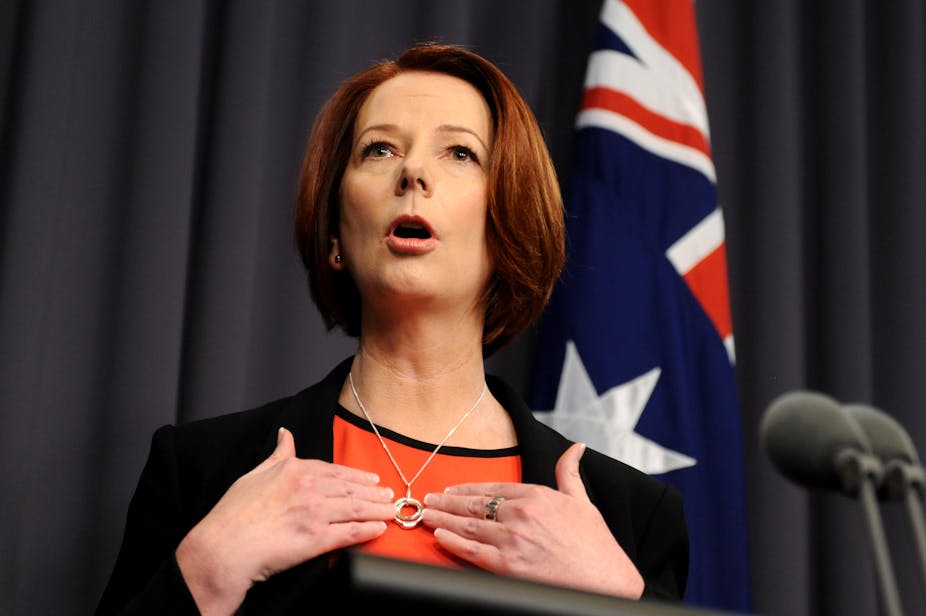
Prime Minister Julia Gillard answered questions about the AWU affair at a press conference yesterday. AAP/Alan Porrit

The recent drama about Julia Gillard’s activities on behalf of one faction of the Australian Workers’ Union back in the early 1990s is another chapter in the long story of money in Australian unions.

Parliament is only one institution in Australian society; there are churches, clubs, trade unions and business corporations. The internal practices of trade unions are frequently the object of scrutiny as to how democratic they are or to what extent office-bearers fulfil their responsibilities. The same level of scrutiny is very rarely applied to the corporate sector, where large institutional shareholders dominate corporations, individual shareholders play little role, and votes at company general meetings are usually formalities. For many churches, an undemocratic internal structure is symbol of their status as “civil society” organisations.

Trade unions are an exception. They are constituted on the basis of one-vote-one-value. This principle has not always been acknowledged. Ruling groups once manipulated elections – the Communist Party became notorious for this – but it was as common, or more common, on the right. Although the letter of union democracy has been maintained, often its spirit has been weak. Incumbents are usually favoured in union elections, for example.

The AWU has been a notable example of this. Its conservative, anti-Communist and devoutly labourist leadership was frequently challenged by internal dissenters in the 1960s. The AWU leadership fought back against dissenters by using ballot manipulation, arbitrary reconstructions of dissident branches, and even cooperation with employers against militants.

Union electoral battles are often reflections of broader social conflict: in particular the battle between left and right during the Cold War. In the early 1990s, worker resentment at economic restructuring and employer offensives generated substantial internal dissent among many unions.

Some Victorian AWU members were so unhappy that support emerged for a breakaway “Shearers and Rural Workers’ Union”, but their dissent also impelled the victory of a left-wing “reform group” within the union. Around the same time, long established, right-wing leaderships were overthrown in the Federated Clerks’ Union, the Transport Workers’ Union (TWU) and the Hospital Employees’ Federation (HEF).

These left-wing victories ran counter to the broader social trend of a shift to the right. Unions struggled for survival due to high unemployment and employer militancy, while the broader labour movement was disoriented by the collapse of Communism and political Labor’s shift to neo-liberalism. Of the four new “reform” union leaderships of this era, only that of the Federated Clerks survived in Victoria as a significant political force on the left. The erratic TWU reform group was defeated by a revived right in the union and the AWU and HEF reform leaderships drifted towards the right.

But all this came at a cost. Union election campaigning is expensive. An often disengaged membership has to be bombarded with leaflets and phone calls to get them to vote. It was inevitable that a newly elected reform Victorian AWU leadership, which was in constant conflict with the conservative national leadership, should seek to build a campaign infrastructure.

The so-called “slush fund” that is now haunting Julia Gillard had the potential to guard against corruption: campaign funds were to be under the control of an incorporated association rather than parked in individual bank accounts. We now know that any hope of such protection was unfulfilled.

Part of the explanation for what went wrong is a matter of personality, the reappearance of a labour movement archetype; the amiable knockabout who charms the membership but confuses individual and organisational interests. Labour historians know this type. “Jock” Garden, NSW Labor Council secretary of the 1920s and 1930s and a leading Communist, was a classic example. More recently, the Jeff and Kathy Jackson partnership of the Health Services Union is another example. The Victorian AWU leadership of the early 1990s, and in particular the now notorious Bruce Wilson, also fit this description, which is bad luck for Julia Gillard.

The great labour historian VG Childe complained in 1923 that political Labor, “starting with a band of inspired Socialists, degenerated into a vast machine for capturing political power, but did not know how to use that political power except for the profit of individuals”.

To Childe, this failure was a direct product of Labor’s rejection of socialism for populism. “Such is the history of all Labour organisations in Australia,” he wrote, “And that is not because they are Australian, but because they are Labour”.

Ninety years on, Childe’s diagnosis may be more accurate than ever.

Join the conversation

9 Comments sorted by

  1. Sean Lamb

    Science Denier

    "The so-called “slush fund” that is now haunting Julia Gillard had the potential to guard against corruption: campaign funds were to be under the control of an incorporated association rather than parked in individual bank accounts. We now know that any hope of such protection was unfulfilled."
    That is a very delicate way to encapsulate a situation where the future PM was getting brown envelopes of $5000 being placed in her bank account

    Her intentions were good! Imagine the collective howling on The Conversation if Tony Abbott had been involved in anything similar with his Pauline Hanson prosecution fund.

    report
    1. Sean Lamb

      Science Denier

      In reply to Sean Lamb

      The silence is quite a stunning measure about how badly, behind the bravado, the reputation of Julia Gillard has been damaged by Julie Bishop.
      I remember back in August when I said anyone who read that exit interview with Slater and Gordon would have to be a mug to think anything other than only the sudden demise of Bruce Wilson in the AWU meant that Julia Gillard rushed to pay her renovations bill and that she almost certainly had previous renovations paid from the "slush" accounts, people jumped…

      Read more
    2. Yuri Pannikin

      Director

      In reply to Sean Lamb

      What I find more interesting is the convoluted relationship and long history she has with the AWU - considering the Rudd dumping.

      report
    3. Felix MacNeill

      Environmental Manager

      In reply to Sean Lamb

      Amazing how little actual evidence Julie Bishop or anyone else has been able to provide - lots of innuendo but nor much fact to date.

      report
    4. Sean Lamb

      Science Denier

      In reply to Sean Lamb

      At last, a bite, a feeble half-hearted bite, but nonetheless a bite.

      Felix, you are right, of course. I have no evidence that the 5000 dollars Mr Hem placed in Gillard's account was not from a "big win at the casino", for that matter I have no evidence it was not from a genie appearing out of a bottle and handing it to Mr Wilson. And the fact is I am not particular bothered by this lack of evidence. Because despite the lack of evidence you, me and anyone who is not a blithering idiot deep down is convinced it came from embezzled funds.

      That is what a meant by the damage that has been inflicted on Julia Gillard's authority. The issue can't be forced, she will doubtless hang on for no other reason that no one can see a way to deliver the coup de grace. But her standing has been shattered beyond repair.

      report
  2. Michael Brown

    Professional, academic, company director

    "The same level of scrutiny is very rarely applied to the corporate sector, where large institutional shareholders dominate corporations, individual shareholders play little role, and votes at company general meetings are usually formalities".
    If you take into account ASIC and the reams of corporate law governing businesses in Australia, with the requirements for independent auditors, annual reports, and AGMs, as well as all the independent scrutiny from stockmarket analysts and business reporters in the media, there is lots of scrutiny. Unions, on the other hand, are largely a law unto themselves, as Messrs Williamson, Thompson, Wilson, Blewitt and their cronies have demonstrated.

    report
    1. Peter Bysouth

      Semi-Retired

      In reply to Michael Brown

      Why not have Unions registered with and regulated by ASIC and Union Executives/Directors covered by the same rules as company directors and the Unions themselves subject to the Trades Practices Act? Simple; Union members would know they are being protected by the same laws and rules as the companies they work to/for! What could be more fair and above board for all? How Australian is that; a fair go for all?

      report
  3. Rex Gibbs

    Engineer/Director

    I design and build waste water treatment plants. We use bacteria to break down the waste. I use intermittent processes not steady state processes and a fundamental part of the design is to maximise selective pressures to breed bacteria that do what we want. My Eureka moment that changed the whole way we do this was watching a Catalyst program about 15 years ago on how MDR organisms were selected and the impact of conjugation as a means of genetic information transfer. We now use techniques doctors…

    Read more
  4. wilma western

    logged in via email @bigpond.com

    The article supplies some historical context but doesn't actually further explore the accusations and rebuttals over the 1990's controversy. It's pretty obvious that anti-Gillard types will furiously continue to accuse her ; while defenders point to her replies to journalists questions and Abbott's inability to justify in the parliament his accusations of criminal behaviour . Whether anything comes of the referral to the Victorian police is yet to be discovered , as is how much if any further damage has been done to the government and the PM. However the political motivation is pretty obvious.

    report