

OBESE NATION: It’s time to admit it – Australia is becoming an obese nation. This series looks at how this has happened and more importantly, what we can do to stop the obesity epidemic.
Here Suzie Ferrie explains why a fat tax isn’t enough to deal with the problem while Kathryn Backholer and Anna Peeters look at the relationship between socioeconomic status and weight.
We often hear calls for a junk food tax or “fat tax” when there’s discussion of Australia’s growing obesity problem. The idea behind such a tax is that it would enable governments to subsidise healthy foods so that they’re more affordable, and make unhealthy foods comparatively expensive so people buy less of them.
But would they really? Is cost really the most powerful determinant of what food products people buy?
Let’s consider the likely effects of a junk food tax. Researchers claim that a 20% tax on a can of soft drink would be a sufficient deterrent to purchasing it.
It’s easy to visualise this: someone approaches the refrigerator in a convenience store wanting to buy a drink and ready to make a decision based on taste and cost. If a soft drink is more expensive than low-fat milk or water, it becomes less attractive and we could see a change in buying behaviour – and the attendant reduction in the consumption of obesity-promoting products.
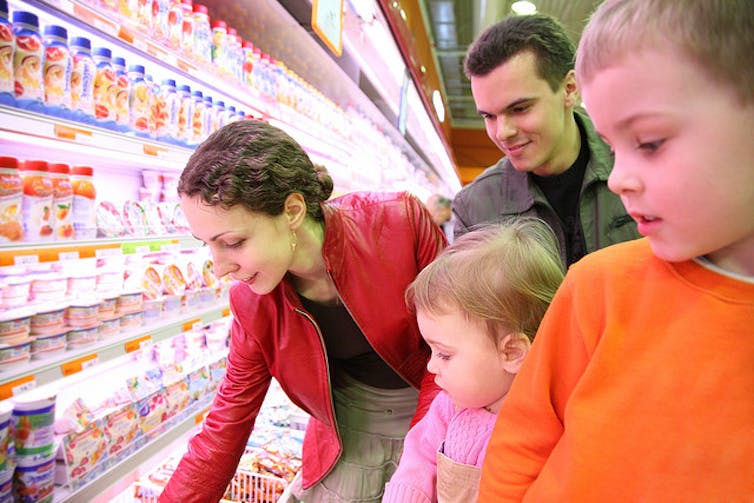
But the junk food tax idea falls over in other situations where food choices are made – when factors other than price come into play. Family dinner options, for instance, are rarely arrayed together in one location for a simple price comparison.
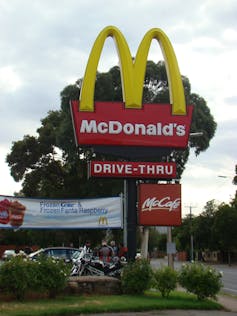
In lower-income areas, where obesity is disproportionately more common, main roads are lined with takeaway food outlets and the only greengrocer may not have a car park (let alone a drive-through service). Part of the attraction of takeaway food is that it provides instant satisfaction while demanding little in the way of (cooking) skills or (nutritional) knowledge.
Dinner options that require food preparation may be out of the question for people living in housing with inadequate cooking and food storage facilities. So, although I can prepare a vegetable and lentil curry with brown rice, followed by apple crumble with real egg custard, for a total of $3.39 per person, in disadvantaged communities this might not compare favourably with the “Five-dollar Meal Deals” offered by various takeaway chains, even if the meals were taxed until they became “Ten-dollar Meal Deals.”
And regardless of the price, it may be hard to sell my healthy $3.39 meal to someone accustomed to takeaway’s addictively sweet and salty and fatty flavours, low in vegetables and high in melt-in-the-mouth starches.
When people claim that healthy food is expensive, they are sometimes simply observing that processed foods labelled “diet” are priced higher, or that high-energy junk foods supply more (unneeded) calories per dollar than vegetables do. Both claims are true, but trivial.
But sometimes they are actually pointing out, correctly, that the real cost of my meal is more than $3.39 – that, unlike the takeaway alternative, this home-cooked dinner cost nearly an hour of my time. An hour that I might not be inclined to spare if I were tired and footsore from a hard low-income job and trying to feed fractious children as soon as possible.
And that my home-cooked meal required a number of different skills and resources I might take for granted, such as cooking ability and a functional kitchen. And that it would cost more than $50 if I had to fund the start-up cost of all the ingredients – the kilogram of flour and the bottle of oil, and so on – instead of just using (and costing) smaller amounts of items I already had.
My $3.39 meal is very nutritious. Unlike the takeaway meal, it provides the full spectrum of essential vitamins and minerals, as well as beneficial fibre and health-protective plant substances, at around 2800kJ per serve. Five-dollar meal deals, on the other hand, typically overfeed, with one meal providing 4300kJ or more (over half of a day’s requirement), as well as less protein and more fat than my version.
Better food labelling might help consumers realise this. But labelling also works best when your options are equally convenient and equally available, sitting side by side for comparison on the supermarket shelf or a food outlet’s menu. When this is not the case, labelling loses much of its power to influence food choices. Just as price manipulation strategies, such as a “fat tax”, do.

Efforts to combat obesity need to look beyond simple pricing strategies, to the underlying knowledge and skills that influence food choices. Just as physical activity is now compulsory at school, basic cooking (real basics, not just biscuits and pizza) should be an integral part of the personal development and life skills curriculum for all kids.
And rather than merely requiring a sink and food preparation area as they do now, building codes need to be updated so that adequate cooking facilities are mandatory in all dwellings. Communal kitchens are another suggestion worth considering.
An emphasis on improving skills means that rather than just punishing poor food choices, we equip people to make better ones – every day at home, not just in the convenience store.
This is part eight of our series Obese Nation. To read the other instalments, follow the links below:
Part one: Mapping Australia’s collective weight gain
Part two: Explainer: overweight, obese, BMI – what does it all mean?
Part three: Explainer: how does excess weight cause disease?
Part four: Recipe for disaster: creating a food supply to suit the appetite
Part five: What’s economic growth got to do with expanding waistlines?
Part six: Preventing weight gain: the dilemma of effective regulation
Part seven: Filling the regulatory gap in chronic disease prevention
Part nine: Education, wealth and the place you live can affect your weight
Part ten: Innovative strategies needed to address Indigenous obesity
Part eleven: Two books, one big issue: Why Calories Count and Weighing In
Part twelve: Putting health at the heart of sustainability policy
Part thirteen: Want to stop the obesity epidemic? Let’s get moving
Part fourteen: Fat of the land: how urban design can help curb obesity
Part fifteen: Industry-sponsored self-regulation: it’s just not cricket
Part sixteen: Regulation and legislation as tools in the battle against obesity
Mark Amey
logged in via Facebook
Suzie, I agree, it's easy to assume that, if junk food costs more, through tax,that people would buy less. The demand is relatively inelastic for the group that such a tax would target. Plus the supermarkets are always going to have specials, so the tax, although still being collected, would be ineffective. There was a young mum interviewed in the local paper, recently, who had sincerely believed that she was being a 'good mum' by providing all of the food groups in the form of fast food. She had…
Read morePeter Ormonde
Peter Ormonde is a Friend of The Conversation.
Farmer
Here's a bolshie notion ...
The reason that junk food is so cheap is that the wages and working conditions in the industry are well below the value that the consumer puts on their own time.
There I've said it.
The junk food industry is the most efficient bare bones operations we've got and it relies on kids and a marginalised workforce to do it. I suspect that quite a large slab of the processed food industry operates on low wages and poor conditions.
So perhaps one of the most effective…
Read moreIvan Lawler
Adjunct senior lecturer
I agree wholeheartedly that a fat tax is not enough, but I worry that such arguments are often construed to suggest that it would have no positive effect. I really don't think that's the case - a fat tax would very likely have a positive influence.
Most of the approaches we've seen are based around education and awareness and have some effect, but nowhere near enough. In my view, this is because the buyer gets the benefit (the food) straight away, and pays the cost of the choice (poor health) much later down the track. Inceasing the price makes the cost of a poor choice much more direct at the time of the decision, so should affect the decision more strongly.
Increased prices have helped to reduce use of cigarettes and alcohol, so why shouldn't they also work with food? It couldn't do much harm to try.
It won't be enough to do the whole job, but in combination with a range of other measures it should help.
Steve Brown
logged in via email @yahoo.com.au
Allowing the government to be involved in any way on this issue would appear to be a major mistake. They simply can't be trusted to give good advice when:
a) their dietary recommendations over the last 30 years have been completely unscientific (note that their advice coincided with the rise in obesity)
b) they are subject to lobbying and electoral consequences from various economic interests, most notably grain farmers and various food manufacturers
And unfortunately as this series on obesity has shown, those in the academic and medical professions charged with researching and addressing this problem appear to be just as clueless about the fundamental causes of this epidemic.
The readers have merely been subjected to the usual speculation, dogma and scientifically baseless explanations about the causes of the epidemic (gluttony, lack of exercise, lack of vegetables).
Steve Brown
logged in via email @yahoo.com.au
"health-protective plant substances"
Which don't seem to exist:
This study of over 100,000 people, conducted by the Harvard School of Public Health, showed that, 'Increased fruit and vegetable consumption was associated with a modest although not statistically significant reduction in the development of major chronic disease' [emphasis added]. It continued: 'The benefits appeared to be primarily for cardiovascular disease and not for cancer.'[5] Their conclusions state:
'Consumption…
Read moreSuzie Ferrie
Clinical Affiliate at University of Sydney
Hi Steve,
I agree that these studies make interesting reading and surprised a lot of people. But I don't think they support your argument much. The four studies you list here do not "show absolutely no benefits from fibre and vegetable intake" - three of them looked only at cancers, not other benefits. The other looked at cancer and cardiovascular disease and found that one extra serve per day of fruit/vegetables did not make a significant difference. One serve is half a cup of veg - I don't know anyone who believes that vegies are so magical that an extra half-cup a day will alter disease risk. The biggest effect of vegetables in the average diet is to displace higher-energy and more harmful foods, that is, the most beneficial plant substance is simply the satisfying low-energy bulk rather than any of the esoteric phytochemicals therein.
Steve Brown
logged in via email @yahoo.com.au
'The biggest effect of vegetables in the average diet is to displace higher-energy and more harmful foods'
That assumes that high-energy foods are bad for us, or at least make us fat.
I've already mentioned the Atkins study on one of the other obesity articles, it clearly refutes the notion that we can attribute weight gain solely to energy intake as the test subjects who ate a calorie unrestricted diet lost more weight than those who starved themselves:
http://jama.jamanetwork.com/article…
Read moreKaren Tough
equine learning facilitator with a passion for natural farming & nutrition.
Were the fruits & veges used in these studies organic ? were they grown on "live" mineral balanced soil ? If the soil is "dead" & the plants drowned in toxic chemicals why would you expect them to improve your health ??
Julia Abbott
Policy Officer
I agree with Suzie.
Also, we already have a 10% fat tax - the GST. It's applied to processed foods bought in shops and all restaurant and takeaway foods. Therefore fresh fruit and vegetables currently have a comparative price advantage.
The fact that this advantage has not had any discernible impact either on people's buying choices or waistlines (and as the GST has been in place for more than 10 years now, you would think that any impact would've shown up) implies that you would need a very…
Read moreMelanie White
Registered Nurse, Academic
Some thoughts in response to the article (not a critique, not expert opinion, not evidence based research, just brainstorming free form thoughts).
How about instead of taxing the end product (which won't prevent manufacturers from producing them) we tax the raw product. Now I know that is not realistic, but I am thinking about David Gillespie's thoughts on obesity... that the rise of obesity appears to be inversely correlated with the the price of sugar.
I doubt that we could do a long term…
Read moreKaren Tough
equine learning facilitator with a passion for natural farming & nutrition.
with iodine deficiency such a concern to the Australian government that we have been compulsory supplemented via bread products since 2009 & its known impact on the thyroid - I wonder why no-one seems to be making the connection ? Add to this a fluoridated water supply, poor diet advice by the mainstream ( in bread products - really :/ & don't get me started on the "low fat / vegetable oil diet :( ) & its no wonder Australians are getting fatter & fatter !!! & STILL the AMA says sugars ok !!