Why move back? Floods and the difficulty of relocation

The 2013 floods show a striking resemblance to the weather system that generated the 2011 floods. A small cyclone in North Queensland (Tasha in 2010, Oswald in 2013) moved down the east coast bringing extensive rainfall. The difference is this year the rainfall was preceded by extremely dry conditions…

5m7pfwjq-1359586138
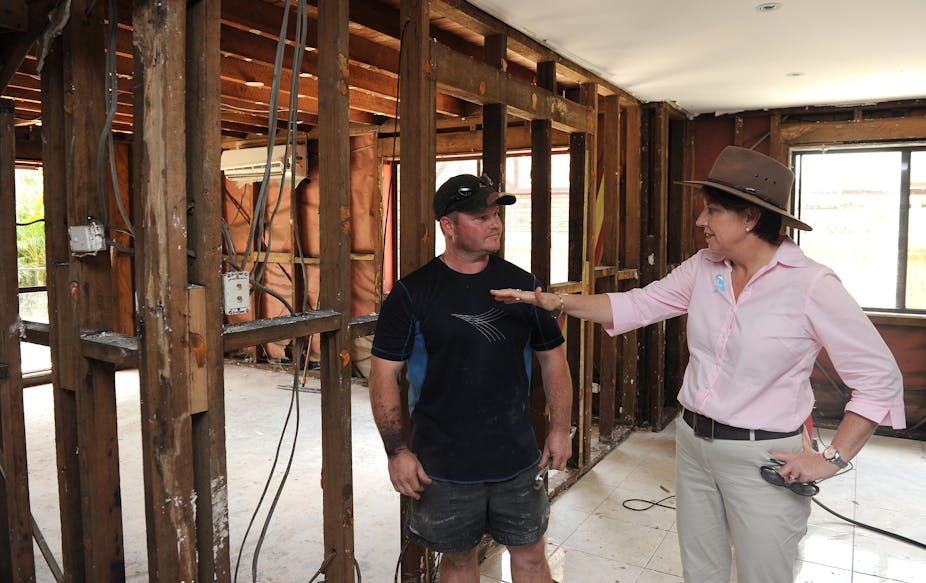
Many people flooded out in 2011 went back and suffered the same fate in 2013.

The 2013 floods show a striking resemblance to the weather system that generated the 2011 floods. A small cyclone in North Queensland (Tasha in 2010, Oswald in 2013) moved down the east coast bringing extensive rainfall. The difference is this year the rainfall was preceded by extremely dry conditions. There was greater capacity for the rain to soak into the ground, while for the most part rivers had not begun to flow.

But for households in the path of the latest floods it was, “here we go again”.

Following the 2011 floods there was a great deal of emphasis on the role of planners. The second volume of the Queensland Floods Commission of Inquiry was dominated by the planning process and the responsibilities of planners and local governments for the vulnerability of communities that were inundated. The inquiry didn’t apportion blame, but it did make many recommendations to improve land-use planning.

Before urban development can be constrained to avoid flood risk, an expensive exercise in floodplain mapping needs to take place. The Queensland Reconstruction Authority played an important role in establishing the basis for this.

But in the meantime, places that were vulnerable to the 2011 floods remained vulnerable this year. Future changes in land use will only slowly alter flood vulnerability.

Coastal and floodplain policy have seen introduced the idea of three strategies: retreat, accommodate or protect.

The “protect” part involves building things like levees, rock walls and drainage channels. Unfortunately levees will only work in the short to medium term and are expensive to construct and maintain.

“Accommodate” strategies take in the mitigation, hazard preparedness and community awareness that get ordinary households, councils and emergency services better prepared for the next hazard event. This group of strategies include warnings, awareness campaigns, community education, preparing evacuation centres, emergency and evacuation plans and kits, maintenance and retrofitting of houses and property and the building and encouragement of community resilience.

“Retreat” strategies place responsibility on to planners, councils and state government, as well as individual households. In the face of regular flooding and inundation some locations are simply going to be unsustainable. This will become even worse as climate change brings about sea level rise which will extend up tidal estuaries into city centres, and bring an increase in severe storms and floods.

Retreat will involve decommissioning and abandoning extremely vulnerable locations. The Grantham relocation scheme is one such example of a community moving away from the floodplain onto adjacent elevated land. Such schemes are going to be expensive because they will require councils or governments to buy back land and property from residents. To date, buyback schemes have not been either popular or particularly successful, but in the long term we are likely to see more of these types of relocation.

In anticipation of these processes of worsening floods and inundation, researchers from James Cook University, Macquarie University and the University of Southern Queensland carried out a number of post-flood studies over the last couple of years.

We looked at the experiences of households in Charleville and Mackay after the 2008 floods, and Emerald, six flood-affected suburbs in Brisbane and Donald in Victoria following the 2011 floods, as well as communities in North Queensland following Cyclone Yasi and floods.

In all of these surveys we asked people whether they might consider relocating either elsewhere in the town or to a completely different town or city if they endured further floods in the future. For small places like Charleville or Donald there is not much option of finding a less flood-vulnerable location within the town. In Donald only 8% of households thought that they would move in the coming years, but in Brisbane 21% considered they might move and in Emerald 24% considered it likely. In Charleville and Macquarie we asked the question of businesses as well at households.
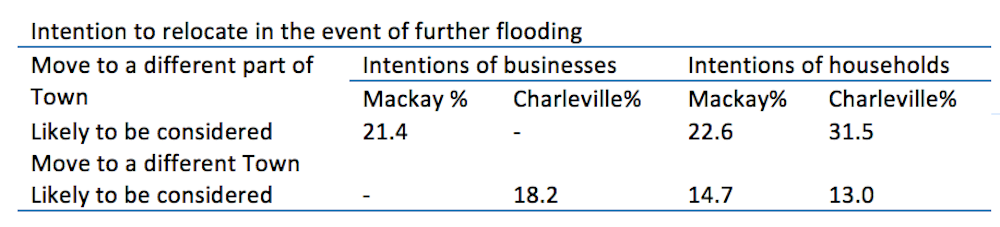
In Ingham and Innisfail in North Queensland we asked a similar question following floods in Ingham and Cyclone Larry at Innisfail. Ingham is very regularly flooded, so that it is part of the experience of living in the town. Still, around 10% of the population is considering leaving the place. In Innisfail, which recorded a net decline in population after cyclones Larry and Yasi, between 20 and 30% of the population is considering relocation.

Then at Mission Beach after cyclone Yasi we asked residents “In the near future are you likely to relocate in order to decrease or negate you or your family’s vulnerability to coastal hazards like storm surge?” This represents a direct retreat strategy: 19% of the households responded yes, they would be likely to relocate.

In all of these surveys the majority of the population clearly stated that they were not likely to move. This is what we expect and it’s a measure of the resilience of the communities. However, the proportions of households who expressed a serious consideration of leaving the community in the face of future disasters represents a significant impact upon the economy and long-term sustainability of their towns. It also represents a willingness to participate in retreat and relocation strategies.

Sign in to Favourite

Want to follow The Conversation?

Sign up to our free newsletter to get the day's top stories in your inbox each morning, with a special wrap on Saturday.

Spinner
Help us have better conversations — donate

Join the conversation

9 Comments sorted by

  1. Dale Bloom

    Analyst

    In one of the towns mentioned in this article, it is expected that a trench fills with water after the trench is dug, but the developers of a new housing subdivision noticed that the water level in a newly dug trench would rise and fall when the tide came in and out.

    This is because the new subdivision was being built on what was once coastal swampland, but that didn’t stop them from building 100’s of new houses in that area.

    Meanwhile the local council is almost bankrupt, and has stopped its workforce from working overtime, because they can’t afford overtime payments.

    This is ponzi demography gone completely mad, and it would be highly unlikely that such councils could afford payback schemes to relocate people elsewhere.

    The ponzi demographers and real estate developers make their money and retire to a hillside villa in Byron Bay, but the long term costs for what they have done have to be paid by everyone else.

    report
  2. Ron Chinchen

    Retired (ex Probation and Parole Officer)

    Some are going to hate me for saying this, but are we moving into unprecedented weather patterns that are a sign of what is ahead. Record temperatures throughout Australia, records floods..and the conditions overseas seem also to be hitting the extremes more often than they have in the past.

    Some may say its cyclic, others that its Global warming. Does it matter now. The weather is changing. And because of increased population and agriculture on more and more of the land, chaotic events are occurring…

    Read more
  3. Geoffrey Harold Sherrington

    Boss

    In loose property rights terms, one should be able to live and continue to live at a legal place unless it is resumed by the State for a purpose. The rider is that doing this does insignificant harm to others - requiring that the harm be assessed and compensated in full by the person causing the harm. The citizenry should not have to pay for repeated unwise decisions by individuals, as through hikes in insurance premiums.

    People are free to live in areas of repeated flooding if they choose to…

    Read more
  4. Colin Kline

    logged in via Facebook

    -
    Fire? Flood? Drought? Climate storms? Earthquakes? Solar storms? Hailstones? Icebergs? Rising seas? Disasteroids? War (political, food. water)? Nuclear mismanagement? Viral catastrophes? Energy collapse?

    Are we all thoughtless ninnies in the face of what Nature (man) can wreak?

    There is a well known stratagem, called The Precautionary Principle, used by Risk Engineers, Insurance Firms, and Actuaries.
    See: http://en.wikipedia.org/wiki/Precautionary_principle

    And there is a…

    Read more
    1. Jeremy Bradley

      Farmer

      In reply to Colin Kline

      Amen to that Colin. I have often wondered if a government could be held liable for lack of duty of care for not using the precautionary principle. How could it be done, class action?

      report
  5. Robert Tony Brklje

    retired

    The ego of water front versus the reality of under water front.
    Dealing with it requires some harsh love ie flood zoned properties will no longer gain any local, state or federal financial assistance, properties will be clearly mapped and prior to sales transfer new owners will be required to be advised of the risk and lack of future government financial assistance, this supported by a large marketing campaign.

    report
  6. Geoffrey Harold Sherrington

    Boss

    Science tends not to recognise the precautionary principle. If research is pointing in a certain direction that indicates possible harm, the answer is to finish the research faster, suggest solutions and costs and turn it over to decision makers.

    Indeed, for many scientists, the "precautionary principle" is a misnomer. It has not gained the status of a principle. It is often used to send a message "Hey, I'm running out of research funds, treat me favourably next round".

    I doubt if there is…

    Read more
    1. Michael Hay

      retired

      In reply to Geoffrey Harold Sherrington

      At over 80 years of age, I do not wish to live on a hillside - it is too hard to walk anywhere. I live on a flood plain, where the township should never have been built, and I walk on the flat.
      Herewith a dilemma: townships should not be built on average or better agricultural land, but they should also not be built on steep slopes.
      It would be ideal if flood-prone areas were to be removed from the hands of housing developers - but that suggestion is fraught with objections based on financial intentions.
      My flood-plain dwelling has never been flooded and we now have a flood mitigation scheme which means I can continue to live on the flat ground without fear of flooding, but that does not negate the fact that the land I live on is above average agricultural land and should be used for farming.
      Ho Hum - no answers at all !

      report
  7. Michael Maloney

    Supercheap Self Storage

    I recall my mates’ story before he moved over to the Gold Coast after a small cyclone Tasha hit the area on Christmas Eve in 2010. It was a trying time, when they did not have power for a few days, and the entire area was flooded. The first floor of his house was entirely flooded, gladly that most of his important and valuable items were in the storage room on the second floor. Months before that he was making a provision for storage in his home, and he initially planned it to be on the ground level. But for some reason, he had the room temporarily on the 2nd floor, and forgot about it. Good thing that when the cyclone and flooding happened, he had all his important items (documents of his business) secured in the storage room.

    report