

A journey into the weird and wacky world of climate change denial

CLEARING UP THE CLIMATE DEBATE: Professors Stephan Lewandowsky and Michael Ashley step into the twilight zone of climate change scepticism: where the sun is made of iron and the royals are out to get you. Science, like much human endeavour, thrives on debate. Climate deniers want to participate in…

Lewanashley
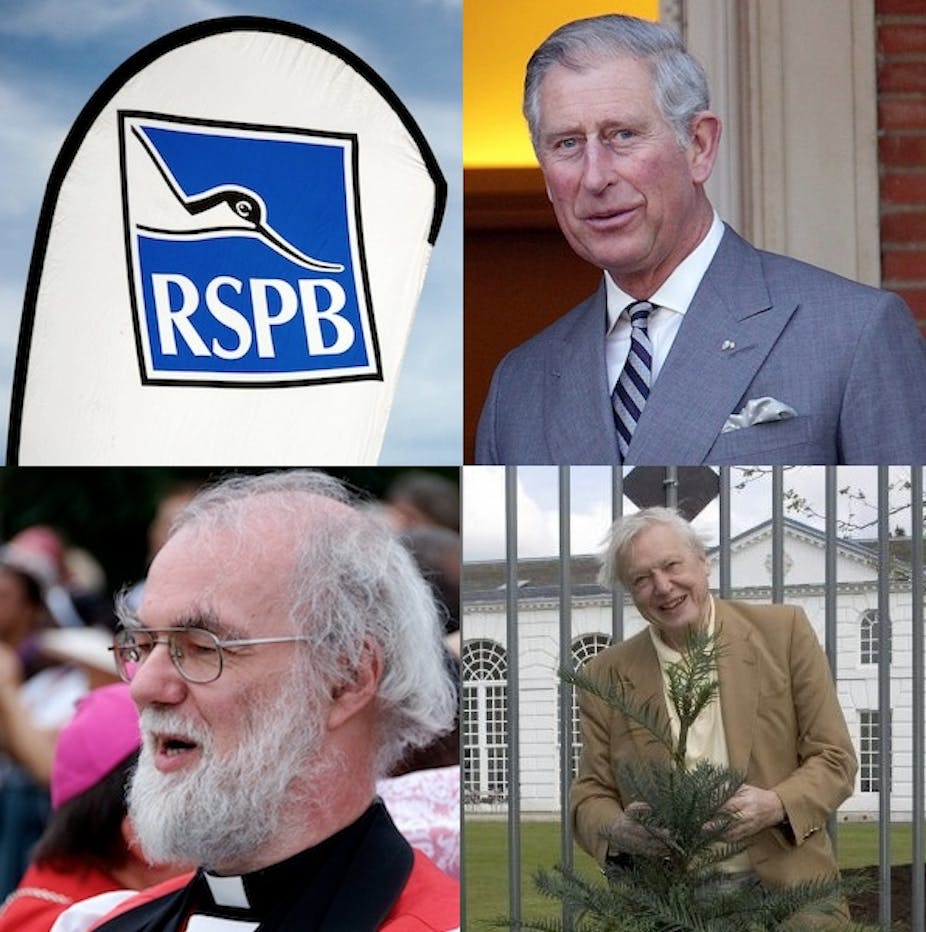
Just some of the people and organisations climate deniers think are coming to get them. -(Jonathan)-/flickr, scottgun/flickr, Kew Gardens/fickr

CLEARING UP THE CLIMATE DEBATE: Professors Stephan Lewandowsky and Michael Ashley step into the twilight zone of climate change scepticism: where the sun is made of iron and the royals are out to get you.

Science, like much human endeavour, thrives on debate.

Climate deniers want to participate in this debate as equal partners, and feel that they are entitled to be heard and to be taken seriously. This is quite understandable, but by itself does not create an entitlement.

In science, to actually contribute at the forefront of a field one has to earn credibility, not demand it. Being taken seriously is a privilege, not a right.

In science, this privilege is earned by not only following conventional norms of honesty and transparency but by supporting one’s opinions with evidence and reasoned argument in the peer-reviewed literature.

This is what makes science self-correcting. If arguments turn out to be wrong, in time they are caught and corrected by other scientists. It is virtually impossible to publish long-refuted nonsense in good peer-reviewed journals.

Climate deniers, by contrast, seem to avoid the peer-reviewed literature or publish by sometimes abusing the system. Nor do the deniers turn up and present their ideas at any of the many international scientific conferences, open to anyone, where these issues have been explored for decades.

Deniers simply keep restating nonsensical arguments that the scientific community has known to be wrong for a long time.

The illusion of debate

So why do deniers continue to make their loud, and egregiously mistaken, claims? And what explains the tiny handful of deniers with verifiable academic credentials?

Many are (generally former) Professors, albeit usually with tenuous unpaid Adjunct or Emeritus associations with universities.

Are these individuals indicative of a scientific debate, after all? And if not, what motivates them?

Today, denial of the link between HIV and AIDS would be laughable, if the consequences of that denial hadn’t been so serious.

It is thus important to remember that twenty years ago a tiny handful of people in the medical community, including senior academics at reputable universities, rejected the consensus that HIV causes AIDS.

It is illuminating that just as in climate science, the contrarian publications on HIV were accompanied by an unusual context that made headlines and raised eyebrows for the same ethical reasons that arise from climate deniers’ subversion of peer review.

An example from astronomy is also prescient. The consensus of astronomers is that the sun consists largely of hydrogen and helium, and is powered by fusion at its core.

The evidence for this is overwhelming, and supported by multiple independent lines of investigation.

Like climate change, there are contrarian academics who argue against the consensus. O. Manuel, unpaid Emeritus of the Missouri University of Science and Technology, has claimed for decades that the sun is mostly composed of iron.

Manuel has recently published his bizarre theories in the bottom-tier journal Energy & Environment, also a favorite of climate deniers due to its, to put it mildly, unusual review processes.

There is an important lesson here: an overwhelming scientific consensus does not imply the absence of contrarian voices even within the scientific community.

Over time, those contrarian voices simply fade away because no one takes them seriously, despite their shouts of “censorship” and accusations of bias.

This is not to say that a scientific consensus is never overturned.

There are well-known examples such as the Helicobacter pylori discovery in medicine, and continental drift in geology. But in both cases the arguments were won and lost in the peer-reviewed literature, not by contrarians sitting on the side-lines writing opinion pieces about how they were being oppressed.

Manipulating the media

Normally the underbelly of obsessed contrarians that strangely afflicts many areas of science would go unnoticed.

With climate change, however, we are in the extraordinary situation where the deniers have had almost free reign in media outlets such as The Australian, while scientists are given short shrift.

The editors there claim to be providing balanced commentary for their readers to make informed decisions. In reality they are doing a great disservice to the community by publishing junk science.

Providing a platform for deniers, thereby enabling political leaders to mistake contrarian cranks for real science, can have horrendous consequences, as we have seen in the case of HIV, where perhaps hundreds of thousands of people have needlessly died.

There is an ethical imperative to hold deniers accountable for their actions.

But the question remains: what motivates deniers?

With very few exceptions, academic climate deniers are male and either retired or close to retirement.

The climate deniers’ champion, MIT’s 71-year old Richard Lindzen, has had a distinguished career, but 30 years after his major contributions, he appears to struggle to respond to devastating peer reviews when he attempts to publish his contrarian views in a major journal.

More commonly, the academic climate denier will have had a mediocre career that escaped public notice and left little imprint on science. Some haven’t been able to keep up with the rapid advances in science coming from its increasing complexity and the impact of computers and new technologies. Once respected, these scientists find themselves “out of the loop” and being ignored, which sometimes makes them quite grumpy.

There is much truth in the eminent physicist Max Planck’s observation, “a new scientific truth does not triumph by convincing its opponents and making them see the light, but rather because its opponents eventually die, and a new generation grows up,” sometimes paraphrased as, “science advances one funeral at a time.”

A strong motivation for contrarians appears to be the attention that they can gain or re-gain in the public arena.

Any scientist, no matter how out of touch, can become the darling of talk shows by simply disagreeing with the consensus on climate.

89-year-old Vincent Gray was introduced recently by shock jock Alan Jones as “world acknowledged and acclaimed,” and among “some of the most eminent people in the world”.

Gray’s most recent peer-reviewed publication appears to be an article on the chemical properties of coal, from 17 years ago. Nothing at all on climate.

Jones also recently interviewed 72-year-old Tim Ball, describing him as “one of the world’s most eminent climate scientists, and acknowledged as such.” This is in contrast to Ball’s CV, in which he reveals he got his PhD at the age of 44 and retired from academia at the age of 57 with a very thin list of publications, most frequently in The Beaver and the Manitoba Social Science Teachers Journal.

Jones’ listeners and The Australian’s readers are being misled.

David Attenborough is watching you…

Another necessary element of denial is conspiratorial thinking. Any denier sooner or later, whether an academic or not, must resort to a global conspiracy theory to negate the overwhelming evidence arrayed against them.

One self-proclaimed “rocket scientist” who has published junk science in the opinion pages of The Australian has been quoted on a New Zealand website as saying:

“To win the political aspect of the climate debate, we have to lower the western climate establishment’s credibility with the lay person. And this paper [an accompanying picture book of thermometers] shows how you do it. It simply assembles the most easily understood points that show they are not to be entirely trusted, with lots of pictures and a minimum of text and details. It omits lots of relevant facts and is excruciatingly economical with words simply because the lay person has a very short attention span for climate arguments. The strategy of the paper is to undermine the credibility of the establishment climate scientists. That’s all. There is nothing special science-wise.”

Undermine credibility.

That’s all.

Nothing science-wise.

Are these the people one should entrust with the welfare of future generations?

Lest one think this is an isolated case, conspiracy theories are an essential ingredient in writings of deniers.

According to a recent (not peer-reviewed) book by Bob Carter, who has an unpaid Adjunct position at James Cook University, it is “simply professional suicide for a scientist to put a questioning head above the parapet” when faced with opposition from “the BBC, commercial television, all major newspapers, the Royal Society, the Chief Scientist, the Archbishop of Canterbury, the Bishop of London, David Attenborough, countless haloed-image organisations such as the Royal Society for the Protection of Birds, and even Prince Charles himself.”

Just imagine the devastating rebuttal of climate change that Bob Carter could submit for peer-review if he wasn’t being oppressed by the Archbishop of Canterbury and Prince Charles.

But seriously, why doesn’t Carter, or any of the deniers, simply write a coherent outline of their best arguments against the expert consensus and publish it in the peer-reviewed literature?

Why don’t they turn up to the relevant scientific conferences and give a talk on their theories?

The answer is simple: they don’t have any arguments that have any scientific merit.

Which is why Carter publishes in The Australian. Again, and again, and again and again.

Returning to our discussion of conspiracy theorists, O. Manuel, whose imaginative theories on the sun we discussed earlier, avidly posts to blogs and often mentions President Eisenhower’s 1961 warning against a government-funded “scientific-technological elite”.

Manuel claims that this “tax-feeding ‘elite’ has distorted experimental data to give tax-payers misinformation about the sun’s origin.”

The peer-reviewed literature on conspiratorial thinking cites several identifying attributes that are replete in the statements of climate deniers.

For example, the imaginary conspirators are at once small in number but also all powerful.

They claim on the one hand that science is based on the strength of argument, not on the consensus of experts, but on the other hand they desperately manufacture petitions and lists of “scientists” on their side.

There’s a laughable list circulating on the internet of 31,000 “scientists” — including at one point Dr. Pierce and Dr. Hunnicutt of M*A*S*H fame — who allegedly oppose the consensus on climate change. But on the other hand there’s the simultaneous claim that opposition is squashed by the world’s science academies and Prince Charles.

Deniers yelp about being oppressed, while at the same time claiming to number 31,000.

And just to be sure, Prince Phillip runs the world’s drug trade and climate change is a means by which the Royal family is culling the population for a forthcoming genocide. Or something like that, maybe you can figure it out.

Time to close the phony debate on climate science

At a time when the oceans are accumulating heat at the rate of five Hiroshima bombs per second, are conspiracy theorists the people whom a nation should entrust with the future of our children?

The so-called “debate” on climate change has been over for decades in the peer-reviewed literature. It is time to accept the scientific consensus and move on, and to stop giving air-time to the cranks.

It is time for accountability.

This is the ninth part of our series Clearing up the Climate Debate. To read the other instalments, follow the links below:

Join the conversation

56 Comments sorted by

Comments on this article are now closed.

  1. Paul Richards

    Paul Richards is a Friend of The Conversation.

    Stephen your perspective on the mindset of these individuals is clear and easily understood. After reading the climate science since the mid 70s, I still have trouble grasping the deniers cognitive process.
    So I appreciate sensible observations about their motivation, or why they do what they do. This is a much needed piece, thank you.

    report
  2. Brian Angliss

    climate/energy writer

    The book "Merchants of Doubt" by Naomi Oreskes and Eric Conway discusses in great detail and with extensive documentation the likely motivations of the U.S. science deniers (not just climate disruption deniers, but deniers of the risks of secondhand smoke, acid rain, DDT, and ozone depletion) and finds that they were largely former cold-warriors who came to view environmentalism as communism in disguise and who felt passed-over for government jobs they felt their service had earned them.

    You can see the same logic today in the "watermelon" claims made against environmentalists in general and climate realists in particular.

    report
  3. Jonathan Borwein (Jon)

    Laureate Professor of Mathematics at University of Newcastle

    Stephen: thanks for this excellent series.

    A small point you write "89-year-old Vincent Gray was introduced recently by shock jock Alan Jones". Do you mean http://en.wikipedia.org/wiki/Alex_Jones_(radio_host)?
    If so he is a major league conspiracy theorist not just a shock Jock, and his growing legitimacy (largely on the US right) is symptomatic of the problems science and sanity have in the current "climate".

    report
  4. John McLean

    logged in via email @connexus.net.au

    I see that Stephan Lewandowsky is continuing his diatribe against people who don't believe. As a cognitive psychologist he should be aware that there's a difference between belief, as illustrated by religions, and trusted knowledge. The essential different is that the former is an act of faith and the latter is supported by evidence.

    I ponder why it is that Lewandowsky isn't questioning whether sufficient evidence exists to support the notion of significant and dangerous man-made warming.

    One…

    Read more
    1. Brian Angliss

      climate/energy writer

      In reply to John McLean

      John, I'm afraid that you've made a number of errors. Climate models make projections of what should happen in the earth's atmosphere and oceans that can be tested by looking to see if those projections are accurate. For example, models project that warming from any source should shift the jet streams poleward and this has in fact been observed, a point that indicates climate models are accurate in this regard.

      It's the attribution of the combination of all the warming fingerprints projected to…

      Read more
    2. John McLean

      logged in via email @connexus.net.au

      In reply to Brian Angliss

      Oh dear. You seem to think that models tweaked to match a situation, no matter how poorly they embody many forces, should be regarded as gospel.

      I find it interesting that models have been corrected to now claim they show the pattern of atmospheric warming. It's intersting in that it's happened only recently when we've been told for over 20 years that climate models are accurate. It seems that only when there was clear evidence that the models were wrong that they were tweaked.

      Can you prove…

      Read more
    3. William Blackburn

      logged in via Facebook

      In reply to John McLean

      John McLean, on the assumption that you have a basic grasp of the peer review system (if not,see earlier articles in this series) why don't you try and get your views published in relevant scientific journals?

      If you cannot, then I suggest there are two possible reasons:
      1) you don't know what you're talking about, or
      2) there is a vast conspiracy that has consumed every scientific academy and every publishing climatologist across the globe.

      I'm guessing you're leaning towards the latter. Me personally, I would apply Ockham's razor, and humbly suggest that you're not as well informed as you like to consider yourself.

      report
    4. Brian Angliss

      climate/energy writer

      In reply to John McLean

      Wow, so much wrong with such a short response.

      Let's start with your last sentence, as it shows you are unfamiliar with the physics of radiation transfer of photons through a medium.

      When photons are injected into a medium (say by the sun), they are absorbed by the medium and then re-emitted in a full sphere (4 pi steradians, if you're familiar with radial coordinates) regardless of where the source of the photon was. Assuming the medium is homogenous, those emitted photons will be reabsorbed…

      Read more
    5. Brian Angliss

      climate/energy writer

      In reply to John McLean

      Regarding your claim that models have only recently been "tweaked." This is incorrect, as Figures 1.2 and 1.4 of the IPCC AR4 WG1 report show - there have been major advances in modeling spatial and temporal resolution, modeling chemical and biological effects, and the like.

      Technically, what the modelers are doing is something akin to a Monte Carlo analysis, running multiple simulations varying initial conditions in order to test the sensitivity of the climate system to various initial conditions…

      Read more
    6. Brian Angliss

      climate/energy writer

      In reply to John McLean

      Finally, on ENSO, I'm hardly an expert, but the actual experts on the subject appear to be largely in agreement that the apparent ENSO shift in the 1970s was likely an effect of increased heat accumulation in the Earth's climate system rather than a cause of it.

      My question to you is this - if the shift in ENSO from La Nina to El Nino was the cause of the recent climate shift, where did all the energy for the El Nino's come from?

      report
    7. Mike Hansen

      Mr

      In reply to William Blackburn

      John McLean has published a paper with Bob Carter which claimed "the "close relationship between ENSO and global temperature, as described in the paper, leaves little room for any warming driven by human carbon dioxide emissions".

      http://www.skepticalscience.com/peer-reviewed-response-to-McLean-El-Nino-paper.html
      http://scienceblogs.com/deltoid/2009/07/ahh_mclean_youve_done_it_again.php

      John has now decided to "double down" claiming "It is likely that 2011 will be the coolest year since 1956…

      Read more
    8. Brian Angliss

      climate/energy writer

      In reply to Mike Hansen

      Wait, this is that John McLean? Oh my. John, if this is really you, Foster et al 2010 demolished your paper with Carter. It was even more wrong than "A comparison of tropical temperature trends with model predictions" by Douglass, Christy, Pearson, and Singer (Douglass et al 2007), and that's saying something.

      Next time try using a method that doesn't inherently eliminate annual trends from your calculations.

      report
    9. James Szabadics

      Technical Development and R&D Manager, Plantation Timber Industry

      In reply to Brian Angliss

      Brian I would expect the models to improve with time as we get more real world data to better balance forcings. Also if there turn out to be any new indirect atmospheric forcings from the GCR/cloud theory these can be added to the model over time.

      report
    10. Tristan Croll

      logged in via Facebook

      In reply to John McLean

      "And on your last point, on radiation into space, it strikes me that adding CO2 will actually mean more molecules up there to do that radiation. "

      That quite literally made me facepalm.

      report
  5. Chris Knowles

    logged in via Twitter

    The Bob Carters of this world would have little impact if it were not for a publishers that see a buck to be made; media outlets who don't like the flavour of the government of the day and by and large pander to those who abhor change and want to retain teh status quo or even worse return to a idealised past that never existed; and for politicians who put their own short-term ambitions before the welfare of future generations.

    Combating climate change is necessarily difficult and painful and there's always going to be a significant proportion of the population who will be attracted to the notion that is just a beat-up and the pain unnecessary.

    Unfortunately, there's also always going to be those outside the scientific community who are far more powerful and far more influential that will see a considerable opportunity in peddling that myth. And those are the killer motivations.

    report
  6. Michael Pollard

    logged in via Facebook

    With very few exceptions, academic climate deniers are male and either retired or close to retirement."

    This may well be correct, although being closer to retirement than the beginning of my career, I would plead that I not be included in such a group. Interestingly my twin brother, a rabid denier, is clearly a card carrying member!

    I would like to see added to the above description the overwhelming political beliefs of the deniers. They all seem to lean significantly to the right, which is the…

    Read more
    1. John Mashey

      Semi-retired computer scientist/corporate executive

      In reply to Michael Pollard

      Some demographic data can be found in:
      http://www.desmogblog.com/another-silly-climate-petition-exposed
      See pp.12-16 on demographics of the (mostly Physics PhDs) who signed a silly petition to the American Physical Society, thus showing that even people who should know better can ignore physics ... although only 0.5% signed.
      "The signer list seems unrepresentative of the APS membership. As a group, the signers are certainly older, seem likely more politically conservative, and somewhat more likely to be male than the total membership."

      There also was a social network analysis, as many of the signers were clearly closely connected, just as they are in Oz/NZ.

      report
  7. Simon Arnold

    Mr

    I note this web site says:

    "Who We Are

    "The Conversation is an independent source of information, analysis and commentary from the university and research sector – written by acknowledged experts and delivered directly to the public. As professional journalists, we aim to make this wealth of knowledge and expertise accessible to all.

    "We aim to be a site you can trust. All published work will carry attribution of the authors’ expertise and, where appropriate, will disclose any potential conflicts…

    Read more
    1. Doug McLean

      logged in via email @gmail.com

      In reply to Simon Arnold

      I appreciate your very thoughtful analysis.

      I do however belive that you have overlooked an incredibly important concept. The deniers are not interested in being right or proving anything via the rules of the game of science.

      They are "Merchants of Doubt". I refer all to the book by the same name.

      Deniers motivation? Why do they do it? Money. Many if not all are motivated by $$$s. Paid for by wealthy and powerful special interests who know that all they have to do to maintain their monetary and…

      Read more
    2. Jane Rawson

      Editor, Energy & Environment at The Conversation

      In reply to Simon Arnold

      Hi Simon,
      thanks for your comment. If you click on Stephan's profile you will see a summary of his research on various aspects of denial.

      report
    3. Simon Arnold

      Mr

      In reply to Jane Rawson

      If you read what I wrote carefully you see that I was talking about content knowledge.

      Their piece isn't about denial, its about "climate deniers" (undefined, which is sloppy). I see no peer reviewed papers dealing with studies of "climate deniers" in either of their web sites, so why we should take the various assertions about this class of people peppered through their article seriously I know not.

      It is as I said a polemic,not learned comment from professionals. Its attempt to claim a veneer of scientific respectability is just that.

      You are not doing your core purpose any good by publishing it here.

      report
    4. James Szabadics

      Technical Development and R&D Manager, Plantation Timber Industry

      In reply to Doug McLean

      How about "science and knowledge" as a motivator and a quest for understanding as a reason to question. A healthy debate even if you learn that your understanding was wrong is good for the science and learning. People should be encouraged to ask questions and challenge conclusions that do not make sense if they want to learn something, not chided. Brian Angliss has at times in his posts been a good educator in the debate, when he has done this it has been great. The article itself is not the result of research and does nothing for the layperson or the educated person to help them understand possible misconceptions about climate science projections. It is like a womans day gossip column with fringe stories designed more to entertain, it covers none of the serious areas of actual scientific debate.

      report
  8. Sean Lamb

    Science Denier

    Who is this lunatic who thinks the sun is made of iron? Doesn't he know the sun is a giant ball of gas where hydrogen is being converted to helium (at least I think that is the story, I haven't paid much attention to astronomers since they flip-flopped on the whole sun goes around the earth-thingy. Most of them would struggle to find their way out of paper-bag, in my humble opinion)

    If I may take the liberty of quoting GK Chesterton: "how much happier you would be, how much more of you there would…

    Read more
    1. Ian Enting

      Honorary Senior Associate, Faculty of Science at University of Melbourne

      In reply to Sean Lamb

      "Who is this lunatic who thinks the sun is made of iron?" Mike Ashely knows more about him than I do, but Ian Plimer thinks so highly of him that Plimer plagiarised chunks of the "iron sun" paper in his book "Heaven + Earth".

      "shouldn't the scientific community be developing a plan for feasible replacement and realistic engineering solutions beyond a few windmills and a couple of solar panels" There is of course this caper called nuclear fission.

      report
  9. John McLean

    logged in via email @connexus.net.au

    Doug McLean, do you the slightest shred of evidence to (a) support your claim and (b) the slightest evidence to support your implied claim that researchers who take funding from the government are all virtuous souls who wouldn't dream of distorting their claims in order to benefit?

    Oreskes has been dismissed so many times that I'm surprised that anyone should take her seriously, anyone who seeks evidence and is not a committed believer that is.

    report
    1. Brian Angliss

      climate/energy writer

      In reply to John McLean

      Sorry, John, but you're going to have to do better than a logical fallacy (Authority of the Many - look it up) to dismiss the 1047 references from Merchants of Doubt. Better yet, look up some of the references from the tobacco document libraries and other sources that are easily checked on-line. You'll find that Oreskes and Conway accurately represent those sources (and yes, I've done some spot checking on my own, and every reference I checked was accurately described in "Merchants of Doubt."

      report
    2. Mike Hansen

      Mr

      In reply to John McLean

      So John. We are supposed to not notice that the leading climate change deniers are all members of right-wing think tanks who take funding from the fossil fuel industry.

      We now have well known British crank Lord Monckton about to embark on an Australia wide tour. His first port of call is the Perth convention of the lobby group the "Association of Mining and Exploration Companies". His previous tour was partly funded by Gina Reinhart.

      This is fresh from a conference in the USA where he claimed Professor Garnaut's statement "on a balance of probabilities, the mainstream science is right" was a fascist point of view and showed it next to a large Nazi swatiska.

      http://www.abc.net.au/unleashed/2765990.html

      report
  10. John McLean

    logged in via email @connexus.net.au

    I see that Joanna Nova presents this folly to a wider audience.

    See http://joannenova.com.au/2011/06/peer-review-denial-and-the-abuse-of-science/ for details.

    Who can blame her for going to a wider audience when the supposed conversations here amount to rational argument (saying "what evidence?" and exposing flaws in understanding of physics, statistics etc) trying to battle against belief, ad hominem attack, bluster, bravado and other things starting with B.

    report
    1. Mike Hansen

      Mr

      In reply to John McLean

      I assume that you are the same John Mclean who predicted
      "It is likely that 2011 will be the coolest year since 1956, or even earlier ..."
      http://climaterealists.com/index.php?id=7349

      From NOAA NCDC
      http://www.ncdc.noaa.gov/sotc/global/

      "•The combined global land and ocean average surface temperature for May 2011 was 0.50°C (0.90°F) above the 20th century average of 14.8°C (58.6°F). This is the 10th warmest such value since records began in 1880.

      •For March–May 2011, the combined global land and…

      Read more
    2. John McLean

      logged in via email @connexus.net.au

      In reply to Mike Hansen

      I could easilt answer by questioning your gullibility about GISS data but the more pressing question is why you decided to try to redirect the conversation thread.

      Do tell us all.

      report
  11. Sean Lamb

    Science Denier

    Someone made this claim in a comments above
    "and there are a number of key fingerprints that relate to the source of any warming being from the accumulation of CO2. One is that the stratosphere should cool while the troposphere warms,"

    Stratosphere cooling can be simplest explained by the depletion in ozone, which is largely found in the stratosphere. So at present I don't think we can say that this is necessarily a symptom of CO2 accumulation.

    Since the point is a rather simple one, it is alarming that this incorrect factoid is being trotted out with such regularity these days. This is perhaps why we should be spared such accusations as "Don't you believe the science?" - Well, no, not when it is that ill-informed

    Sorry about the typos towards the end of my previous post. I think I chortling too hard at my own witticisms - someone has to.

    report
    1. Mike Hansen

      Mr

      In reply to Sean Lamb

      Sorry Sean.

      You have it back to front.

      From NASA GISS
      "Ozone holes are caused by chemical reactions that take place primarily on the surface of polar stratospheric clouds, ice particles, or liquid droplets, which form at high altitudes in the extreme cold of the polar regions. The number of particles that form, and therefore the amount of chemical ozone destruction, is extremely sensitive to small changes in stratospheric temperature. Hence, even small amounts of stratospheric cooling can greatly increase ozone depletion.."

      and

      "While the buildup of greenhouse gases leads to global warming at Earth's surface, it also cools the stratosphere, which increases the amount of ozone depletion in the polar regions"

      http://www.giss.nasa.gov/research/briefs/shindell_02/

      report
    2. Sean Lamb

      Science Denier

      In reply to Sean Lamb

      "Sorry Sean.

      You have it back to front. "

      No I most certainly do not. Lower ozone levels will trap less radiation - whether this wil lead to even less ozone formation and even further temperature drops in a runaway positive feedback cycle, I leave to NASA to determine.

      It reminds back in the day when people used to argue that AGW was proved by the correlation in ice-cores of CO2 and temperature - what a load of nonsense that was originally. Fortunately climate scientists have since retreated…

      Read more
    3. Sean Lamb

      Science Denier

      In reply to Sean Lamb

      Just to avoid confusion: by solar cycle in regards ice-core data, I meant the Milankovitch cycle variations and the like.
      But I can never remember how it is spelt.

      report
    4. Brian Angliss

      climate/energy writer

      In reply to Sean Lamb

      Could you explain further what you mean with respect to the ice cores? Are you referring to the 800 year delay from the start of a deglaciation to the point at which CO2 rises in the ice core, or are you thinking of something else?

      As the person who made the stratospheric cooling point, lower ozone affects mostly the polar regions, and so we could reasonably expect that the greatest stratospheric cooling would be present in those regions, especially over Antarctica. And in fact, satellite data…

      Read more
    5. Ian Enting

      Honorary Senior Associate, Faculty of Science at University of Melbourne

      In reply to Sean Lamb

      "the correlation in ice-cores of CO2 and temperature - what a load of nonsense that was originally. Fortunately climate scientists have since retreated into a fundamentally unprovable model involving initial forcing events and positive feedback cycles that mysteriously stops when the solar cycles stop."

      This is a common denialist lie that scientists have "retreated" on this. The interpretation of the correlation as CO2 "amplifying a relatively weak orbital forcing" is right up front in the abstract (from which the previous quote is taken) of the early (1987) paper reporting the correlation.(Genthon et al, Nature, vol 329, p414).

      report
    6. James Szabadics

      Technical Development and R&D Manager, Plantation Timber Industry

      In reply to Mike Hansen

      Given low incident UV with the current weak solar cycle (UV generates Ozone and in doing so warms the upper stratosphere) we can expect stratospheric cooling. The link between the amount of incident UV and stratospheric warming and cooling is well documented.

      report
    7. Sean Lamb

      Science Denier

      In reply to Ian Enting

      Yes, well - leaving aside the terminology such as "denialist" or "lie" (I think it is always a good idea to assume the sincerity of those whom you disagree with) - can I just say as long-term unemployed I would be delighted to shill for Big Carbon for a little bit of extra dosh. I made it clear above that I don't read specialist climate science literature nor do I pretend to be competent to judge it. However that was definitely climate science as it was presented by science journalists and by spruikers…

      Read more
    8. Ian Enting

      Honorary Senior Associate, Faculty of Science at University of Melbourne

      In reply to Sean Lamb

      There is a bit more on this in the section on Vostok Ice core in the document where I analyse Plimer's book. see
      http://www.complex.org.au/tiki-download_file.php?fileId=91
      I give a rough schematic suggesting CO2 is responsible for about half
      the temperature change in the glacial-interglacial cycle.
      there are two reasons why even this effect of 100ppm change is a lot
      more than the 20th century change.
      (a) the relation between CO2 and temperature is roughly logarithmic - this has been known since…

      Read more
    9. Grant Burfield

      Dr

      In reply to Ian Enting

      "(a) the relation between CO2 and temperature is roughly logarithmic - this has been known since Arrhenius 1996"

      Thanks for that. And for pointing out the inaccuracies in Plimer's book. Climate scientists and mathematical physicists would never make such obvious mistakes.

      Although what the Arrhenius paper in 1996 on "Evidence for life on Earth 3,800 million years ago" has to do with the debate is beyond me.

      But then again, I'm not a Climate Scientist.

      http://courses.washington.edu/bangblue/Mojzsis-3.85Ga_Akilia_d13C-Sci96.pdf

      report
    10. Sean Lamb

      Science Denier

      In reply to Ian Enting

      I am not a mathematician so logarithmic is not a term which I would use. But I have always assumed that the CO2 warming effect would tend to saturate or level out - which is essentially what you seem to be saying. But again, in the popular science press which is to the extent which I read, you seldom get a sense of this.

      It would be interesting if you could describe this curve more closely.
      For example, using my "back of the envelop" approach

      The range from 0 to 180 ppm adds 6 degrees
      The range from 180 to 280 adds 2.5 degrees (using the rough range of the ice cores and your estimate of this contribution to warming)
      The range from 280 to 390 ppm adds 1.25 degrees (adding a 50 per cent loading, per your objection).
      The range from 390 to 500 ppm adds 0.6 degrees
      The range from 500 to 610 ppm adds 0.3 degrees

      etc etc.

      Well, you get the idea, has someone drawn this logarithmic curve properly?

      report
    11. Ian Enting

      Honorary Senior Associate, Faculty of Science at University of Melbourne

      In reply to Sean Lamb

      For a logarithmic curve, think of an exponential curve (eg growth from compound interest) turned on its side (i.e. swap the axes.)
      For actual numbers: logarithmic doesn't apply at really low concentrations. But, simpliying the numbers a bit, think of it as each time you multiply the concentration by 1.5, you add about 2 degrees to the medium term warming - the instantaneous warming lags and there may be more long term warming from ice sheet feedbacks.
      so 180 to 270 adds 2 degrees, 270 to 405 adds another 2, 405 to 607 adds another 2.
      If you have acess to a spreadshet like excel (or the open office equivalent) you can plot up a more detailed version yourself.

      report
    12. Lisa Meredith

      B.App.Sc.

      In reply to Ian Enting

      "(a) the relation between CO2 and temperature is roughly logarithmic - this has been known since Arrhenius 1996"

      I think you mean 1896, not 1996.

      report
  12. Malcolm Edward-Cole

    Retired

    How, please, can we understand the views of somebody like the now (thankfully) retired Senator Minchin. An outwardly intelligent person, maybe, but so narrow in his worldly view. How long do we have to keep banging our heads against the wall? When will they ever learn?
    It's frustrating to the nth degree

    report
  13. helen stream

    teacher

    I guess I’m someone you would cast as a ‘crank’ or ‘weird’ or wacky’, or some of the other smears that climate scientists reserve for those who question anything about this consensus.

    But some of us are used to that, if we’ve had the temerity at times to attempt to ask a question respectfully on Real Climate, only to be smeared as ‘shills’ for ‘big tobacco’ and the fossil fuel industry etc , by the regulars there.

    Professor Lewandowsky…

    You and your colleagues apparently want anyone who sees aspects…

    Read more
  14. helen stream

    teacher

    ‘In science, this privilege is earned by not only following conventional norms of honesty and transparency but by supporting one’s opinions with evidence and reasoned argument in the peer-reviewed literature.
    This is what makes science self-correcting. If arguments turn out to be wrong, in time they are caught and corrected by other scientists. It is virtually impossible to publish long-refuted nonsense in good peer-reviewed journals.’
    How does your comment above, fit with the corruption of the…

    Read more
  15. John Coochey

    Mr

    This is really nothing more than a rather silly rave, reminiscent of the Club of Rome, of which none of its predictions have come to pass. Now the outcome of a major event is easier to predict than a minor one, the results of jumping off Black Mountain tower are certain, off the roof of a house less so, So alarmists should be able to tell us how long it would take for cooling to take place if all human activity ceased. Tim Flannery says a thousand years, Andy Pittman, twenty to thirty. Our chief scientis Ian Chubb is honest if naive. His response a week ago on ABC 666 was quote "I do not have a clue, not a clue!". And I thought the science was settled

    report
  16. Andrew Glikson

    Earth and paleo-climate scientist at Australian National University

    A couple of responses/clarifications:

    Helen:

    You write "guess I’m someone you would cast as a ‘crank’ or ‘weird’ or wacky’"

    In my experience it is rare for scientists to use such terms as you refer to. Most of us don't look down on others, rather, like medical scientists, we try and do our best to fulfil our ethical dury and help people, whether on individuals or on a larger scale.

    Sadly those who do not accept the critical evidence for dangerous climate change have lately resorted to wholesale…

    Read more
  17. Douglas Cotton

    B.Sc.(Physics), B.A.(Econ), Dip.Bus.Admin

    P.S. I have just added this summary (which you may have missed) This is based on long-established (obviously peer reviewed) laws of Physics. Noone can raise any argument refuting this .. the old theory is debunked, the new theory will prevail - eventually - when peers study it with open minds.

    Explain the slightly warmer temperatures in 3,000 metre deep mines with the old theory - you can't. Explain the slightly declining temperatures from Jan 2003 to June 2011 when accumulated CO2 increased…

    Read more
  18. Douglas Cotton

    B.Sc.(Physics), B.A.(Econ), Dip.Bus.Admin

    Folks I was wrong about my assumptions that heat from the core would be transferred by convection to the mantle in a matter of only a few months or years. In fact it can be transferred virtually instantly by changes in the magnetic field which is generated in the core basically by converting energy that comes from the force of gravity. You probably don't realise that only about 10% of the heat required to maintain Earth's surface temperatures comes from solar insolation. The other 90% comes from…

    Read more
  19. Father Æthelwine

    Priest and researcher.

    This science amuses me. In the 1970s and 80s our newspapers in the UK were warning of the scientific consensus warning us to be prepared for moving fast into the next ice-age.

    There is no such thing as a scientific consensus of 90+% 'scientists' being behind the 'Global warming' theories, unless you count only the infinitesimally small number who work on climatology. Medical 'scientists' have as much authority as I have or have not, to tick the 'approval' box that is pro 'Global Warming'. What you have here is more in my field - Global warming is easily recognised as a religion. Well paid too.

    report