
Who’s your expert? The difference between peer review and rhetoric

CLEARING UP THE CLIMATE DEBATE: Director of the Global Change Institute, Ove Hoegh-Guldberg submits some climate “sceptics” to peer-review and finds them wanting. Peer review is the basis of modern scientific endeavour. It underpins research and validates findings, theories and data. Submitting scientists…

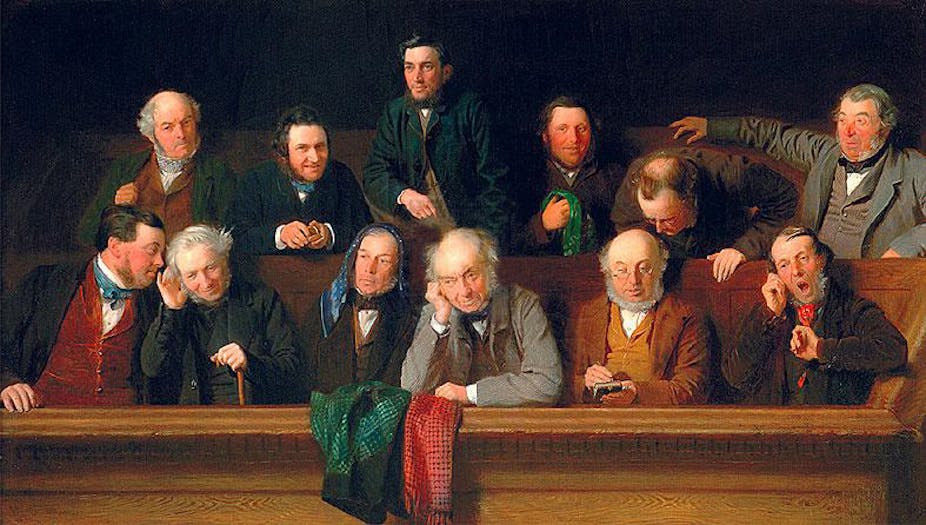
The_jury_by_john_morgan
A jury of one’s peers should assess scientific claims.

CLEARING UP THE CLIMATE DEBATE: Director of the Global Change Institute, Ove Hoegh-Guldberg submits some climate “sceptics” to peer-review and finds them wanting.

Peer review is the basis of modern scientific endeavour. It underpins research and validates findings, theories and data.

Submitting scientists' claims to peer review is a straightforward way to assess their credibility.

The Climate Commission was established by the Australian government to help build consensus around climate change.

Chief Commissioner Professor Tim Flannery handed the first major report, The Critical Decade to Julia Gillard on May 23.

Peer-reviewed by internationally respected scientists, the report summarises key evidence and conclusions regarding climate change for Australia and the world.

Rising temperatures, changing rainfall, threats to human health and agriculture, and deteriorating ecosystems are carefully documented from the scientific literature. The report makes compelling reading and a solid case for rapid action on greenhouse gases such as CO2.

But are all experts really in agreement with the Climate Commission’s report?

Enter an alternative group of experts.

Writing in Quadrant Online Bob Carter, David Evans, Stewart Franks and Bill Kininmonth stated, “The scientific advice contained within The Critical Decade is an inadequate, flawed and misleading basis on which to set national policy.”

Carter and his colleagues dispute the major findings and assert that “independent scientists are confident overall that there is no evidence of global warming” or unusual “sea-level rise”.

According to them “there is nothing unusual about the behaviour of mountain glaciers, Arctic sea ice or the Greenland or West Antarctic ice sheets.”

You would be forgiven for concluding that firm action on carbon dioxide might not be warranted if the experts can’t agree.

But is there really so much scientific dispute over the facts of climate change?

One way to resolve this is to ask a simple question. If Carter and company hold different views to those expressed in the majority of the peer-reviewed, scientific literature, then have they submitted their ideas to independent and objective peer-review?

This is a critical process that sorts opinion and rhetoric from scientific knowledge and consensus.

If the answer is “yes”, there are legitimate grounds for concern over the report’s conclusion.

If the answer is “no”, the arguments against the Climate Commission’s report fall away as unsubstantiated opinion.

The Web of Science is maintained by Thomson Reuters and covers 10,000 journals across the sciences, social sciences, arts and humanities.

You can search this database for papers by different authors within reputable, peer-reviewed journals.

I used the Web of Science to see if Carter, Evans, Franks and Kininmonth were legitimate experts in the areas in which they claim superior knowledge.

Given such strong opinions, you would expect that the four individuals would have published extensively in the peer-reviewed, scientific literature on subjects like climate change, oceanography, and atmospheric physics.

After all, if they have such strong opinions, then surely these ideas have been treated like all other valid scientific ideas?

The Climate Commission and its scientific advisory panel survive this type of scrutiny extremely well. For example, Climate Commissioner Professor Lesley Hughes has at least 39 peer-reviewed publications since 2000.

Many of these articles focus on the terrestrial ecosystems on climate change, an area for which Professor Hughes is internationally recognised.

Similar conclusions can be made for Professors Will Steffen, Matt England, David Karoly, Andrew Pitman and the others associated with the Climate Commission.

Searching for peer-reviewed articles by “R. M. Carter”, however, revealed plenty of peer-reviewed articles on unrelated topics within geology.

Only one paper turns up that could be remotely related to climate change.

This paper, however, was found to be seriously flawed by an internationally recognised group of Earth scientists.

This brings us back to zero for the number of credible papers published by Carter on climate change in the Web of Science.

Searching for articles by David Evans and William Kininmonth revealed no peer-reviewed scientific literature that tests their claim that climate change is not happening.

Lastly, searching for peer-reviewed papers from Stewart Franks yielded a number of articles (>50) on hydrology and climate variability since 2000.

None of these peer-reviewed articles presented data or tested the idea that climate change is or is not happening, or any of the other “errors” that Carter and his co-authors claim are associated with the conclusions of the Climate Commission.

The number of articles by Franks since 2000 that involve peer review of his claims that climate change is not happening is also zero.

So the number of peer-reviewed papers that adequately expose the ideas of Carter and co-authors to the scientific peer-review system on the climate change issue is 0, 0, 0 and 0.

We are left, then, with the observation that the Climate Commission’s report, peer-reviewed and assessed by scientists with appropriate expertise, is being challenged by four individuals who refer to websites and blogs and who have not had their core claims about climate change tested in the peer-reviewed scientific literature.

Don’t get me wrong, discussion is important, but on serious matter such as climate change, let us hope we listen carefully to the experts and not the unsubstantiated opinions of those that are not.

This is the fifth part of our series Clearing up the Climate Debate. To read the other instalments, follow the links below:

Join the conversation

238 Comments sorted by

Comments on this article are now closed.

  1. Andrew Glikson

    Earth and paleo-climate scientist at Australian National University

    Too true.

    Given the geological scale of climate change, namely an abrupt shift from Holocene conditions to near-Pliocene conditions (~400 ppm CO2, committed to >2 degrees C and +25+/-12 meters sea level rise), with a few exceptions the silence on the part of the Earth science community has been deafening.

    Indeed, the most prominent voices from this field have been by those who do not accept the compelling evidence from climate science and even from paleo-climate science.

    Fortunately, to compensate for this absence, the excellent research by James Hansen and his large group of paleo-climate scientists, climatologists and modellers has now filled the gap, as in: Paleoclimate Implications for Human-Made Climate Change, 2011, James E. Hansen and Makiko Sato, NASA Goddard Institute for Space Studies and Columbia University Earth Institute, New York. http://www.columbia.edu/~jeh1/mailings/2011/20110118_MilankovicPaper.pdf

    report
    1. James Szabadics

      Technical Development and R&D Manager, Plantation Timber Industry

      In reply to Ove Hoegh-Guldberg

      Hansens papers conclusion that sea level rise and ice loss is accelerating seems to be wrong. Forgive me for thinking accelerating implies that the rate of change is increasing - i.e. sea level rise is becoming faster, ice loss is speeding up.

      Hansens conclusion must be based on theoretical models rather than real world obseration of sea levels or ice data.

      Sea level rise long term remains around 3.1mm/yr. Recently though (5 years) sea level rise is only 2mm/yr which is not what you would expect…

      Read more
    1. Ove Hoegh-Guldberg

      Director, Global Change Institute at University of Queensland

      In reply to Paul Richards

      Thanks Paul - you are right, it still is difficult to grasp this fact. Perhaps even more difficult to grasp, is the fact that these people also deny fundamental laws of physics and chemistry!

      report
  2. Marc Hendrickx

    Geologist

    Ove,
    And what about the credentials of our lead climate commissioner? How many peer reviewed papers in climate science has Tim Flannery? Let's run Tim's name through the Gold standard for collecting and collating peer-reviewed scientific information,Thomson Reuters Institute for Scientific Information, and see how many times that this climate science ‘expert’ has published on climate change in the expert literature since 1956. If he were a bone fide expert then he would be listed in the ISI Web…

    Read more
    1. Ove Hoegh-Guldberg

      Director, Global Change Institute at University of Queensland

      In reply to Marc Hendrickx

      Yes, that is correct Marc. The difference between Tim Flannery and Bob Carter, however, is that Tim refers to the peer-reviewed scientific literature and Bob hardly ever does. That is the point that I make within the article - if you do not refer to the peer-reviewed literature, then it would be expected that you have tested your ideas in the peer-reviewed literature. This is not the case with Adj Prof Carter. Hence one has to conclude that his pronouncements on climate change are merely opinions and not scientifically grounded facts.

      report
    2. Marc Hendrickx

      Geologist

      In reply to Ove Hoegh-Guldberg

      Ove,
      You claim Tim refers to the peer reviewed literature. Which peer reviewed publication was he referring to when he recently made these spurious comments? Any idea?
      “There are islands in the Torres Strait that are already being evacuated and are feeling the impacts."
      http://manly-daily.whereilive.com.au/news/story/tims-grim-sea-warning/
      There are in fact no islands in the Torres Strait that are being evacuated. Another furphy from the climate commissioner. As someone who contributed to the Government's recent report will you let this mistake go uncorrected?

      I'm sure Bob Carter can speak for himself but I believe his commentary on the Climate Commission's recent report "The Critical Decade" is full to the brim with references to the peer reviewed literature. It seems you are stretching the truth on this somewhat.
      http://www.quadrant.org.au/blogs/doomed-planet/2011/05/auditing-the-critical-decade-part-ii

      report
    3. Ove Hoegh-Guldberg

      Director, Global Change Institute at University of Queensland

      In reply to Marc Hendrickx

      I guess if you look at the references to Carter's commentary - most of the references are to unreviewed blog sites and opinion pieces and rarely to the peer-reviewed science on climate change.

      As for your comments regarding Tim Flannery, all I can say is that the majority of his commentary refers back to the scientific literature. I'm sure you can cherry pick one or two examples but the fact still remains, the majority of his references go back to the scientific literature and not to opinion pieces and blog sites. The very fact that he supports and refers to the recent report from Climate Commission ( heavily referenced in the peer-reviewed literature) is testimony to the fact that his conclusions about climate change are based on the peer-reviewed scientific literature.

      report
    4. Marc Hendrickx

      Geologist

      In reply to Ove Hoegh-Guldberg

      Ove, I had a quick look at the references in Bob Carter's commentary and compared them to the references in the Climate Commissions report, and based on this I challenge your assertion that "most of the references are to unreviewed blog sites and opinion pieces".

      Here's the findings:
      The Critical Decade: Peer Reviewed papers, government data repositories and government reports 86% Other (books, websites) 14%
      Carter's commentary: Peer Reviewed papers, government data repositories and government reports…

      Read more
    5. John Brookes

      logged in via Facebook

      In reply to Marc Hendrickx

      Tim Flannery's, "Failed rainfall predictions"? You may be referring to Perth.

      We are doing just fine in Perth, so Tim must have been wrong. What's that? We built a desal plant? Our groundwater is running low? Our dams are nearly empty? Details, details, we really are doing fine.

      report
    6. Ove Hoegh-Guldberg

      Director, Global Change Institute at University of Queensland

      In reply to Marc Hendrickx

      Marc - that is not what I get.

      When you look at the list from Carter et al, they have plenty of references to the work they are criticising, but when they are referring to the support for their own ideas, it descends into blogs and non-refereed material. Look at the list from Carter et al and then look at the list from the Comission report. Night and day in terms of credibility.

      Carter et al. (after reference to the material they criticise - not the complete list as it is simply more of…

      Read more
    7. Ove Hoegh-Guldberg

      Director, Global Change Institute at University of Queensland

      In reply to John Brookes

      Indeed. I guess you are meant to ignore the science and just call it a bad decade! And the massive bleaching event which has affected Western Australian recent the first time is driving major impacts within Western Australia's iconic coral reef ecosystems? Another bit of 'climate variability'. Marc continues to ignore the experts, preferring instead to refer to worn out and inaccurate posts from non-experts such as Andrew Bolt and Jo Nova.

      report
    8. Marc Hendrickx

      Geologist

      In reply to Ove Hoegh-Guldberg

      Ove continues to just make things up, and throws some ad hom abuse in (all while the employ of the Australian Tax payer, thanks mate, glad to see my taxes in action).

      A bad decade-now he's focusing on the weather-there have been many bad decades over the course of the last 200 years.

      He ignores the main issues with his failed bleaching prediction for Ningaloo- the issue of extent and of mortality, the former was localised and the later does not appear to have eventuated to the degree he claims…

      Read more
    9. Ove Hoegh-Guldberg

      Director, Global Change Institute at University of Queensland

      In reply to Marc Hendrickx

      Where is the abuse Marc? "Marc continues to ignore the experts, preferring instead to refer to worn out and inaccurate posts from non-experts such as Andrew Bolt and Jo Nova." is merely pointing out 2 facts. You do ignore the experts and you do refer to the non-expert non sense of Bolt and Nova.

      report
    10. Ove Hoegh-Guldberg

      Director, Global Change Institute at University of Queensland

      In reply to Marc Hendrickx

      "He ignores the main issues with his failed bleaching prediction for Ningaloo". The data are being worked up now for a peer-review article. I feel sorry that you have jumped the gun here. Let's wait and see what the peer-reviewed science tells us.

      report
    11. Marc Hendrickx

      Geologist

      In reply to Ove Hoegh-Guldberg

      Hard to ignore the experts when so often their predictions, yours included, are so spectacularly wrong. How many times will you call wolf and get away with it?

      In regard to your claim that that I refer to posts by respected journalist Andrew Bolt and Science educator Joanne Nova, it would be nice if you could point out where this has occurred above. Some facts would be nice Ove.

      report
    12. Marc Hendrickx

      Geologist

      In reply to Ove Hoegh-Guldberg

      I'm sure the data are being "worked up". I hope the raw, non "worked up" data are made available for an independent audit if the study passes a review. Indeed it would be nice for tax payers to see the results of such a review process.

      Here's a challenge Ove publish the reviewer's comments of your last 10 papers online so the public can see the rigourous scrutiny your work has had to go through. Publish also the names of the reviewers so the public can see how they relate to you and your institution. Are you up to this challenge?
      I'll bet a case of Coopers pale:
      1. That a fair proportion of the reviews are soft, with little substance and depth, and
      2. that quite a number of reviews will have been done by your mates.

      Why don't you prove me wrong with some facts.

      report
    13. Ove Hoegh-Guldberg

      Director, Global Change Institute at University of Queensland

      In reply to Marc Hendrickx

      Hi Marc - given your impression that everyone else is wrong and that you're right, I look forward to reading about your ideas in the peer-reviewed literature. Till then, I enjoy the banter and look forward to hearing more about your gut feelings and opinions.

      report
    14. Ove Hoegh-Guldberg

      Director, Global Change Institute at University of Queensland

      In reply to Marc Hendrickx

      The only trouble with publishing the reviewers' comment on my last 10 papers, Marc, is that they are anonymous and hence unavailable. Why don't you write to Science (as an example) if you don't believe me?

      Let me tell you about one key feature of anonymous review: And that is, that all of the reviews of my papers have been quite hard-core and quite confronting - in cases where I've had been given a hard time, I have either lost the fight and the paper has not been published, or I have prevailed…

      Read more
    15. Ove Hoegh-Guldberg

      Director, Global Change Institute at University of Queensland

      In reply to Marc Hendrickx

      I have been thinking about your problem - and have come to the conclusion that you do not you understand the difference between weather (bleaching) and climate change (long-term loss of coral reefs). As I have pointed out many times to ideologues such as Andrew Bolt (plenty of facts here - please see my endless corrections to Andrew Bolts mythologies and misinformation - http://www.climateshifts.org/?p=6713) the accusations you repeat endlessly are flawed and senseless. Try to be a little bit more critical Marc - this sort of nonsense is really getting tiring and I'm getting to a point where I can't help you any further.

      report
    16. Marc Hendrickx

      Geologist

      In reply to Ove Hoegh-Guldberg

      Ove,
      So no facts again from Ove, just continued bluster.

      Proving soft reviews, very well...here's a copy of a letter sent to your university FOI officer this morning.

      "Under FOI/RTI legistation I seek access to the following documents:
      Comments by Reviewers and editors made on the following papers
      published by Ove Hoegh-Guldberg while in the employ of the Coral Reef
      Ecosystems Lab, School of Biological Sciences, The University of Queensland."
      (list of papers follows)

      I've kept the (anonymous…

      Read more
    17. Marc Hendrickx

      Geologist

      In reply to Ove Hoegh-Guldberg

      Guess we shall see what that study of coral core finds. Until then you should refrain on using the term "unprecedented" in regard to coral bleaching and reef extents, except of course if it is succeeded by the words "since the late 1970s".
      Ove, you should also endeavour to escape from your echo chamber. There's a world of ideas out there, why not try some mind opening curry ...http://judithcurry.com/

      report
    18. Philip Mitchell Graham

      In reply to Marc Hendrickx

      Marc, you are quite a fighter... as long as people are drawn into your endless arguments. But your arguments are irrelevant to the OP. Your vindictive hatred of anyone contradicting you, drips from every line you post. Your comments are hardly the work of an objective participant and scream political bias. You side step and spread disinformation and engineered doubt at every opportunity. In short, you are a troll.

      report
    19. Ove Hoegh-Guldberg

      Director, Global Change Institute at University of Queensland

      In reply to Marc Hendrickx

      No need to get nasty Marc. Good work on the MPhil though and sorry for not realising you had one. I will ignore your insulting remarks concerning whether not my students consider that I am the burden. No doubt if you contact them, they can tell you directly what the truth is regarding your allegation. No need for me to intervene.

      report
    20. Marc Hendrickx

      Geologist

      In reply to Ove Hoegh-Guldberg

      Ove, Your double standards are amazing.
      I've been thinking about your problem Ove, it seems that you have confused a passion for coral with a passion for science. This seems to be quite prevalent among marine biologists - must say something about the way the subject is taught.
      Ove, you'll make a much better scientist and educator when you are able to find some objectivity.

      report
    21. Marc Hendrickx

      Geologist

      In reply to Ove Hoegh-Guldberg

      I'm not getting nasty Ove I'm merely pointing out some facts. Let's again examine these. For your last 10 papers listed in The Web of Science here is your author position.
      1. Validation of Housekeeping Genes for Gene Expression Studies in Symbiodinium Exposed to Thermal and Light Stress: Last author out of 4
      2. Mesophotic coral ecosystems on the walls of Coral Sea atolls: second last author out of 7
      3. Ocean acidification and warming will lower coral reef resilience: last author out of 7
      4. Coral…

      Read more
    22. Ove Hoegh-Guldberg

      Director, Global Change Institute at University of Queensland

      In reply to Marc Hendrickx

      Marc - I am surprised that you are not aware the last author position on publications in many fields (such as marine and molecular biology) goes to the head of the laboratory or research group. This is to recognise the effort that these individuals put into the science, but also as recognition of the funding, experience, and infrastructure that invariably goes into a project. In our field, this is not insubstantial and my calculations have revealed that studies involving molecular biology or field work can often require substantial costs in terms of materials and supplies required to do the science. Obtaining that funding is not an easy task as I'm sure you know.

      Life is too short to keep justifying myself to you Marc. Despite your continual insults, my track record and the cohesion of my research group ( some of the finest young biologists in Australia) does speak for itself.

      Anyway, enough of this - I have a lab group to run, papers to write, and an institute to direct.

      report
    23. Marc Hendrickx

      Geologist

      In reply to Ove Hoegh-Guldberg

      In geology we generally take credit for our own work, and not the work of others. If there has been administrative assistance it typically gets a place in the Acknowledgements.

      report
    24. Paul Douglas Fullerton

      In reply to Marc Hendrickx

      Why is this person being allowed to pollute this discussion with his rank ignorance? Surely he, and Douglas Cotton, have plenty of other outlets for his deluded opinions, and can be asked to leave this forum to those who take the issue of global warming seriously.

      report
    25. Chris McGrath

      Senior Lecturer at University of Queensland

      In reply to Marc Hendrickx

      Marc, I'm confused. Are you still asking Ove to publish the names of anonymous reviewers? Why not ask him who killed Kennedy while you're at it. Surely he'll know the answer to that too.

      report
    26. Ove Hoegh-Guldberg

      Director, Global Change Institute at University of Queensland

      In reply to Marc Hendrickx

      Yes Chris, it is a strange request indeed.

      Anyway, on a more serious note, just wanted to say (to Marc) that the projects you outline with respect to looking for evidence of past bleaching events, and re-examining the data of De'ath et al. 2010, are two very good projects.

      A number of people have attempted the first and have been looking for so-called kill or bleaching scars. I don't know what they found any consistent evidence but I think there's some interesting stuff to be done there. And equally, several people have been interested in re-examining Glenn De'ath and Janice Lough's data ... I understand that they are quite happy about interacting with people over the re-examination and that the data are up online. You should contact them.

      Perhaps a better place to put your energies as opposed to dreaming up scenarios for how I might mistreat my students.

      report
    27. Marc Hendrickx

      Geologist

      In reply to Chris McGrath

      Chris, I don't expect Ove to provide names that he obviously has no way of accessing. However in the interests of a full and frank discussion I am interested in the reviewers comments on his work, to allow others to judge their quality.These he would have access to. I assume one of his many minions would be able to assemble them. Perhaps he could release them as part of an annual report, thereby gaining another publication credit to add to a list of papers dominated by the work of his students…

      Read more
    28. Marc Hendrickx

      Geologist

      In reply to Ove Hoegh-Guldberg

      I thought you had a lab to run, an institute to direct, papers to appropriate?

      On a more serious note, I have been in touch with Janice and Glenn, and am in the process of re-analysing some of the data, (independently of AIMS) with some interesting results that may one day (possibly later next year) be tested in the peer reviewed press. At which point if you were interested in seeing the reviewers comments I would happily pass them on.

      report
    29. Chris McGrath

      Senior Lecturer at University of Queensland

      In reply to Marc Hendrickx

      Marc, personally I don't see how publising anonymous peer reviews is that helpful in judging the value of Ove's publications. A far better gauge is to read the articles, judge their quality, and then look at whether they have been accepted by the wider scientific community and supported and cited by others in later publications.

      A good example would be to look at Ove's 1999 groundbreaking article in the aftermath of the mass coral bleaching in 1998: Hoegh-Guldberg O (1999) Climate change, coral…

      Read more
    30. John Nicol

      logged in via Facebook

      In reply to Ove Hoegh-Guldberg

      Ove Hoegh-Guldberg. The difference between Tim Flannery has nothing to do with his "per reviewed references". Any fool can do that. The differnece is that Bob Carters work on historical and meaningful variations in the world's climate formed a very large part of a life time of research work which he now reports again in a manner accessible to the general public. Flannery hides behind quotations of articles which he most probably does not undersatnd anyway. It is also a terrible indict ment of…

      Read more
    31. helen stream

      teacher

      In reply to Ove Hoegh-Guldberg

      Your thesis here is about the wonders of The Critical Decade report , and the Climate Change Commission scientists, and of peer review---and on the other hand , the lack of credibility of the scientists who disagree with you.

      The Climate Commission Report was a political publication by a politically-aligned group.

      It was full of half-truths designed to cause alarm to induce Australians to vote for Labor and its carbon tax.

      For example, in the tipping points section, the handwringing over the…

      Read more
  3. Peter Miller

    Digital Artist/Sound Designer/Composer at Scribbletronics

    So just about now we should be getting to the conspiracy theories...

    report
    1. Michael Marriott

      logged in via Twitter

      In reply to Peter Miller

      ...very true. We should expect some criticism of the peer review system and how it is broken pretty soon.

      However, I'm not sure even the the most brazen deniers will be able to wave the Wegman report around given how seriously compromised it is in order to claim the "hockey stick" is broken.

      I predict some highly selective snippets from the EAU/CRU hack (Climatefizz... I mean "Climategate").

      Steve McI is making some noise about IPCC WG3 and how "compromised" it is, not understanding the use of "grey" literature and (gasp) modelling. So I'd also expect links to Climate Audit will be posted soon.

      Or the recent "controversy" over the sun's influence. Apparently you guys have forgotten about the sun /wink

      Alternatively they'll retreat to Jo Nova/Andrew Bolt/WWUT blogs where their claims are treated seriously.

      Michael Marriott aka WtD

      report
    2. Ove Hoegh-Guldberg

      Director, Global Change Institute at University of Queensland

      In reply to Michael Marriott

      Thanks Michael - I also don't doubt that there will be the e-mails that deny the utility of a peer review system which has served us so well in every other realm of science for hundreds of years. To deny the importance of this process with respect to our understanding of the climate change and its impacts, is also to deny its role in every other field from medicine to engineering. Doesn't make a lot of sense does it?

      report
  4. Douglas Cotton

    B.Sc.(Physics), B.A.(Econ), Dip.Bus.Admin

    I'd be interested to hear your comments on the peer-reviewed items at http://epw.senate.gov/public/index.cfm?FuseAction=Minority.Blogs&ContentRecord_id=84e9e44a-802a-23ad-493a-b35d0842fed8&Issue_id= especially the one claiming that "LESS THAN HALF OF ALL PUBLISHED SCIENTISTS ENDORSE GLOBAL WARMING THEORY"

    I don't claim to be a "peer" but even my Physics major from the late 1960's gives me enough basic knowledge to recognise valid and invalid trend analysis.

    I throw open the challenge to anyone to disprove the validity of the "60 year Cycle" referred to in links from my site http://earth-climate.com because, if it is valid, then the IPCC claims relating to accelerated warming are debunked.

    report
    1. Paul Richards

      Paul Richards is a Friend of The Conversation.

      In reply to Douglas Cotton

      This is predictable.
      We are in the final throws of the debate as a country.
      One of the last on the planet and the deniers are arguing
      semantics.
      The weight of evidence has grown exponentially since
      Scott set foot on Antarctica with climate scientists to
      gather global warming data.
      An expedition funded for scientific purposes, a fact lost
      in time and similar jingoism to that shown by climate change
      deniers.

      report
    2. Ove Hoegh-Guldberg

      Director, Global Change Institute at University of Queensland

      In reply to Douglas Cotton

      The problem with the people on those so-called expert lists are that they often include people that are exactly the non-experts that I referred to in the article. Having a Ph.D. or being a professor doesn't necessarily equate you to the same expert status as those working and publishing within atmospheric physics and other related fields. In answer to your question regarding whether or not the sun is driving climate change, I refer you to the relevant scientifically peer reviewed literature (e.g. Erlykin 2009; Lockwood 2008 and many others) that reveals among other things that solar activity is decreasing yet warming is continuing. Doesn't seem to be a particularly good fit, does it?

      report
    3. Douglas Cotton

      B.Sc.(Physics), B.A.(Econ), Dip.Bus.Admin

      In reply to Ove Hoegh-Guldberg

      Firstly, my question was not whether the sun was driving climate change. The 60 year cycle in fact appears to be driven by changes in the (relative) centre of gravity of the solar system as you would have read if you followed the links in my site http://earth-climate.com . My challenge is clearly set out: show me (and the world) that the 60 year cycle does not exist in the face of cogent evidence that it does. This is a vital issue pertaining to the validity of all predictions relating to accelerated warming. And, by the way, what acceleration do you perceive since 2002?.

      report
    4. Ove Hoegh-Guldberg

      Director, Global Change Institute at University of Queensland

      In reply to Douglas Cotton

      All ideas worth consideration. To fly however, they need to be published in the peer-reviewed scientific literature. Until then, they are just that, ideas without broad scientific validity.

      report
    5. Douglas Cotton

      B.Sc.(Physics), B.A.(Econ), Dip.Bus.Admin

      In reply to Ove Hoegh-Guldberg

      Correction: The 60 year cycle is blatantly obvious in the temperature data. Take the trouble to read this article and study the plots. Compare them with any other data you have! Let others too form their own opinions about this. (I draw a parallel: in the medical field it took "peers" 20 years to agree on penicillin and the effect of cholesterol - so millions of lives were lost as a result.) http://www.appinsys.com/globalwarming/SixtyYearCycle.htm

      report
    6. Ove Hoegh-Guldberg

      Director, Global Change Institute at University of Queensland

      In reply to Douglas Cotton

      I think you have proved my point with these two examples which where the debate was conducted through the peer-reviewed scientific (medical) literature. Look at the papers on penicillin and cholesterol going back to the beginning - - both involved debate in the peer-reviewed scientific literature, not in blogs or newspapers, or on the basis of unqualified opinion.

      report
    7. Michael J. I. Brown

      ARC Future Fellow and Senior Lecturer at Monash University

      In reply to Douglas Cotton

      Douglas Cotton has been pushing his 60-year cycle nonsense throughout the climate change discussions. He displays all the traits of a crank. In particular, he believes he has found a very obvious 60-year cycle in the activity of the Sun that has been completely missed by tens of thousands of astronomers (both professional and amateur). Rather than reflecting on why this may be so, he puts his "theory" onto the net. He also reinforces the key point of the article, that blogs are no substitute for careful science that has undergone peer review.

      report
    8. Douglas Cotton

      B.Sc.(Physics), B.A.(Econ), Dip.Bus.Admin

      In reply to Ove Hoegh-Guldberg

      As you still do not appear to have read the linked item, below is a quote regarding Journal of Atmospheric and Solar-Terrestrial Physics (2010), doi:10.1016/j.jastp.2010.04.015 ...

      Nicola Scafetta has identified the change in the location of the center of mass of the solar system (CMSS) as a possible mechanism driving the 60-year cycle. (Scafetta, N., “Empirical evidence for a celestial origin of the climate oscillations and its implications”, Journal of Atmospheric and Solar-Terrestrial Physics…

      Read more
    9. Ove Hoegh-Guldberg

      Director, Global Change Institute at University of Queensland

      In reply to Douglas Cotton

      Put it through the peer-review system and get t published in a reputable scientific journal, and I look forward to reading it. Given that I am not a planetary physicist (hence unable to judge the veracity of the idea), I will have to wait patiently until that day!

      report
    10. Douglas Cotton

      B.Sc.(Physics), B.A.(Econ), Dip.Bus.Admin

      In reply to Ove Hoegh-Guldberg

      Regarding the medical issues - and natural medicine issues (in which I have done post-graduate studies back in my 50's) - my point is that there were unnecessary delays in "peers" eventually coming to agreement - when the evidence was there from the initial research. I quote from http://lef.org ...

      "In 1929, Dr. Alexander Fleming’s discovery of penicillin was published in the British Journal of Experimental Pathology. Yet well into the 1940s, humans were still dying of bacterial infections that…

      Read more
    11. Douglas Cotton

      B.Sc.(Physics), B.A.(Econ), Dip.Bus.Admin

      In reply to Ove Hoegh-Guldberg

      Put what through the peer-review system? I'm not the author of the paper I referred you to - Nicola Scafetta is. I presume the "Journal of Atmospheric and Solar-Terrestrial Physics" did some checks before publishing her paper. Nor have I written any of the articles linked from my site. My site itself is hardly original content - but I'm gratified by the hit rate of nearly 200 a day.

      report
    12. Michael J. I. Brown

      ARC Future Fellow and Senior Lecturer at Monash University

      In reply to Michael J. I. Brown

      OK.

      So the paper is by Nicola Scafetta, a climate skeptic, who contributes to Heartland Institute reports. He shows that there are quasi-period oscillations in the distance between the Sun and the Centre of Mass of the Solar System. He also states there is a similar quasi-periodic oscillation in the temperature data. He then matches the two sets of data together, assuming a 5-year lag.

      I would put this in the plotting stuff against other stuff category of papers (and to be fair, he does state…

      Read more
    13. John Mashey

      Semi-retired computer scientist/corporate executive

      In reply to Douglas Cotton

      Taking Rhodes Fairbridge-cycles fan Scafetta seriously is not a plus for credibility, unless you think a PhD automagically confers correctness, I guess he might be more credible than Viscount Monckton, although I'd have to think about+ it a while.
      Here is his webpage:
      http://www.fel.duke.edu/~scafetta/

      Note that 10 years post-PhD, he is an Assistant Adjunct Professor,
      Active Cavity Radiometer Irradiance Monitor (ACRIM lab)
      & Department of Anesthesiology

      and his Nov 2010 CV is:
      http://www.fel

      Read more
    14. Douglas Cotton

      B.Sc.(Physics), B.A.(Econ), Dip.Bus.Admin

      In reply to Michael J. I. Brown

      OK John and Michael - if you want to judge reports on such personal criteria that's your prerogative.

      Have a go at this (green) polynomial fit - degree = 5, number of data points used = 240, Coeff of determination R squared = 0.498589

      http://earth-climate.com/62yearcycle.jpg

      We haven't got to the 11-year maximum in 2012 yet, so why have temperatures peaked around 2002 - 2003 = predicted maximum in 62 year cycle?

      Source: http://climate4you.com/GlobalTemperatures.htm#Recent land surface temperature

      report
    15. John Brookes

      logged in via Facebook

      In reply to Douglas Cotton

      Hey Doug, you know you can ask Tamino - I'm sure he'll put you right!

      report
    16. Douglas Cotton

      B.Sc.(Physics), B.A.(Econ), Dip.Bus.Admin

      In reply to John Mashey

      Yes - sorry about that. (I have a sister "Nicola")

      It has nothing to do with Monckton though and, having now studied Nicola's papers in detail and watched his video, I am all the more convinced that he is correct about the 60 (or 62) year cycle and, therfore, that the IPCC has made very profound errors in applying linear trends to cyclical data. Doesn't it make sense to anyone that gravity from the planets affects the oceans - well established in 60 year cycles in ocean currents, levels of fish…

      Read more
    17. Douglas Cotton

      B.Sc.(Physics), B.A.(Econ), Dip.Bus.Admin

      In reply to George Crisp

      George - I read your references but they have not adequately addressed the issue of the validity of the 60 (or 62) year cycle. The three extracts below warrant careful scutiny because this IS ground-breaking stuff. But firstly, let me point out we have a problem for GH exponents in that the temperature was slightly lower in the 12 months ending yesterday than in the 12 months ending 31 Dec 2003. See http://earth-climate.com/2003-2011.jpg

      This levelling out (actually a decline below the long-term…

      Read more
    18. Paul Douglas Fullerton

      In reply to Douglas Cotton

      Well perhaps you have a credible explanation as to why the Global Annual Mean Surface Air Temperature (published by NASA) in 2000 was about 0.65C higher than around 1940 and 1.0C higher than 1880?

      Even if your 62-year cycle is a factor in global climate there is obviously something much, much more significant happening now. And while you are at it, can you explain why those global temperatures are increasing for every successive peak in the 11-year solar cycle as well?

      I wonder if it could be greenhouse gas emissions which have been increasing steadily over that time period? Just a thought!

      report
    19. John Nicol

      logged in via Facebook

      In reply to Ove Hoegh-Guldberg

      Ove, if you were a serious participant in this debate, I don't believe you would be looking for or needing "peer" review. These items from Douglas Cotton are substantiated else where. If you do not understand the physics, the diagrams, the results, well enough to make a judgement for your self, but need to be "told by a peer reviewer" that the paper meets the publications standards - may not be correct mind you, but meets the "standards" - then it may be that you could get some help from Douglas…

      Read more
    20. John Nicol

      logged in via Facebook

      In reply to John Mashey

      This person's career has nothing to do with his capacity to do research in his area of interest. Einstein was a patents officer when he developed special relativity and many of the greatest developments came from workers in similar circumstances. Quoting peoples jobs, qualifications or their "peer reviewed climate publications" is often used to disguise the fact that the person criticising them is unable to understand the science presented. Such is the case in yours and Ove's comments I believe. Have either of you read the work of Fairbridge, another person who followed his interests beyond his original qualification, (somewhat like Isaac Newton perhaps!) and the papers by Nicola Scaffeta. Probably not. Let us know when you do and what you understand from them. Douglas, if you would like to exchange some ideas with a physicist, I am at
      jonicol18@bigpond.com

      report
    21. Eclipse Now

      Manager of design firm

      In reply to Douglas Cotton

      It's bizarre that you say there's been no increase in temperatures from 2003 and 2010. 2005 was the hottest year on the instrumental record equalled only by 2010. What is it... 15 of the last 15 years are in the top 15 hottest years on record — our 150 years of instrumental records?

      How on EARTH do you come up with a regular 60 year cycle of temperatures (moving through gravity from the planets to our oceans to our climate) when the last decade has been the hottest in 150 years of instrumental records…

      Read more
    22. Eclipse Now

      Manager of design firm

      In reply to Douglas Cotton

      Douglas, any time you disagree with peer-reviewed journals rebutting your wide-of-the-mark opinions, you just repeat... "I read your references but they have not adequately addressed the issue". I'm suspecting this is your mantra when confronted by the peer-review process. It's the automatic reply. Then simply reassert your original opinion, and hope the lay readers like myself are baffled by the bull.

      report
    23. Eclipse Now

      Manager of design firm

      In reply to Douglas Cotton

      ///And, to keep on the topic of this section, let me just add that IMHO there is often a risk that ground-breaking research in any scientific field will be clamped upon by the weight of contrary peer pressure with vested interests in former theories. Many a newcomer must have been discouraged to the point of giving up. It's happened many times in history I'm sure - more than we will ever hear of. ///

      But the whole point of peer-review is not weight of opinion but the weight of the data and facts. The truth will out. So don't pretend despair, that's just a conspiracy theorist's guise to appeal to underdog status they don't deserve.

      report
    24. Eclipse Now

      Manager of design firm

      In reply to John Nicol

      Einstein's theories were proven to be correct by the weight of experimentation and data in the peer-reviewed process, over time. You are trying to portray a variety of anti-science up there with the "Earth is Flat" or the "Moon Landing was faked" mobs. You're trying to generate sympathy where none is warranted, to suck in some lay readers browsing on the net and confuse the audience. Fortunately, the objective peer-reviewed process is only swayed by the sheer weight of evidence, not gut feelings, opinions, or hysterical conspiracy theory rants on some blog!

      report
    25. Eclipse Now

      Manager of design firm

      In reply to Douglas Cotton

      //OK John and Michael - if you want to judge reports on such personal criteria that's your prerogative.//
      After what Michael just wrote about the physics of causation V the probabilities of correlation, you write this? Wow. I'm done ever listening to you again. You're a crank.

      report
    26. Eclipse Now

      Manager of design firm

      In reply to Douglas Cotton

      //We haven't got to the 11-year maximum in 2012 yet, so why have temperatures peaked around 2002 - 2003 = predicted maximum in 62 year cycle? //
      (Hint: Try reading NOAH and NASA now and then. It'll blow your mind that you're wrong about when temperatures peaked. I'm betting temperatures go UP from here, after 2005 and 2010 were the hottest on record! So you are arguing from faulty data to begin with!)

      report
    27. John Nicol

      logged in via Facebook

      In reply to Eclipse Now

      I don' usually reply to comments from people who aren't prepared to provide their name. The physics of CO2 to which you refer is not about refracting but absorbing and the only spectroscopy of any note done in Laboratories on CO2 has been done by people other than "climatologists" but by chemists and physicists who have shown the its properties are such that increases will NOT cause the increases in temperature claimed by the IPCC.

      The reason for the fact that the couple of years in the last ten…

      Read more
    28. John Nicol

      logged in via Facebook

      In reply to Eclipse Now

      The per review process in the field of climate change is very limited and refers mainly to 1. The results from models which are compared but which never agree as canbe seen clearly fromreading the IPCC reports - tmeprature estimatees for doubling CO2 range from 1 to 5 degrees even after the so-called "implausible" models have been eliminated because they are the ones which showed that the effect of increased CO2 is to cause cooling because of increased radiation in the wings of the spectral lines…

      Read more
    29. John Nicol

      logged in via Facebook

      In reply to Michael J. I. Brown

      I think you do need to put peer review and the references/citations given in the IPCC report into perspective. Most (99.99%) of papers cited are of an environmental nature discussing what will happen if. A very small number quote Hansen, Callendar and others who simply speculate on the effects of carbon dioxide but are unable to provide any of the fundamental and necessary science behind the spectral characteristics and analysis of collisions, radiation etc in any quantitative fashion. In short…

      Read more
    30. John Nicol

      logged in via Facebook

      In reply to Michael J. I. Brown

      Yes I agree with you totally and this is the very reaso why I am a climate skeptic. There is no paper which delves into the spectroscopic characteristics of carbon dioxide and shows that it can cause the warming cliamed and which is based purely on the correlation between 1979 qnd 1998 when both CO2 and T were increasing. The tempoerature also increased in a similar fashion from 1860 to 1880 and from 1920 to 1945 without the corresponding increas in CO2. Svensmark's work shows solar changes relate very closely indeed to the temperature over many more years than the 19 which the IPCC rests its case upon, apart from some "experiments" with dubious models. Jon Nicol

      report
    31. Eclipse Now

      Manager of design firm

      In reply to John Nicol

      //the medeaval warm period was much warmer than now//
      Anyone who quotes MWP conspiracy theories has immediately lost all credibility. Even Dr Karl's podcast has totally debunked the MWP hype. And no, you don't get to try and tarnish the well established physics of the Radiative Forcing Equation because some imaginary "chemists and physicists" have shown it not to be so WITHOUT quoting peer-reviewed papers in a thread all about the peer-review process. Go shout your 'opinions' somewhere else; this thread is about how scientists practice science.

      report
    32. Eclipse Now

      Manager of design firm

      In reply to John Nicol

      These pages summarise some of the peer reviewed papers and provide ample links to the peer-reviewed findings — IF the real science interests you. My guess is it doesn't. You've quoted 3 of the top myths in your opening salvo; my guess is you'll just rinse and repeat the same behaviour and then duck out when it becomes too obvious.

      //While the Medieval Warm Period saw unusually warm temperatures in some regions, globally the planet was cooler than current conditions. //
      http://www.skepticalscience

      Read more
    33. John Nicol

      logged in via Facebook

      In reply to Eclipse Now

      It is very rude to engage in the conversation withoout identifying your self and to quote skepticl science as a credible source further demonstrates that you do not have any real interest in science or the peer review process. John Nicol jonicol18@bigpond.com

      report
    34. Michael J. I. Brown

      ARC Future Fellow and Senior Lecturer at Monash University

      In reply to John Nicol

      A good reference for this discussion is "Surface Temperature Reconstructions for the Last 2,000 Years", which provides an overview of temperature reconstructions (circa 2006).

      This book is online at http://books.nap.edu/openbook.php?record_id=11676&page=R1 and the executive summary shows temperature reconstructions using a variety of methods. This report indicates that the MWP was not warmer than the present day.

      report
    35. John Nicol

      logged in via Facebook

      In reply to Michael J. I. Brown

      Sure the temperature shown for some of the proxies and the instrumental record go higher than those for the MWP but reading the discussion on the errors and noting that in fact that:
      1. other proxies in fact show lower T than the MWP
      and 2. The known fact that some historic sites exposed in the earlier centuries lie buried, it is vey debatable one way and another. The main thing is that there is nothing exceptional about recent temperatures and that the MWP was certainly NOT the result of anthropogenic carbon doioxide. What do you think might have caused it to be warm then?
      John Nicol

      report
  5. Andrew Glikson

    Earth and paleo-climate scientist at Australian National University

    Essential points to adhere to in the scientific discipline include:

    1. Direct empiirical observations in nature.
    2. The use of verfied measurements and databases reported by major science organizations (NASA/GISS, Colorado NSIDC, Potsdam, Hadley-Met, Tyndall, CSIRO, BOM, the list goes on).
    3. Adherence to the basic laws of physics and chemistry.
    4. Publications and debates within, and references to, the peer-reviewed literature.

    In my debates since 2005 with those who do not accept the scientific…

    Read more
    1. Ove Hoegh-Guldberg

      Director, Global Change Institute at University of Queensland

      In reply to Andrew Glikson

      Thanks Andrew. What is sad about the current state of affairs is that unqualified experts appear to be given the same weight in the media as the very best and relevant scientific minds in our country. This is despite the fact that there is a massive scientific consensus in our expert communities. A recent survey estimated that over 97% of climate scientists had concluded that climate change is occurring and is of significant threat to the prosperity of our country. Not only this, but our peak scientific body,Australian Academy of Science, as as well as the leaders of our major scientific organisations (from CSIRO to our universities) have all come out with statements of support for the science and concern about the implications. You would think that this would compel us into action, wouldn't you?

      report
    2. Michael Marriott

      logged in via Twitter

      In reply to Andrew Glikson

      We know the "balanced" approach of journalism has been gamed.

      But if I may make an observation - and this is of course purely anecdotal - in my conversations with friends, acquaintances, the public etc. I've noted the confusion over "who" is an expert and people's willingness to hear both sides.

      Folk wisdom rules, dictating that there must be "two sides" to every story. Therefore in the interest of "fairness" many will attempt to listen to both sides.

      Indeed, I've had this conversation at least…

      Read more
    3. Ove Hoegh-Guldberg

      Director, Global Change Institute at University of Queensland

      In reply to Michael Marriott

      You are right. Communication is central and that we need to be conscious of how people are perceiving science and its outputs. This issue really relates to almost every scientific endeavour - as the world has become more complex, there has been an increasing challenge in getting across the central messages. This has left the public susceptible to individuals who (for whatever reason) choose to masquerade as leading experts on areas of concern from GM to climate science.

      report
    4. John Brookes

      logged in via Facebook

      In reply to Ove Hoegh-Guldberg

      What will ultimately sway public opinion is weather itself. A few more extreme weather events and everyone will decide for themselves.

      report
    5. Peter Miller

      Digital Artist/Sound Designer/Composer at Scribbletronics

      In reply to Ove Hoegh-Guldberg

      Rather more unfortunately, if we're entering the initial stages of a chaotic disruption, by the time we start seeing enough extreme weather events to convince most people that there's something wrong, it may also be too late to effect any countermeasures.

      report
    6. John Nicol

      logged in via Facebook

      In reply to Ove Hoegh-Guldberg

      Ove, who counted these "97%" of scientists. Perhaps 97 % of biologists and perhaps 97% of geopgraphers. But certainly NOT 97% of Physicists, hydrologists, geologists, chemists, meteorologists....., all of whoim have a lot of expertise in studying the matters which count in determining whether or not carbon dioxide cancause the claimed warming. I am wondering if you could send me one reference to a definitive peer reviewed paper which analyses the important characteristics of carbon dioxide ans shows how it goes about causing an enhanced green house effect. Just one will do but if you know of others please add them to the list. I am referring to the physics of CO2 - not speculation based on its properties to absorb IR which everyone acknowledges, but which does not lead to the EGHE.
      John Nicol jonicol!8@bigpond.com

      report
    7. John Nicol

      logged in via Facebook

      In reply to Michael Marriott

      Carter et al. could well speak on some of these topics - the moon landing involved geology and some physics - very little climate. But Carter has spent 40 years studying past climates, as has Plimer while Evans spent about twenty five years both modeling the atmosphere and measuring the temperatures at various heights in the atmosphere - as di several other groups around the world. The knowledge and experience these people leant in that twenty five years with CSIRO made them skeptical of the old Arrhenius hypothesis used as the basis for the claims made by the IPCC.

      report
    1. Ove Hoegh-Guldberg

      Director, Global Change Institute at University of Queensland

      In reply to keith may

      But, how many are active in research and how many have published on the topic of climate change within the peer-reviewed scientific literature? Try and search using the Thompson-Reuters Web of Science. You will find very few have. All very well to have a Ph.D. or to be called Professor, but it is another thing to have your ideas/scientific arguments properly vetted through the scientific peer review process. Have a look at those lists? How they stack up against the world's scientific academies…

      Read more
    2. keith may

      Mr

      In reply to Ove Hoegh-Guldberg

      yes, but that 97% is only 76 of 79 (those who listed climate science as their area of expertise and who also have published more than 50% of their recent peer-reviewed papers on the subject of climate change). By contrast the report I referenced had over 1000 scientists behind it to disagree with the findings of the IPCC. From a quick look through the report it looks like a mix of people from applied sciences and the core sciences (Maths, Physics) are well represented; plus quite a few climate scientists…

      Read more
    3. John Mashey

      Semi-retired computer scientist/corporate executive

      In reply to keith may

      In the real world, if 99 of as 100 cardiologists tell you your mother needs a bypass operations, but a 1000 brain surgeons say she doesn't, who do you believe? I assume you'd believe the brain surgeons, because after all, they're doctors. Likewise, (physicist) Fred Singer wrote not to worry about secondhand smoke, but he's a PhD, so must be right, along with the various others who front for thinktanks saying the same thing. Is that right? Does his opinion count as much as medical researchers…

      Read more
    4. John Nicol

      logged in via Facebook

      In reply to Ove Hoegh-Guldberg

      Ove in relation to these comments, I am wondering if you could both accept my earlier request for a refernce to apeer reviewed papaer on the physics of carbon dioxide in the atmosphere which demonstrates its capacity to do as you would claim. More importantly on your comment above, could you please send me a detailed description of what you know of the physics of carbon dioxide and its spectroscopic characteristics.
      John Nicol jonicol18@bigpond.com

      report
  6. Michael J. Biercuk

    Senior Lecturer in the School of Physics at University of Sydney

    Dear Ove,

    It's interesting (and painful) to watch these debates online. I'd like to get your take on a more general issue:

    There has been broad discussion about the media providing "equity" to opposing viewpoints in a manner that gives false/unwarranted credibility to nonexperts posing as experts because they have some unrelated qualification or yell sufficiently loudly.

    Do you see this as specific to climate change due to the complexity and economic significance of the scientific issues, or do you think it's part of a broader trend associated with a proliferation of media outlets? If it's the latter, how can science and peer review stand-up in the face of an avalanche of blogs that in the public mind are just as credible as PRL, Nature, or your-favorite-climate-journal? This seems bound to continue in other domains...

    report
    1. Ove Hoegh-Guldberg

      Director, Global Change Institute at University of Queensland

      In reply to Michael J. Biercuk

      Thanks Michael. I would tend to agree with you that the proliferation of 'soapboxes' for opinions to be broadcast from has lead to some difficult issues with respect to public understanding of what is a legitimate expert opinion versus quackery. In this confusing situation, maintaining scientific standards and review has become more rather than less important in my opinion. It has also become very important that we help educate people as to the role of peer reviewed journals and how they function to provide some level of scientific standard and process.

      report
  7. Justin Peter

    Dr

    What should be laid bare once and for all in this country, is that all criticism of the conventional science is based on conspiracy theories.

    While most of the so-called sceptics will begin their rant with superficially plausible scientific critiques, once challenged it generally takes only three ripostes before they have to resort to a conspiracy theory.

    As this article shows, the fall back to conspiracy theories is necessary- since the weight of scientific literature, expert opinion and text…

    Read more
  8. Andrew Glikson

    Earth and paleo-climate scientist at Australian National University

    There is a world of difference between legitimate scientific debates, or any debates, and between, for example:

    1. A non-expert trying to interfere with the navigation of a jet plane under severe weather conditions
    2. A non-expert trying to interfere with open heart surgery by qualified surgeons.
    3. A non-expert telling the medical profession smoking does not cause cancer
    4. A non-expert telling scientists ozone depletion is "safe"
    4. A non-expert trying to convince poliitical institutions that the emission of >330 billion tons of carbon into the atmosphere is "safe", ignoring the laws of physics and chemistry of the atmosphere, iignoring basic text books of climatology and trying to contradict direct and measured observations of climate change made by qualified scientists with many years experience in the field.

    In each of these examples lives are in stake.

    report
    1. keith may

      Mr

      In reply to Andrew Glikson

      See http://hockeyschtick.blogspot.com/2011/06/dr-svensmark-comments-on-warmist-paper.html quoting Dr. Henrik Svensmark "I have had a fast look at the paper, and as far as I can see the authors are only looking at solar irradiance changes, and effects like the one that I have been involved in, like an amplification of the solar signal caused by clouds and cosmic ray modulation, is not taken into account. We known with good confidence that the terrestrial response to the solar signal is 3-7 times…

      Read more
    2. Andrew Glikson

      Earth and paleo-climate scientist at Australian National University

      In reply to keith may

      The solar effect has, continues to be, inensely studied, as for example in "Scientists Uncover Solar Cycle, Stratosphere, and Ocean Connections August 27, 2009"
      http://www2.ucar.edu/news/851/scientists-uncover-solar-cycle-stratosphere-and-ocean-connections.

      Cosmic radiation has been oscillating consistent with the 11 years solar cycle over the last century. Its effect on cloud nucleation is real. However, water vapor levels and cloudiness are low over polar regions, yet these are the latitudes which…

      Read more
    3. keith may

      Mr

      In reply to Andrew Glikson

      I accept the Law, I just don't agree with the confidence with which the Law is being applied to an area which is still being researched and understood. For instance http://www.sciencedirect.com/science/article/pii/S1364682610001495

      As the Dr states, we will find out soon enough how these two cycles pan out; which I why I think its particularly important both sides of the debate put their heads together - neither side has perfect knowledge and if anybody is thinking otherwise that is to deny their own limitations of information awareness.

      Based on my experiences in both the academic and commercial fields, academia has just as much a problem with information awareness as any other professional body. Its an uphill struggle, but people need to work together to get over it.

      report
    4. Tim Burrows

      logged in via Twitter

      In reply to keith may

      If you are uncertain as to the confidence level, you primarily have a risk management problem, not a technical problem. That's because, in this instance, there is a time-phased aspect. If the AGW theory is correct, we can't afford to wait for further validation before some response must be implemented.
      To my way of thinking, this leads to the conclusion that we should start to implement mitigation strategies while we concurrently refine the science. Of course there will be some level of cost associated…

      Read more
    1. Paul Richards

      Paul Richards is a Friend of The Conversation.

      In reply to Douglas Cotton

      Mr Cotton,
      many possible patterns have been suggested, but only the 11 and 22 year cycles are clear in the long term observations.

      I am not a climate scientist but that information is available and simple enough for K6-7 children to understand.

      The real contention is whether there is breathing space granted by a solar minima event like the Dalton Minimum.

      My concern is any time gained by a solar minima event, could be wasted and not used intelligently.

      report
    2. Douglas Cotton

      B.Sc.(Physics), B.A.(Econ), Dip.Bus.Admin

      In reply to Paul Richards

      http://earth-climate.com/62yearcycle.jpg We haven't got to the 11-year maximum in 2012 yet, so why have temperatures peaked around 2002 - 2003 = predicted maximum in 62 year cycle? Source: http://climate4you.com/GlobalTemperatures.htm#Recent land surface temperature

      "Among them, large climate oscillations with peak-to-trough amplitude of about 0.1 oC and 0.25 oC, and periods of about 20 and 60 years, respectively,"
      Published source: http://arxiv.org/PS_cache/arxiv/pdf/1005/1005.4639v1.pdf

      report
    3. Douglas Cotton

      B.Sc.(Physics), B.A.(Econ), Dip.Bus.Admin

      In reply to Paul Richards

      Obviously the gravitational pull of the Sun and planets will have some effect on the oceans, even though nowhere near the effect of the moon on tides. In the published paper "Empirical evidence for a celestial origin of the climate oscillations and its implications" Nicola Scafetta argues ...

      " ...climate models referenced by the IPCC cannot explain the warming occurred since 1970 with any known natural mechanism. Therefore, several scientists have concluded that this warming has been caused by…

      Read more
  9. Michael. Clayton

    logged in via Facebook

    Can anyone explain why the earth has been cooling for the past several years. Also what will be the effect of the lack of sun spot activity and no sun spot activity for several years, which is expected. Would this not lead to more cooling? I think the radicals are having a field day with so called global warming.

    report
    1. Douglas Cotton

      B.Sc.(Physics), B.A.(Econ), Dip.Bus.Admin

      In reply to Michael. Clayton

      Andrew - See plot of cooling after 2002 and probable reasons at the end of http://earth-climate.com but don't expect others here to agree (LOL)

      report
  10. Andrew Glikson

    Earth and paleo-climate scientist at Australian National University

    It appears to be a popular thing for "sceptics" to ignore responses and repeat questions ad-infinitum.

    As in my earlier reply:

    The graph at http://www.skepticalscience.com/graphics.php?g=21 indicates that under Maunder Minimum conditions and a sustained carbon emission regime mean global temperatures would be ONLY ABOUT 0.2 DEGREES CELSIUS lower than otherwise.

    As compared with 2.3 degrees C to which the climate is committed already, currently mitigated by about the -1.1 degrees Celsius effect…

    Read more
    1. Douglas Cotton

      B.Sc.(Physics), B.A.(Econ), Dip.Bus.Admin

      In reply to Andrew Glikson

      Andrew wrote ...

      "Hence the Sun cannot be the dominant source of this latest temperature increase," I totally agree.

      " manmade greenhouse gases being the likely dominant
      alternative." I totally disagree ...

      ... and suggest the 62-year cycle explains the rise AND the the slight decline since 2002 (which GH can't explain) -

      See http://earth-climate.com/cooling.jpg and a detailed discussion at http://earth-climate.com

      report
  11. Hamish Johnston

    logged in via Facebook

    Although I agree with the main premise of this article, I don't think Lesley Hughes is a very good example of an climate-change expert. As far as I can tell, her field of expertise is "the effects of climate change", and I don't think she is an atmospheric physicist with expertise in the mechanisms driving climate change.

    As such, I think a sceptic would be right to question her authority on the fundamentals of climate change.

    Indeed, if I were a conspiracy theorist (I'm not) I might say that Prof Hughes has a vested interest in climate change because her research grants depend upon its existence!

    I would rewrite this article citing a bona fide atmospheric physicist as a credible expert. James Hansen perhaps, or the Aussie equivalent?

    report
    1. Roger Jones

      Professorial Research Fellow at Victoria University

      In reply to Hamish Johnston

      Ove picked Lesley Hughes because she is a member of the Climate Commission. Their task is to communicate a wide range of climate issues. Lesley covers impacts and is a good communicator. The technical group supporting the commission has a wide range of skills that go beyond, but include atmospheric physics. Any questions or issue can be referred to an expert who has the core skills in that area.

      And since when does legitimate scientific interest represent vested interest? No-one familiar with the Australian research grants system would think of it as a gravy-making facility. Lesley works on climate change because it is such a serious issue. She would much rather work in straight ecology because it is so interesting - but instead she works on what she views to be most important.

      report
    2. Ove Hoegh-Guldberg

      Director, Global Change Institute at University of Queensland

      In reply to Roger Jones

      Thank you Roger. That is exactly why I selected Professor Hughes. This is not only about the atmospheric physics of climate change but also about its impacts and ramifications. She also has a reputation for rigour when it comes to science, pointing towards the peer-reviewed literature on subjects outside her immediate expertise.

      report
    3. Hamish Johnston

      logged in via Facebook

      In reply to Roger Jones

      Roger, is it possible that you are being a bit too misty-eyed about the altruism of scientists? After all they do tend to be ambitious people with careers to build and bills to pay.

      The public understands that scientists, like everyone else, can sometimes act in their own self-interest. Yet most scientists deny that their work is affected by this most basic human trait. Perhaps that is why there is a great deal of mistrust towards scientists?

      report
    4. Ove Hoegh-Guldberg

      Director, Global Change Institute at University of Queensland

      In reply to Hamish Johnston

      No system is perfect - but no system is not acceptable. The safety comes from the thousands of scientists and hundreds of reputable institutes are focused on the one set of climate problems. This means that competition invariably drives in the opposite direction - that of constant challenges to leading ideas which fall eventually if they're not robust. And you have to ask - this process works with all the other sciences, why would it not work with the climate science community? The truth is that it does work with the climate science community just like any other science community.

      report
    5. Roger Jones

      Professorial Research Fellow at Victoria University

      In reply to Hamish Johnston

      Hamish,

      I can speak about Lesley's motivations because we've discussed this - she would prefer to work on population ecology in an ideal world.

      But as a general rule, money is lower down on the scale of things that motivates scientists in general. Once people are making a living they are prtty satisfied. Ten climate scientists had this discussion over dinner about a month ago. A big motivator within that group is solving problems - the satisfaction when ideas click into place after a great deal…

      Read more
  12. John Brookes

    logged in via Facebook

    I think about peer review as a group of people trying to understand something. If one of them has an idea, they explain it to the group, and everyone thinks about it, trying to find anything wrong with it. If everyone agrees, then the idea is added the groups body of knowledge, and becomes a building block for further exploration.

    You can understand how annoying it would be for members of this group if outsiders started up with lots of silly criticisms, especially because their motivation is not a search for the truth, but is ideological in origin.

    report
    1. Ove Hoegh-Guldberg

      Director, Global Change Institute at University of Queensland

      In reply to John Brookes

      Thank you John. A fair comment, John. The additional frustration is also felt by people who spend many decades studying the phenomenon, becoming the best in their field, only to be rated by the media as equal to someone who is an armchair specialist with no qualifications or experience. No wonder we see ire from specialists when it comes to this issue.

      report
  13. Andrew Glikson

    Earth and paleo-climate scientist at Australian National University

    The peer review process proceeds as follows:

    1. The author/s submit a paper to a scientific journal.
    2. The editor chooses 2 or 3 reviewers who are known/published spciealists in the particular discipline.
    3. The reviewers send their reports to the editor.
    4. Normally the paper is either subject to minor revision, major revision or rejection.
    5. The paper is re-submitted.
    6. Commonly the paper is then subjected to adjudication by a specialist in the field.

    Not all papers get published and not all published papers present valid conclusions, but if the published paper includes serious errors it becomes a subject to critical comments and discussion letters by other scientists.

    A slightly more rigorous procedure than internet opinions?

    Cotton may like to try the procedure with the proposed 60 years solar cycle.

    report
    1. Marc Hendrickx

      Geologist

      In reply to Andrew Glikson

      That's the ideal, however it's quite different in the real world Andrew, and you of all people should know better.

      report
    2. Marc Hendrickx

      Geologist

      In reply to Ove Hoegh-Guldberg

      Ove, Yes, as a matter of fact I do know of a better system. It's currently being used by the journal "The Cryosphere". Here's the blurb...http://www.the-cryosphere.net/
      "The Cryosphere has an innovative two-stage publication process which involves a scientific discussion forum and exploits the full potential of the Internet to:

      foster scientific discussion;
      enhance the effectiveness and transparency of scientific quality assurance;
      enable rapid publication;
      make scientific publications freely accessible…

      Read more
    3. Ove Hoegh-Guldberg

      Director, Global Change Institute at University of Queensland

      In reply to Marc Hendrickx

      No skeletons in the closet Marc. Just a problem with divulging anonymous review on the Internet. And I'm not sure I could dig them up - why don't you go and ask the journals to see if they will release this information?

      report
  14. Douglas Cotton

    B.Sc.(Physics), B.A.(Econ), Dip.Bus.Admin

    I probably wouldn't be alive today if I had waited for "peer reviewed" published papers about natural medicine supplementation in particular. For example, I have been taking high dose vitamin E for about 35 years now. I lower my homocysteine with trimethylglycine (plus folic acid and vitamins B6 & B12) to reduce risk of heart disease, stroke and cancer. I slow the aging process by raising my body's natural antioxidant superoxidedismutase with SODzyme and taking resveratrol and several other high…

    Read more
    1. Michael Pollard

      logged in via Facebook

      In reply to Douglas Cotton

      An N of 1! Yep, that is clearly a superior approach to ordinary science, Mr Cotton.

      report
    2. Douglas Cotton

      B.Sc.(Physics), B.A.(Econ), Dip.Bus.Admin

      In reply to Michael Pollard

      On the contrary, most of the thousands of research papers in natural medicine involve huge samples - but most (probably 99% of) results do not get acceptance from the medical profession. Spend some time visiting http://lef.org

      And, back on the subject of global warming etc this plot (up to yesterday - and quite accurate enough with satellite measurements) shows no warming at sea surface since 2002. (Compare June 2010 to June 2011 with all of 2003.) So how does that sit with peer reviewed GH advocates who still believe the IPCC predictions? There are reasons for the levelling off but you'll only find them in ground breaking research - just as in Natural Medicine. Check this chart and let me know what the consensus of peer reviewed published papers are saying about it and, most importantly, how they are explaining it - if they've noticed http://earth-climate.com/2003-2011.jpg

      report
  15. John Coochey

    Mr

    I have a few simple problems, one Tim Flannery has said that if all human activity ceases it would take a thousand years to bring down the world temperatures, I understand his degree is in palaentology specialising in kangaroos, however Andy Pitman (a geographer I understand) says it would take twenty to thirty years so which is right? Furthermore we are told that sea levels can be read within milimetres but I used to work for the RAN Hydrographer (Commodore John Leech at the time) and was told by…

    Read more
  16. Lorna Jarrett

    PhD candidate at University of Sydney

    To quote something said to me recently: "Your problem is you're arguing from the facts - this is all about emotions".

    I think a lot of suitably-qualified and well-meaning scientists are behaving exactly like scientists and expecting people to be rational. In the meantime, the vast majority of people, who don't understand even the basic science, are taking sides based on their emotional and political views - and aligning themselves with whatever "scientific experts" they find to agree with.

    I wonder…

    Read more
    1. John Nicol

      logged in via Facebook

      In reply to Lorna Jarrett

      Lorna, I am sorry but the finer points of the science ARE important. The problem we are in is because the climatologists have NOT argued these finer points which is to do with whether of not CO2 can cause climate change. I have explained in other comments on this thread why I believe it isn't able to do that. No one else appears to be explaining why they believe it is. You have said that yiu have observed the effects of global warming. Could you give some examples and tell us why this warming MUST be from carbon dioxide increases in the atmosphere? Other comments are rally irrelevant since we are about to turn our economy upside down because CO2 is said to be the cause. If the arctic ice is melting for some other reason than that, then I do not think it is enssible to ruin Australia's standard of living. Good luck with your PhD anyway.

      report
  17. Jackie Wolf Heinl

    Soil Scientist

    Although not a researcher, I am a field scientist and the effects of global warming are available for anyone to see. Those that do not see it chose not to.

    report
    1. John Nicol

      logged in via Facebook

      In reply to Jackie Wolf Heinl

      John Brookes, That is only after the paper is published. The peer review itself is done by a couple of very busy but dedicated people who really only check if the paper is reasonable, has correctly referenced a small sample of the refernces given, and appears to meet the aims of the journal as far as the topic is concerned. If the peer review process "verified" the correctness of the paper, there would be no need for any more science done any more on that topic as far as was covered there. This is obviously NOT the case and peer review does not guarantee quality. Subsequent discussion in the whole scientific community does that or condemns it to be damned!

      report
    2. John Nicol

      logged in via Facebook

      In reply to Jackie Wolf Heinl

      John Brookes, That is only after the paper is published. The peer review itself is done by a couple of very busy but dedicated people who really only check if the paper is reasonable, has correctly referenced a small sample of the refernces given, and appears to meet the aims of the journal as far as the topic is concerned. If the peer review process "verified" the correctness of the paper, there would be no need for any more science done any more on that topic as far as was covered there. This is obviously NOT the case and peer review does not guarantee quality. Subsequent discussion in the whole scientific community does that or condemns it to be damned!

      report
  18. John Coochey

    Mr

    What happened to my earlier comment? Too hot to handle? I have not received any communication from this sight

    report
    1. Nathan Stewart

      Mr

      In reply to John Coochey

      Choose one of the following options John:

      1. There is a global conspiracy to trick us all into believing that humans are causing global warming

      or

      All the worlds best scientific organisations with research projects that have cost hundreds of millions, if not billions of dollars launching satellites, submarines, missions to antartica etc all have dodgy instruments? If we can collide single atoms together and simulate the milliseconds after the big bang i think we man kind can accurately measure sea level rises to the millimetre. Here in the South West of Australia the sea level has been rising over 8mm per year for the last 20 years. Water expands when it gets warmer, and the water around here is getting a lot warmer unfortunately.

      report
  19. Willis Eschenbach

    logged in via email @taunovobay.com

    Two comments. First, as the Director of a Climate Change Institute, you have a huge vested interest in the hypothesis of AGW being shown to be correct. If the science is wrong, you're out of work. So you are hardly the disinterested observer of science that you would like us to believe.

    So for you to say that you are not affiliated with 'any company or organisation that would benefit from this article" is a child's fairy-tale. Your organization benefits directly from your claims in this article…

    Read more
    1. Justin Peter

      Dr

      In reply to Willis Eschenbach

      As usual, the deniers are showing their true colours. It is entertaining to read the conspiracy theories though. Anyone with thoughts on the vast conspiracy by climate scientists to take over the world?

      It was a cunning plan. Step 1: spend ten years at university studying maths and physics and obtain PhD. Step 2: cue deniers/conspiracy theorists...

      report
    2. John McLean

      logged in via email @connexus.net.au

      In reply to Justin Peter

      I don't see the word "conspiracy" anywhere in the posting by Eschenbach. Can you please identify it.

      report
    3. Ove Hoegh-Guldberg

      Director, Global Change Institute at University of Queensland

      In reply to Willis Eschenbach

      A 'small correction' Willis. I am director of the Global Change Institute. Quite a different organisation to the one you have claimed I am director of. Our organisation is focused on trying to understand and strategically respond (for Australia's benefit) to the big changes that are occurring in our world, be they industrial, environmental or political.Naturally, it takes on board issues such as climate change, population and technology revolution. If you are saying that I am ethically or criminally compromised, please put that in writing so I can respond appropriately.

      report
  20. John McLean

    logged in via email @connexus.net.au

    I am deeply saddened by this article, in particular that an Australian academic has sunk so low.

    The single sentence extract from the response by the four authors was the first sentence of a summary. The remainder of the same paragraph read

    "The report is emotive and tendentious throughout, ignores sound scientific criticism of IPCC shibboleths that has been made previously, and is shotgun in its approach and at the same time selective in its use of evidence. The arguments presented depend heavily…

    Read more
    1. Ove Hoegh-Guldberg

      Director, Global Change Institute at University of Queensland

      In reply to John McLean

      Hi John (McLean). The peer-reviewed system is a tough one. I estimate that only one in every four manuscripts that I submit them to get published. But it is a good system for vetting science as you know from the comments you received in response to your article. Do you have a perspective on why your response was not published (apart from evoking conspiracy theory)? If so, let's hear them.

      report
    2. John McLean

      logged in via email @connexus.net.au

      In reply to Ove Hoegh-Guldberg

      Ove, aren't you going to tell us whether you do actually give a damn about whether peer review, and editor's decisions associated with it, are accurate and in accordance with the journal's documented regulations?.

      report
    3. John McLean

      logged in via email @connexus.net.au

      In reply to Ove Hoegh-Guldberg

      Stop evading the question.

      I don't give a stuff about any reputation of the journal, and you will notice that I did not ask you any question about the journal's reputation.

      I asked whether you do actually give a damn about whether peer review, and editor's decisions associated with it, are accurate and in accordance with the journal's documented regulations.

      Why won't you answer?

      report
    4. Ove Hoegh-Guldberg

      Director, Global Change Institute at University of Queensland

      In reply to John McLean

      No question being evaded. I have been flunked more times than I can remember for papers that were not good enough to survive peer-review and be published. Heart-breaking but this didn't lead me to say 'its all a big conspiracy to push one agenda over another'. Or to claim, in the words Nick Minchin, the climate science is "a Communist plot to deindustrialise the world." Rather it meant that I strove to do better the next time I submitted a paper for peer review.

      Again - the journal you submitted to has an excellent reputation as does the research team that found your publication flawed. End of story. The holes in your paper are fairly obvious - sorry to be so blunt but that is a fact of life. You did not survive the acid test of science - that is to survive critical analysis of your colleagues and other scientists.

      Sad but true.

      report
  21. Mike Martin

    Mr

    A point that seems to have escaped both climate scientists writing for the popular media and climate denialists is that the heat-trapping property of carbon dioxide is indisputable. It was first demonstrated by British physicist John Tyndall in 1861 and can be readily shown today by a simple experiment.

    Thus as CO2 concentration rises in the atmosphere, we would expect global temperature to rise. If CO2 is not a major cause of temperature rise - either because the rise is primarily caused by something…

    Read more
    1. Ove Hoegh-Guldberg

      Director, Global Change Institute at University of Queensland

      In reply to Mike Martin

      You point out a very important observation Mike. I wonder how much longer it will take ( and what it will take) for us to understand the implications of not responding to this planetary imperative. Perhaps it is important to point out the obvious here and that is we don't have another 50 years to vacillate on this important issue.

      report
  22. Douglas Cotton

    B.Sc.(Physics), B.A.(Econ), Dip.Bus.Admin

    Who's my expert? Well here are four out of a thousand (1,000) or so ...

    “Please remain calm: The Earth will heal itself -- Climate is beyond our power to control...Earth doesn't care about governments or their legislation. You can't find much actual global warming in present-day weather observations. Climate change is a matter of geologic time, something that the earth routinely does on its own without asking anyone's permission or explaining itself.” -- Nobel Prize-Winning Stanford University…

    Read more
  23. Douglas Cotton

    B.Sc.(Physics), B.A.(Econ), Dip.Bus.Admin

    It is obvious that the debate on climate change is dividing the scientific community. According to the article linked at the foot hereof the number of scientists now expressing dissent regarding man-made global warming is over 1,000 and climbing rapidly in the last two years when people are starting to notice that temperatures are actually falling since 2002. (There is now a statistically significant breakout from the IPCC projected trend between 2000 and 2011 -See my site http://earth-climate

    Read more
    1. Tim Burrows

      logged in via Twitter

      In reply to Douglas Cotton

      Hasn't this already been covered, that it's not enough to just be "a scientist" or have a PhD?
      What percentage of this list are actively publishing in the recent relevant peer-reviewed literature?

      report
    2. Abigail Arletto

      In reply to Douglas Cotton

      And here 1000 "scientists" dissent from Darwin: http://www.canadafreepress.com/index.php/article/22722

      Your point being what exactly? There is not a scientific body of national or international standing, that has maintained a dissenting opinion when it comes to AGW.

      The 1000 'dissenting scientists' thing is being hyperboled ad nauseam at nutjob denialist websites like CFACT, where AGW is a "socialist communist climate agenda" invented by al Gore and all the usual nonsense.

      Try this one: http://www.carbonbrief.org/blog/2011/04/900-papers-supporting-climate-scepticism-exxon-links

      http://www.carbonbrief.org/blog/2011/04/900-papers-supporting-climate-scepticism-exxon-links

      report
    3. John Nicol

      logged in via Facebook

      In reply to Ove Hoegh-Guldberg

      A more important qualification than "publishing in the climate literature" is to be able to understand the basic physics and spectroscopy of carbon dioxide in the atmospphere, the radiation and absorption processes and the transfer of heat and radiation in absorbing gases, the effects of convection and the radiation which is exclusive to green house gases in the upper troposphere and stratosphere. NB O2 and N2 cannot radiate heat from gases at temperatures as low as those in the atmosphere. If…

      Read more
  24. John Coochey

    Mr

    I note Gavin Fialkowski responded to only one of my points regarding sea level rises. He claims to have measured this in South West Australia I believe, why is that sea level rise different from anywhere else in the world. Perhaps he can tell me what techniques were used and who manufactured the equipment. Remember I was in the game to! I know the make of my car and my computer so when you use something you normally know who made it. There are immense difficulties measuring sea level especially withoud tidal datum and I would like to know where he got his from. From I quick glance at comments the other points that I raised have not been answered but I note a discussion of peer review with not mention of Climategate and its attempt to redefine what peer review is.

    report
    1. Nathan Stewart

      Mr

      In reply to John Coochey

      The Bureau of Meteorology recorded the sea level rises. Sea levels are different in different areas because warmer water expands, and we are getting very warm water over here, in fact i believe we are one of the worst affected areas for climate change - we are rapidly losing our rainfall unfortunately.

      See link http://news.bbc.co.uk/2/mobile/asia-pacific/8349760.stm

      report
    2. Nathan Stewart

      Mr

      In reply to Ove Hoegh-Guldberg

      You have to admire their pluckiness Ove. They write as if they expect someone as educated as yourself may actually be seduced by ideas that dont actually explain how it works (I.e. how does the jupiter's gravitational pull generate ebbs and flows of heat???? supposedly in a 60 yr cycle).

      If anyone wants to show empirical evidence of sea levels rising check out this link and be sure to take a look at the data for Hillarys http://www.bom.gov.au/oceanography/projects/abslmp/data/monthly.shtml
      The squiggly line is definitely on an upwards trend.

      Great article by the way Ove, very informative. Glad you took the time to write it, hope you arent getting too much abusive mail.

      report
  25. John McLean

    logged in via email @connexus.net.au

    (I am attempting to comment on this article but the site is such a mess that I can't be sure whether I am.)

    Ove, the UK Commons is currently undertaking an Inquiry into peer review. At least 2 respondents on 8 June said that "peer review is the worst possible method apart from all others". I wonder why.

    Let me illustrate my concern about the peer review system ...

    You have authored papers that claim that the atmosphere is warming the oceans and is killing coral, right?

    Please either
    (a) describe…

    Read more
    1. Chris McGrath

      Senior Lecturer at University of Queensland

      In reply to John McLean

      John, your Quandrant online article was a good example of how publishing rubbish can damage the reputation of a journal. Thanks, I now know that I never need to look at it again.

      The only bit that was interesting was your initial quote from Vaclav Klaus about “Today’s debate about global warming is essentially a debate about freedom". It puts you firmly in the camp of being ideologically opposed to climate science simply because you don't like the solution (government regulation). A common thread of people who remain opposed to climate science despite all of the evidence as Naomi Oreskes discussed in "Merchants of Doubt".

      report
    2. John McLean

      logged in via email @connexus.net.au

      In reply to Chris McGrath

      So where's Ove's explanation of the physics by which the atmosphere supposedly warms the ocean - or for that matter yours?

      And why have you posted this non-response in place of Ove?

      I'm rapidly growing tired of Ove's evasions.

      report
    3. Chris McGrath

      Senior Lecturer at University of Queensland

      In reply to John McLean

      Hi again John, as I have pointed out in a separate thread where you raised this issue:

      RealClimate has a post that should show you that your idea is wrong. It's title is apt: 'Why greenhouse gases heat the ocean': http://www.realclimate.org/index.php/archives/2006/09/why-greenhouse-gases-heat-the-ocean/ (Hat-tip Rob Painting)

      The physics of what's happening (and why your idea that the atmosphere cannot heat the ocean is wrong) is explained in detail in a four part series, 'Does Back-Radiation…

      Read more
    4. John Nicol

      logged in via Facebook

      In reply to Chris McGrath

      Chris McGrath, I can also clearly see that your comments put you firmly in the camp of someone who believes in climate change just because a few people at NASA and HADCRU claim that the globe is warming - which it is and a few hundred computer modelers say the cause is carbon dioxide because they get wraming when they add an input of heat which they assume is from CO2. Can you point me to a paper, preferably a review article in say Phys. Rev. just one, which clearly shows from first princilles that increased carbon dioxide could cause additional global warming. There are many good peer reviewed physics papers which show it can't. So be a devil, produce one which says it can!

      report
  26. Kip Hansen

    Retired IT Professional, Humanitarian Missionary

    Another purely rhetorical attack on 'non-believers'. First, Director of the Global Change Institute, Professor Ove Hoegh-Guldberg, (who according to the disclaimer at the top left doesn't have any conflict of interest except that his very job depends on the hype surrounding the global warming scare) says we must judge scientists, and their published opinions, solely on the numbers of peer-reviewed articles they have published. In the ACGW corner, his best shot is professor Lesley Hughes who has…

    Read more
    1. Chris McGrath

      Senior Lecturer at University of Queensland

      In reply to Kip Hansen

      Kip, if you behave like a child people will treat you like one so stop the comments like "cause I say so. Na-na-na-naaaa-na!"

      Ove's article wasn't criticising "non-believers" (a tag that climate sceptics/deniers like to attach to themselves to suggest that climate science is a religion rather than based on evidence and reason). He was criticising people who do not base their arguments on evidence or submit their ideas to a rigorous checking and validation process (that is what peer review boils down to). Obviously, he is only advancing one argument in this article and he doesn't need to go into climate science in detail. There are other articles in this series in The Conversation that deal with climate science. You are welcome to join in the conversation about them in their comment threads.

      report
    2. John McLean

      logged in via email @connexus.net.au

      In reply to Chris McGrath

      I've been asking for several years and never recieved a decent answer, but I'm foolish enough to try again.

      Where exactly is this empirical evidence that man-made emissions of CO2 have a significant and dangerous influence on temperature?

      Don't insult my intelligence by citing the IPCC advocacy, nor any claptrap based on models that the IPCC admits are flawed. I also know for a fact the that CSIRO has been requested to provide this evidence and failed; David Karoly has been asked to and failed; Will Steffen has been asked to and failed.

      If you have that evidence then present it in detail. If not, then cease what one would conclude are the tactics of a snake-oil salesman - promising that somethign is true when it's not.

      report
    3. Nathan Stewart

      Mr

      In reply to John McLean

      Hi John, here is one piece of evidence that points to man made global warming - it appears global temperatures have never accelerated this quickly in the last million years or so
      "As the Earth moved out of ice ages over the past million years, the global temperature rose a total of 4 to 7 degrees Celsius over about 5,000 years. In the past century alone, the temperature has climbed 0.7 degrees Celsius, roughly ten times faster than the average rate of ice-age-recovery warming."

      From NASA website - http://earthobservatory.nasa.gov/Features/GlobalWarming/page3.php

      I'd be interested to know your thoughts on this data.

      report
    4. Ove Hoegh-Guldberg

      Director, Global Change Institute at University of Queensland

      In reply to John McLean

      John.

      You keep on asking this incessant question as if I am the person who should answer the question for you. My whole point in this article is that you need to go to the expert literature - the integrated collective opinion. To refer to anything else is to simply ludicrous.

      It is not about me, or you, that is important here. It is the collective process and judgement that allows us to consider the complex facts and analysis that is needed to be able to judge whether climate change is a problem…

      Read more
    5. Chris McGrath

      Senior Lecturer at University of Queensland

      In reply to John McLean

      John, have a wonder around the Skeptical Science website. It has plenty of good, simple summaries that will help you understand the basic physics involved in the greenhouse effect and the role this plays in warming the atmosphere and the oceans. See, for example, http://www.skepticalscience.com/does-greenhouse-effect-exist.htm

      You might also find David Archer (2007) "Global Warming: Understanding the Forecast", Blackwell Publishing, helpful in this regard.

      report
    6. John McLean

      logged in via email @connexus.net.au

      In reply to Nathan Stewart

      You've obviously forgotten your basic statistics about what data can be merged and what it's accuracy is. The temperature datasets - all three - draw on data that is very inconsistent in its medium, precision and coverage, then distorted by manual processing.

      If you believe it's accurate then I feel sorry for you.

      report
    7. John McLean

      logged in via email @connexus.net.au

      In reply to Ove Hoegh-Guldberg

      You didn't bother to read my comment, did you?

      I said "Don't insult my intelligence by citing the IPCC advocacy, nor any claptrap based on models that the IPCC admits are flawed."

      IPCC 4AR WGI chapter 9, the pivotal chapter of the entire report, contains no credible evidence whatsoever. It's merely climate modellers' fantasies, undermined by comments in chapters 2 and 8 about model accuracy.

      See also "Prejudiced authors, prejudiced findings" at http://scienceandpublicpolicy.org/images/stories/papers/originals/McLean_IPCC_bias.pdf

      Now Ove, you so called evidence is junk. Do you have any other evidence?

      report
    8. John McLean

      logged in via email @connexus.net.au

      In reply to Chris McGrath

      I wouldn't waste my time on the rubbish at skeptical science. It distorts sceptics comments and sets up strawman arguments.

      Do you rely on such rubbish in the School of Geography, Planning and Environmental management? If so, I feel very sorry for your brainwashed students.

      report
    9. Kip Hansen

      Retired IT Professional, Humanitarian Missionary

      In reply to Chris McGrath

      Professor McGrath: I'm surprised that you can't see the point of my post. Hoegh-Guldberg sets the logical case that we must listen only to those who have published peer-reviewed work. He then knocks his ideological opponents (for he has not brought up any points of science) for their lack thereof, except that with his own research, he finds that Stewart has more papers than his proponents - which, by his own logic, means we should take his opinions more seriously. Hoegh-Guldberg then 'throws…

      Read more
    10. Nathan Stewart

      Mr

      In reply to John McLean

      So basically you just think that NASA has published false information, and that paleoclimatololgy is just some kind of voodoo? You cant just dismiss a whole scientific discipline out of hand. Well, good luck trying to convince Ove he is wrong, i highly doubt you have even put the slightest bit of doubt in his head. In fact, reading through all these comments and doing my own research to contribute has made me even more certain than ever that humans are causing global warming.

      report
    11. Chris McGrath

      Senior Lecturer at University of Queensland

      In reply to John McLean

      John, there seems to be nothing that satisfies you. Skeptical Science is a great website with lots of links to the peer reviewed literature. If you think the whole scientific community is in some enormous conspiracy then there is nothing that I or anyone else can say to allay your paranoia.

      report
    12. Chris McGrath

      Senior Lecturer at University of Queensland

      In reply to Kip Hansen

      Kip, I don't follow your reasoning. Ove made the point about Stewart Franks that "The number of articles by Franks since 2000 that involve peer review of his claims that climate change is not happening is also." It is not simply the number of articles published but whether they were on relevant topics that supported the claims being made in their attack on the Climate Commission's report. I thought that was clear and there was no logical falacy. I think you are mistaken in your argument.

      report
    13. Chris McGrath

      Senior Lecturer at University of Queensland

      In reply to Chris McGrath

      I lost a word in the quote in my last comment. It should have been, ""The number of articles by Franks since 2000 that involve peer review of his claims that climate change is not happening is also zero."

      report
    14. Kip Hansen

      Retired IT Professional, Humanitarian Missionary

      In reply to Chris McGrath

      Typo correction: '......(he doesn't tell us how many peer-reviewed papers more than 50 Stewart published) are +++not+++ on the overreaching issue of 'climate change is not happening',......

      Professor McGrath: The criticism of Stewart Franks et al to the Climate Commission's report is based precisely on the point of 'climate variability', which is Stewart's area of study and the is the climate science specialty on which he publishes, thus his score may not logically be dismissed as 'zero' as…

      Read more
    15. Chris McGrath

      Senior Lecturer at University of Queensland

      In reply to Kip Hansen

      Hi Kip, I have been following the ClimateGate non-event. It hasn't changed our basic understanding of how the atmosphere works or the data on rising CO2 and rising temperatures. Lindzen's latest paper was rejected because it wasn't worth publishing. Happy for you to tell me how wrong I am - I'm sure you are going to anyway.

      BTW, I'm not a professor.

      report
    16. Kip Hansen

      Retired IT Professional, Humanitarian Missionary

      In reply to Chris McGrath

      Must be the differences in educational systems -- I see that you are more correctly identified as a 'Senior Lecturer (Environmental Regulation), The University of Queensland 2010 '. I guess Senior lecturers are not referred to as 'professor' in Australia.

      You are absolutely right -- ClimateGate did not change any of the facts about the climate -- it only changed the world's understanding on how a small team of climate scientists was warping what got published and what went into the IPCC reports…

      Read more
    17. John McLean

      logged in via email @connexus.net.au

      In reply to Nathan Stewart

      I thought this was an academic web site. It can't be if I have to explain that temperature measurements by proxy come with a host of assumptions and so to does the observational temperature record since 1850, both rarely displayed with any indication of error margins. Further, the observational temperature record is a mess of inconsistencies and ignores several fundamentals of statistics (different data sources, variable precision, very different amounts of data etc) and it's ultimate base, the mean daily temperature is nothing more than a pseudo-mean because it's the mid point between the minimum and maximum temperature, both highly suscpetible to variations in cloud cover.

      The HadCRUT, GISS and NCDC temperature records apparently need to come with an explicit warning about their accuracy because academics are blind to how inaccurate the data really are.

      report
    18. John McLean

      logged in via email @connexus.net.au

      In reply to Chris McGrath

      It's not paranoia Chris, it's the blatant misrepresentation in Skeptical Science and it's the blind faith in flawed climate models that I see from the rest of your alarmists.

      By the way, I am still awaiting your explanation of how the atmosphere can warm the ocean. You leapt to Ove's defence, despite him writing the papers to which I referred and he's still evading the question. Where's your explanation of the physics that accounts for it?

      report
    19. Chris McGrath

      Senior Lecturer at University of Queensland

      In reply to John McLean

      John, your analysis (though not you personally) seems plainly bonkers to me but you insist on pursuing it regardless.

      You list yourself as a 'PhD student'. I'd counsel against putting your analysis in your thesis if you ever want to be awarded your degree. It's a matter for you though of course.

      report
    20. Chris McGrath

      Senior Lecturer at University of Queensland

      In reply to John McLean

      John, I realise now why you are so touchy about Skeptical Science.

      You understandably don't like their post criticising your prediction that "it is likely that 2011 will be the coolest year since 1956 or even earlier" at http://www.skepticalscience.com/mclean-exaggerating-natural-cycles.html

      I wasn't aware of the post before.

      I noticed that you didn't make any comments on that site to defend your position or explain why their criticisms were wrong. I wondered why?

      report
    21. John Nicol

      logged in via Facebook

      In reply to Chris McGrath

      Chris McGrath, I went to visit Climate Skeptics for about three weeks, to see if I could get into a thread which did indeed discuss science. As soon as I raised my head above the parapet and mentioned some scientific facts about carbon dioxide, its spectroscopy and possible behaviours in the atmosphere from an experienced gas spectroscopists point of view, I was virtually told not to show my face on the web site again - not by John Cook whose site it is, and who I believe is a gentleman and quite…

      Read more
    22. John Nicol

      logged in via Facebook

      In reply to Ove Hoegh-Guldberg

      Ove, as you will see in another comment I have made, neither the IPCC nor Climate Commission report of Will Steffen (who turned the IPCC's 95% probability into 100%!) give references to significant papers demonstrating that CO2 increases will add to global warming. Sure they quote the 116 year old hypothesis of Svante Arrhenius which has not yet got past being an hypothesis, and Callendar - actually Will Steffen quoted only the biography of Callendar written by a non scientist, which I don't think…

      Read more
  27. Andrew Glikson

    Earth and paleo-climate scientist at Australian National University

    Is there any amount of information which would potentially convince those who promote open ended carbon emission into the atmosphere of the growing danger?

    If so can they specify what further evidence they need?

    Do these people accept:

    1. The basic laws of physics (black body radiation according to the Planck and Steffan-Bolzman laws).

    2. The large databases of instrumentally measured climate parameters (CO2, CH4, aerosols, water vapor, temprature of air and water, ice melt rates, glacier…

    Read more
    1. John McLean

      logged in via email @connexus.net.au

      In reply to Andrew Glikson

      It's no wonder that scientist have to demand respect; they sure don't earn it. You fail to present one piece of evidence, just a grab-bag of comments.

      I don't deny global warming happens sometimes. You are the one who has to prove that it is substantially caused by human activity and like your fellow travellers you seem to have no empirical evidence that doesn't have a very plausible natural cause.

      report
    2. Nathan Stewart

      Mr

      In reply to John McLean

      What would the smoking gun be in your eyes, what evidence would they need to show? because within a few minutes looking up reputable organisations websites like nasa, csiro etc i manage to find mountains of it.

      Please tell me what it is you would need to see to satisfy your doubt, and who knows, maybe ill be able to find it for you.

      I personally think this data is pretty compelling and i do hope you have a look and respond.
      http://earthobservatory.nasa.gov/Features/GlobalWarming/page3.php

      What are the odds that the fastest ever recorded exit from an ice age in the last million years has occurred in the last 100 years when human carbon output and deforestation have increased the CO2 levels in the atmosphere by something like 40%???

      report
    3. John McLean

      logged in via email @connexus.net.au

      In reply to Nathan Stewart

      You continue to amaze me with your nonsense. Whatever your field of specialisation it doesn't appear to be statistics,..

      Do you really that it's okay to join proxy temperature measures and the observational record together on the one graph?

      Do you really think that the precision of either of these should be in thousandths of a degree as the graph would have us believe?

      2. I

      report
    4. John McLean

      logged in via email @connexus.net.au

      In reply to Nathan Stewart

      I forgot to mention, Vostok ice cores give a very different temperature record to GISP ice cores, and I've been told that GISP and GISP2 are also different despite being located relatively close to each other. (Personally I've not confirmed that there is a difference between GISP and GISP2 but will try to when I get time.)

      How do you account for this lack of consistency if you think that ice core temperature proxies are accurate and reliable? Which one is accurate, if any?

      report
    5. James Anderson

      In reply to John McLean

      John McLean.

      It fascinates me to see your responses on this page to scientific understanding, and to scientists themselves, when you are apparently a PhD student.

      I'm curious about how you managed to attain this status, because in none of the institutions where I have worked would someone with your lack of understanding of science, or indeed with your attitude to science, be even remotely considered to have the appropriate intellectual skills to complete a research degree.

      I suspect that your response will be to decry the Establishment's intolerance of 'skeptics'. Even so I am still interested in what you are studying, and I'd be especially interested to know what your Department head would say if he realized how colored your notions of science are by the pseudoscience of AGW deniers.

      report
    6. John Nicol

      logged in via Facebook

      In reply to Andrew Glikson

      Andrew Glikson, I am sorry to correct you but the two examples you quoted are just why the physics does not show that additional green house gases will cause increased global warming. To quote Plancl's law as an arbiter is actually a bit bizarre since th efull blackbody spectrum is hardly uner scrutiny. The main argument which physicists and chemists, (IR spectroscopists) base their objection to the claims, your claims, is that the accuratespectroscopy as presented by Prof. Jack Barrett, Chenmist…

      Read more
    7. John Nicol

      logged in via Facebook

      In reply to Andrew Glikson

      Andrew Glikson, I am sorry to correct you but the two examples you quoted are just why the physics does not show that additional green house gases will cause increased global warming. To quote Plancl's law as an arbiter is actually a bit bizarre since th efull blackbody spectrum is hardly uner scrutiny. The main argument which physicists and chemists, (IR spectroscopists) base their objection to the claims, your claims, is that the accuratespectroscopy as presented by Prof. Jack Barrett, Chenmist…

      Read more
  28. Scott Jones

    Director

    Very informative series of articles Ove.

    I was hoping you and others could comment on the following article by Dr Patrick Michaels.

    http://www.menzieshouse.com.au/2011/06/peer-review-and-pal-review-in-climate-science-.html

    I know he is a prominent climate skeptic with no experience whatsoever in climate research (and works for the Cato Institute). I am also aware that anything published by the libertarian site Menzies House borders on the deranged.

    Just curious to know what he is banging on about with this "double blind" peer review (or lack of it) and whether there is any substance to it.

    report
    1. Kip Hansen

      Retired IT Professional, Humanitarian Missionary

      In reply to Scott Jones

      Mr. Jones: Ask a chemist how peer review works at his favorite chemical science journal. What he will explain to you is 'double-blind peer-review'. You don't know who it is that is reviewing your paper, and the reviewer doesn't know whose paper he is reviewing. The reviewer has to base his review only on what is in the paper and in the support evidence/data, That way, he is not over- or under-awed by the famous (or infamous) reputation of the author is the paper under consideration. Neither…

      Read more
    2. Scott Jones

      Director

      In reply to Kip Hansen

      Ooops! My mistake. Apologies to Dr Michaels for downplaying his credentials.

      You haven't really answered my question though Kip. I understand what "double blind" peer review is. I was more interested in the claims in the article that this type of review is no longer the norm when it comes to climate science.

      He seems to be inferring that some climate scientists are having a tough time getting their work published in scientific journals because of this so-called "pal review" system.

      report
  29. Kip Hansen

    Retired IT Professional, Humanitarian Missionary

    Does anyone else feel a sense of deja-vu in this blog? Any of you in here ever try to correct some little point regarding climate science, global warming, or even the biographies of living climate scientists (at least even slightly skeptical ones) on Wikipedia when William Connolley and his cronies were acting as both members of the RealClimate.org Team and (illegal and strictly forbidden) Gatekeepers of All Things Climatic on Wikipedia? My exchanges here with the author of this piece and his…

    Read more
  30. Walter Starck

    logged in via Facebook

    Ove,
    Several points:
    1. You dismiss any credibility of Carter et al. without ever addressing the evidence they offer. This is decidedly unscientific.

    2. You expend some effort to show they have not published any peer reviewed papers which show that climate change is not happening. This is both meaningless and misleading. It is meaningless in that any student at Logic 101 level could advise you that proof of a negative is not possible. It is also misleading in that they have never claimed that no…

    Read more
    1. Chris McGrath

      Senior Lecturer at University of Queensland

      In reply to Walter Starck

      Walter, you make a good point that "science is determined by reason and evidence". It's a pity that your 6th point contradicts this approach. "Reason and evidence" is exactly what the mainstream climate science community is using to form the view that anthropogenic climate change is real and a major threat to humanity.

      report
    2. Timothy Curtin

      Economic adviser

      In reply to Chris McGrath

      Chris McGrath said '"Reason and evidence" is exactly what the mainstream climate science community is using to form the view that anthropogenic climate change is real and a major threat to humanity.'
      Well, that would be nice, and would that t’were so. But is it? I have previously shown here (at the essay by David Karoly) that the chapter of which he was Lead Review Editor (AR4, WG1, Ch. 9) which set out to show that “anthropogenic” climate change is real and a major threat to humanity failed…

      Read more
    3. Ove Hoegh-Guldberg

      Director, Global Change Institute at University of Queensland

      In reply to Walter Starck

      Thanks Walter. A few quick responses:

      YOU: 1. You dismiss any credibility of Carter et al. without ever addressing the evidence they offer. This is decidedly unscientific.

      This is exactly my point. There are two ways for Bob Carter to have his ideas taken seriously.

      Firstly, if he were an atmospheric physicist with a bonus side peer-reviewed science record of publishing within this area, then I would be willing to listen to his input on these parts of the climate change issue. But as you see…

      Read more
    4. John Nicol

      logged in via Facebook

      In reply to Ove Hoegh-Guldberg

      Ove, it seems that besides whatever else your qualifications might be, that you must surely also be an atmospheric physicist with peer reviewd publications. There is more than one way to skin a cat, and Bob Carrter's speciality, happens to be in the area of analysing results from geological cores which present previous climates and associated densitiesof atmospheric gases. Among the many relationships shown are that the density of CO2 in the atmosphere has never correlated with global temperature…

      Read more
    5. John Nicol

      logged in via Facebook

      In reply to Chris McGrath

      I am sorry, but the most solid abuse in the discussion appears to come from those trying to provide arguments on material which they do not understand and there are equal levels of impolite and unnecessary rudeness from bioth sides. You mention the Physics and Chemistry and the discarding of ALL of the scientific evidence as in:

      "An important "litmus test" of the "sceptics" is that many of them::
      1. Do not refer to the peer reviewed literature
      2. Attempt to discard ALL, not just a part, of…

      Read more
  31. John Coochey

    Mr

    I note that Gavin seems to rely on press articles for his information but where did they get it from. As he asserts there has been local warming, even if he is right about sea level it proves nothing in itself. I note he does not comment on other matters I raise and of course as always I wonder how many cars in his driveway and if he is in a frequent fliers club. Interesting Ian Chubb was asked the "how long to cooling if no human activity?" question on ABC. His answer was quote "I do not have a clue, not a clue!" If he cannot answer such a fundamental question how on earth can the science be settled?

    report
    1. Ove Hoegh-Guldberg

      Director, Global Change Institute at University of Queensland

      In reply to John Coochey

      Because it doesn't depend on Ian Chubb. If you have a problem with the peer-reviewed science, John, there are two steps you need to take. Firstly, you need to read the science that supports a conjecture such as whether or not average global temperature has increased ( for that, you would go to papers by Hansen and others) and, assuming you had evidence to the contrary, you would write a paper and submit it to a credible scientific journal. At that point, other scientists that were expert in the…

      Read more
  32. John Nicol

    logged in via Facebook

    Dear Ove,

    The demand for peer review has beecome a clarion call by climatologists who have difficulty in understanding the science and wish to be able to read the conclusions and perhaps the abstract from a paper which someone else has told them stands up to scrutiny. The arguments presented by most scientific sceptics is related to material published in past years in journals covering many different topics. The paleantological evidence provided by geologists demonstrating the earlier climate…

    Read more
    1. Nathan Stewart

      Mr

      In reply to John Nicol

      Nor warming since 1998 hey John? next youll try and say that the ocean isnt getting any more acidic either.

      using 98', year of a record el nino as a starting point is incredibly disingenous on your part, embarrassingly so. It makes me laugh to be honest.

      You can repeat lies as much as you like John, but youll only ever be preaching to the converted. I take heart that governments in australia and overseas are gradually taking steps necessary to reduce co2, taking the advice of real scientists.

      report
    2. John Nicol

      logged in via Facebook

      In reply to Nathan Stewart

      Gavin! But the paper by Kaufmann et al. including Mann and two other authors was peer reviewed for goodness sake!. They believed carbon dioxide DID cause global warming and were trying to explain why it hadn't occurred for those years as well as that there had been cooling since of a tiny 0.2 C - but still cooling. They even showed a diagram of the NASA, GISS and CRU data to prove it. What am I expected to believe? These people are out of the warming stable, not silly sceptics and deniers. Their belief was that the reason was because of particulate matter - aerosols - mainly in the stratosphere blocking out sunlight. Phil Jones at CRU said in about 2007 "No statistically significant warming since 1995 " May be you should look up the Kaufmann paper by Googling Kaufmann Mann 2008 or similar. I don't recall the other authors right now but can give you full details if you require them. Also Google Phil Jones no statistical warming
      Cheers, John Nicol

      report
  33. John Nicol

    logged in via Facebook

    Dear Ove,

    The demand for peer review has beecome a clarion call by climatologists who have difficulty in understanding the science and wish to be able to read the conclusions and perhaps the abstract from a paper which someone else has told them stands up to scrutiny. The arguments presented by most scientific sceptics is related to material published in past years in journals covering many different topics. The paleantological evidence provided by geologists demonstrating the earlier climate…

    Read more
  34. Timothy Curtin

    Economic adviser


    re Chris McGrath who said ."Tim, your analysis is wrong. The Fourth Assessment Report (including Chapter 9 of WGI) did not ignore the role of water vapour. The fact that water vapour is a positive feedback on rising CO2 concentrations is well documented. See the links at http://www.skepticalscience.com/water-vapor-greenhouse-gas-intermediate.htm";

    I thought I had responded previosuly to Chris on this point. Aparently not.

    So let me try again. Chris fails to distinguish between the primary evaporation…

    Read more
    1. John Nicol

      logged in via Facebook

      In reply to Timothy Curtin

      Well said Tim. This utter rubbish spruiked by the warming fraternity about "water vapour is rained out in 9 days" is about as unscientific as it gets. I put it in the same league as that of the only statement Penny Whetton, head of CSIRO Climate, Melbourne could make in support of the assumption which leads to the addition of heat to a model to account for the "effects" of CO2: "We believe that most of the warming...." - you will know the rest. I suppose when it has "rained out" there is it no…

      Read more
    2. John Nicol

      logged in via Facebook

      In reply to Timothy Curtin

      Well said Tim. This utter rubbish spruiked by the warming fraternity about "water vapour is rained out in 9 days" is about as unscientific as it gets. I put it in the same league as that of the only statement Penny Whetton, head of CSIRO Climate, Melbourne could make in support of the assumption which leads to the addition of heat to a model to account for the "effects" of CO2: "We believe that most of the warming...." - you will know the rest. I suppose when it has "rained out" there is it no…

      Read more