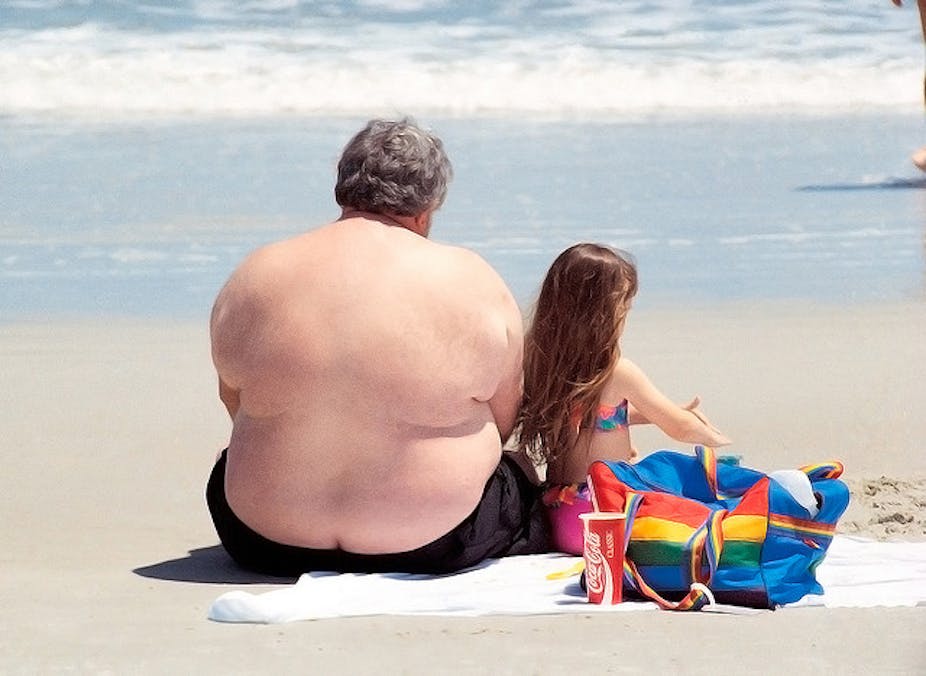
OBESE NATION: It’s time to admit it – Australia is becoming an obese nation. Today we launch a series looking at how this has happened and, more importantly, what we can do to stop the obesity epidemic.
In Australia today, around two-thirds of adults and a quarter of children are overweight or obese. This is a dramatic change from the landscape just 30 years ago when we first collected national data on weight and height.
In 1980, around 60% of Australian adults had a healthy weight; today this has almost halved to around 35%. In 1980, just 10% of adults were obese. In 2012, this figure tips 25%. The infographic below shows just how quickly obesity is increasing in Australia. And why it’s not an exaggeration to call it an epidemic.
The same trend is seen around the world, with around a third of adults and almost one in five children in the United States obese. In some island nations, the prevalence is higher still, with more than half of Samoan and Tongan women classified as obese.
In Australia, we see a higher prevalence of obesity in a number of marginalised populations, such as Aboriginal and Torres Strait Islander adults, Australians living outside the major cities, and those living in more socioeconomically deprived areas.
With excess weight and obesity increasing your likelihood of developing many major chronic diseases, disability and early death, governments and communities around the world are working to halt, or at least slow, this trend.
Some encouraging reports have emerged recently from Australia, the United States and several European countries that show rates of obesity are stabilising in children. But the good news is limited to specific age groups and time periods (and the studies are yet to be replicated to confirm the results). Overall, rates of childhood overweight and obesity remain high.
There are two key objectives in dealing with Australia’s collective weight gain: we must both prevent the ongoing shift towards a heavier population, and increase the proportion of children and adults at a healthy weight. But before we can even contemplate either, we need to understand the drivers of these trends.
Why do we gain weight?
A person’s weight gain is generally caused by an imbalance between energy intake and energy expenditure. This appears simple, but the factors driving this imbalance at a population level are incredibly complex, making simple solutions elusive.
It’s commonly understood that the overweight and obesity we experience today is a normal response to an abnormal environment – often referred to as the obesogenic environment. The premise of this idea is that as humans we’re programmed to conserve energy, storing it up for a time when food is scarce. But most of us now live in an environment where food is plentiful.
On top of this, our need to expend energy in daily life has disappeared. Within our lifetimes we’ve seen the dominant move towards sedentary jobs and leisure-time pursuits, such as watching television, playing computer games and shopping online. We all also recognise the ease and affordability of foods high in energy.
The data supports our anecdotal understanding of these trends. While difficult to measure accurately, a comparison of Australian energy intake from the mid-1980s to the mid-1990s shows an increase in daily energy intake of around 13% for children and 3% to 4% for adults. This latter increase, of around 350kJ a day (approximately half a can of soft drink, or a slice of bread), equates to an eventual weight gain of around 3.5kg.

Similar trends have occurred in the United States, with a 2004 Centres for Disease Control and Prevention (CDC) report indicating daily energy intake between 1970 and 1990 increased by around 7% in men and 22% in women.
Unfortunately, it’s difficult to measure exercise and activity levels over time. A recent report of US workers suggested that while almost half of jobs in the 1960s entailed at least moderate levels of activity, less than 20% do so now.
Trends in overall physical activity levels are more difficult to compare, as different studies generally evaluate different aspects of total physical activity (leisure time, occupational activity, incidental movement, among other measurements). But most Australian and US data suggest recreational activity levels have decreased slightly over past decades.
A recent review by Boyd Swinburn and his colleagues proposes a framework for understanding the combined forces of changes in our energy intake and activity levels. Prior to the 1960s, the dominant change was decreased levels of physical activity, but this had no observable effect on population weight status as food remained a limiting factor. Subsequent to the 1960s, the rapid changes in food availability, composition and marketing drove rapid increases in population weight, now against a backdrop of minimal activity.
The authors also highlight the strong correlation between national economic status and obesity: the move to affordable and accessible high-energy foods requires a certain level of economic wealth and activity. In this sense, the obesity epidemic can be seen as a detrimental outcome of our society’s over-consumption.

Clearly, our food and activity environments require the dominant focus in our efforts to tackle population weight gain. But there are a number of other contributors to weight gain that are also being evaluated for their potential role in achieving healthy population weight.
At an individual level, we know that the in utero environment influences the future child’s weight and chronic disease pathways, with both under- and over-nutrition linked to excess weight gain later in life. We also know that factors such as lack of sleep, low-quality sleep, and use of particular medications, life stages such as pregnancy, and specific genetic variations are also predictive of weight gain. Work to determine the importance of these factors at a population level is ongoing.
There are also newly identified candidates predictive of weight gain, including exposure to environmental toxicants such endocrine disruptors, Bisphenol A (BPA), phthlates and persistent organic pollutants. New studies have also suggested a link between some viral infections, such as human adenovirus, and obesity.
Reversing the trend
Successful population health campaigns to improve the levels of healthy weight, activity and nutrition in our population will need to focus on addressing the overarching drivers of the food and activity environments, while also taking into account these other factors that predict individual variation in weight gain.
The launch last year of the Australian National Preventive Health Agency’s Strategic Plan recognises the importance of this approach. It’s critical that we continue to work towards implementing a range of interventions appropriate for each stage of prevention and treatment, from childhood to adulthood.

Currently, only a third of Australian adults have a healthy weight. If these trends continue, this could decrease to around one quarter over the next decade. There is a real risk that if we are not able to reverse these trends, very soon we will become conditioned to this new demographic, just as smoking was considered “normal” in the 1960s.
To prevent the burden of diabetes, heart disease, arthritis and cancer that will arise from these trends, we need strong and wide-reaching action to drive decreases in energy consumption, particularly within Australia’s vulnerable population groups.
This is the first part of our series Obese Nation. To read the other instalments, follow the links below:
Part two: Explainer: overweight, obese, BMI – what does it all mean?
Part three: Explainer: how does excess weight cause disease?
Part four: Recipe for disaster: creating a food supply to suit the appetite
Part five: What’s economic growth got to do with expanding waistlines?
Part six: Preventing weight gain: the dilemma of effective regulation
Part seven: Filling the regulatory gap in chronic disease prevention
Part eight: Why a fat tax is not enough to tackle the obesity problem
Part nine: Education, wealth and the place you live can affect your weight
Part ten: Innovative strategies needed to address Indigenous obesity
Part eleven: Two books, one big issue: Why Calories Count and Weighing In
Part twelve: Putting health at the heart of sustainability policy
Part thirteen: Want to stop the obesity epidemic? Let’s get moving
Part fourteen: Fat of the land: how urban design can help curb obesity
Part fifteen: Industry-sponsored self-regulation: it’s just not cricket
Part sixteen: Regulation and legislation as tools in the battle against obesity
James Jenkin
EFL Teacher Trainer
I'm not sure it's "time to admit" obesity is an issue. Authorities have been saying it for decades (such as the 1997 NHMRC report 'Acting on Australia's Weight'), and responding with a range of campaigns and interventions.
It raises the question - why has the problem worsened dramatically as public health campaigns have intensified?
The authors propose further "strong and wide-reaching action". It may be well-intentioned, but what's the evidence it will work?
Seamus Gardiner
Citizen
James,
The public health program to limit the incidence and the effects of obesity may be working. It is not working sufficiently as you have pointed out. It may be that it is still preventing a subset of the population from becoming or staying obese. The only way to tell this is to have a control population.
What we do know is that there was a time when obesity rates were much less than now. This means that the problem is not an inevitable consequence of genetics (except in metabolic disorders). The hypothesis is that there has been some recent change in environmental, cultural and social factors that has led to this rise in obesity. If this effect/s is modified than obesity should diminish. A worthy and achievable aim don't you think?
You're right in that further research needs to be conducted to find the right strategy, if indeed there is one. The alternative, of course, is to do nothing and leave it to the acute healthcare system to sort out.
Lennert Veerman
Senior Research Fellow, School of Population Health at University of Queensland
Telling people to move more and eat healty food is simply not enough. Even diet and exercise programs have only limited effects for a limited time. Health education alone is not going to reverse this 'epidemic'.
But health promotion is more than information campaigns. It also includes advocating for restrictions on marketing junk food to children, for subsidies on healthy foods and taxation on junk food, for walk- and bikeways and good public transport. Those are the things that matter. That is where the drivers of this epidemic are.
And in that arena progress has been slow, but children are not getting any fatter so perhaps the worsening of their environment has at least been stopped. There's some reason to be optimistic.
Troy Barry
Postgraduate student
It is quite likely that public health campaigns do harm, not good. I have little doubt the current high levels of overweight people are related to the "eat more grains and cereals" (I can still remember the jingle) message I grew up with.
Seamus Gardiner
Citizen
Troy,
This is called the false cause fallacy.
Correlation does not necessarily imply causation. One of the cognitive biases humans are subject to. You have to do much more to reasonably assert your claim.
Jennifer Lee
Lecturer in Creative Writing, Gender Studies and Literary Studies at Victoria University
Yes, nothing new here in this article. In the US, they changed the BMI so millions (around 25 million) of Americans were put in the 'overweight' category overnight - based on the scale change. It was around 1998 that that happened. I haven't been able to find, with a quick search, whether there was a similar change in Australia. It would be interesting to know if Australia followed suit. If so, any jumps in 'obesity' around 1998-2000 are invalid, if based on the BMI.
Troy Barry
Postgraduate student
Which is why I phrased my comment in terms of likelihood and doubt rather than asserting any claims. At the moment we can consider likely, albeit proved (and effectively untestable) neither true nor false.
Seamus Gardiner
Citizen
Which makes your non-assertion redundant.
I might just as easily say: I have noticed people wearing hi-viz increasingly in the last two decades, It is highly likely that wearing high viz does more harm than good I have little doubt the current high levels of overweight people are related to the wearing of hi-viz garments.
Sue Ieraci
Public hospital clinician
Troy Barry - those wishing to express "likelihood and doubt rather than asserting any claims" should avoid the phrase: "I have little doubt"
Perhaps substitute something like: "I have no particular expertise here, but my guess is..."
Andrew Smith
Education Consultant at Australian & International Education Centre
Yes, more public transport together with better urban design/planning and get people out their cars. Had conversation with many who observe the number of friends, acquaintances and colleagues who have become car dependent apparently due to being time poor (or impatient?), not served by public transport, not considering alternatives or plain lazy..... maybe the sooner petrol prices increase the better......
Troy Barry
Postgraduate student
You certainly could say that. People would assess it and might think it silly and might even tell you so, but that is how conversation goes. If we restricted our conversation to reciting facts proved in multiple blind studies and published in peer reviewed articles - well, people might not be interested in conversing with us. How can we generate hypotheses to test if we cannot raise reasonable but unproven possibilities? If you think my reasonably confident suspicion is unlikely to be true, test it and prove it wrong, or right, or not provable at a certain reasonable level of confidence.
Thus science marches on hand in hand with epistomology.
Seamus Gardiner
Citizen
I claim tu quoque
You stated: "It is quite likely that public health campaigns do harm, not good. I have little doubt the current high levels of overweight people...etc"
I replied False Cause fallacy..
You replied....(I paraphrase) I don't know and neither do you...
This does not make valid your first non-assertion. This is what I have issue with, your first post is fallacious. You can back it up with evidence or not. Your reputation as a commentator on this subject hinges upon that rather than sophistry.
Troy Barry
Postgraduate student
You confuse certainty with belief. I do not presume to, and hence did not, make authoritative statements on the subject, as that would ill fit my qualifications, as any reader can see. That does not stop me from having a belief nor prohibit me from saying that I believe it. You and anybody else can take it or leave it, bearing my qualifications in mind.
You believe my first post is fallacious, but you have no better grounds for your belief than I have for mine. You have an equal entitlement to express your disbelief, but ought to equally express it in terms of limited confidence. Unless you are authoritatively claiming that my proposition is certainly fallacious, in which case you need to do much more to reasonably assert your claim.
Seamus Gardiner
Citizen
Tu quoque again.
My beliefs about the premises of your comment say nothing about whether you have committed a fallacy. The fallacy is committed by the lack of a third premise attaching evidence of any link between your first two premises.
Tom Hennessy
Retired
Quote: Correlation does not necessarily imply causation
Answer: Correlation , to a researcher , ALWAYS implies causation. Correlation does not PROVE causation but correlation DOES , imply , causation. People keep getting it wrong.
Mark Amey
logged in via Facebook
'Yes, nothing new here in this article.'
What, unlike the your rant about obese people being marginalised by those nasty health care workers who continue to insist that obesity is bad for one's health?
Seamus Gardiner
Citizen
Tom,
The key word is necessarily. What if there are two correlates? Or twenty? Which one causes the effect? One? All? None?
Seamus Gardiner
Citizen
Jenny,
I worked in primary care for 12 years from 1990-2002 I recall that in that time overweight was 25 obese was 30? Don't know about the yanks.
Anyway,
'Around 20-25% of Australian children in 1995, aged 7-15 years were considered to be overweight or obese. This is double the prevalence recorded in 1986.' from
http://www.health.gov.au/internet/main/publishing.nsf/content/health-pubhlth-strateg-hlthwt-obesity.htm86.'
This trend was prior to any purported bmi scalar change. Perhaps the change relates to the recatagorisation as per the table below (same source) the table didn't quite come out.....
BMI
Risk of co-morbidities
Underweight <18.50 Low (but risk of other clinical problems increased)
Normal range 18.50 - 24.99 Average
Overweight: >25.00
Preobese 25.00 - 29.99 Increased
Obese class 1 30.00 - 34.99 Moderate
Obese class 2 35.00 - 39.99 Severe
Obese class 3 >40.00 Very severe
Mark Amey
logged in via Facebook
The Americans proposed a change from defining overweight as a BMI of 27.3 down to 25 in the early 90s. It became 'official' in 1998. This was to bring them in line with the World Health Organisation. I agree with many posts here, and on other articles on The Conversation, that it is an arbitrary scale, but, from my observations in the hospital, those with BMIs above 35 have such high risk of dying, and of suffering severe comorbidities during a hospital admission. Many require admission to intensive care after, what are for many, routine procedures. This has an enormous impact on the hospitals capacity to provide services.
Tom Hennessy
Retired
That is the KEY to the research. If there ARE four correlates then there are four possible 'suspects' , and each suspect has to be considered a possible perp , simply because they were present when the crime was committed.
Jan Burgess
Retired
An interesting article.
There are a couple of points that were not mentioned in the article that I would be interested in exploring. Primarily the changes that have occurred in the composition of our diet, not just the increase in energy intakes.
The "low fat" mantra of the 50s and 60s, which arose from the lipid hypothesis, and which coincided with an explosion of processed foods containing various types of non-saturated fats, including trans fats.
The huge increase in simple carbohydrate consumption, with particular emphasis on sugar or more particularly fructose.
I have no expertise in this area, but I have read a number of articles on these topics, some obviously biased, some seemingly authoritative and quite convincing. As a confused consumer, it is difficult to sort the wheat from the chaff.
Lennert Veerman
Senior Research Fellow, School of Population Health at University of Queensland
I am always a bit wary of new insights about diets. First fats were the culprit, then carbohydrates, now apparently specified as fructose. What they have in common is that they make food energy-dense, and that simply gets you more calories for the same mass of food, and therefore may lift your body mass to a higher level. Metabolic and endocrine factors may modify this process, but I haven't seen any compelling reason to abandon this simple model.
And if you are concerned about your weight, don't try too hard to sort the wheat from the chaff. Just eat it all.
Jan Burgess
Retired
"Don't try too hard to sort the wheat from the chaff - just eat it all" - beautifully apt advice to increase fibre intake. As someone who makes their own wholegrain sour-dough bread, I thank you :)
Christopher Mayes
Post-Doctoral Fellow in Bioethics at Pennsylvania State University
"It’s time to admit it – Australia is becoming an obese nation."
Really?
A cursory search through the Australian news media and medical journals over the past five to ten years reveals that Australia is making a near fetish out of "admitting it". Despite this, or rather symptomatic of this fetish, is the continual reporting on the fact that no one is reporting or noticing or doing anything about the "obesity epidemic".
Perhaps the whole endeavor needs rethinking and a few of the sacred cows (energy imbalance, kids don't exercise like they use to, and fat = unhealthy) need to be barbequed.
Seamus Gardiner
Citizen
Christopher,
In reply to your second paragraph, there is a public health program in Australia that works to try and limit obesity. Is it working? We don't know. We know it is not working completely because obesity rates are not decreasing. Is it not working at all? Don't know, as there is no control group. It could be that the rate of obesity would be higher without the program, or foreseeably lower if the program is deleterious to its aim.
In reply to your third paragraph:
http://theconversation.edu.au/explainer-how-does-excess-weight-cause disease-7061
fat=unhealthy is not a good way of putting it (what do you mean by 'fat'?). Obesity= unhealthy is.
Conservation of energy and matter still holds... they are not sociological constructs, although your point on rethinking the application of this law of physics (energy imbalance) to populations I think is a valid one.
James Jenkin
EFL Teacher Trainer
Sean, you raise a really important point - we don't know what effect these public health programs have.
Don't we need to find out before we commit to action for action's sake?
Seamus Gardiner
Citizen
james,
Your question is 'don't we need to find out before we commit to action', well because we are dealing with populations not lab experiments we need to implement based upon existing research and see if it works. It's safe to say that public health researchers are not randomly selecting strategies based upon whimsy.
It is a complex matter and the solutions (if any) will be similarly complex. Give it time. If it doesn't work look for me in 20 years and say 'i told you so'.
Sue Ieraci
Public hospital clinician
James - what would you substitute instead?
Our community is calling for medical services that look at risk-factor modification, not just treatment.
So, what sort of public health campaigns would you suggest?
Bob Buick
Retired medical consultant
We can waffle on all we like about "admitting" to obesity and other peripheral aspects of the underlying generational problem, but we should first ask a few serious questions:
Does over-permissive child-rearing (both at home and in school) lead to self-indulgent adults?
Did anybody obese come out of the WW2 concentration camps?
Does self-indulgence predispose to over-eating and a lazy life-style?
We might also question the following correlations with increasingly obese generation:
Read moreA progressive…
Maurice Swanson
Chief Executive
Congratulations on your article.
Clearly, Australia requires a comprehensive approach to address obesity.
The National Prevention Taskforce provided a number of key recommendations but ufnortunately few have been implemented.
Perhaps those keen to make a difference in this crucial arear of public health might consider those approaches proven to be so successful in tobacco control and road safety.
rory robertson
rory robertson is a Friend of The Conversation.
former fattie
Maurice, what is your response to the criticism that the Heart Foundation's recent contribution to containing obesity literally is "worse than useless", that giving the Foundation's "Tick" - supposedly signifying a healthy choice - to a range of sugary junkfood breakfast cereals - containing about 30% added sugar - is a disgrace?
After all, Australia's steep increase in obesity and related maladies since 1980 obviously is linked to our increased consumption of processed sugar/fructose, the key…
Read moreJoseph Bernard
Director
Rory,
what a great point.. 100% .. I agree the Heart foundation is a disgrace and should be probably even sued out of existance rather than allow it to continue to give people a false sense of security that the food that they are eating is actually 'good' for them
Colin MacGillivray
Retired architect
Measure people from birth onwards and let them or their parents know the results. Kindy and schools could make it a fun event at the beginning of each term- everyone wins because everyone grows at that age. Three numbers- height, weight and waist measurement. Use the numbers in maths to explain the metric system perhaps. (50 years ago, I remember getting to 5 foot eleven and thirteen sixteenths and not making 6 foot)
Spot the slightly overweight kids before they are fat (and the bulemic ones later) and help them back to normal.
Horst Kayak
Pacifist
The overweight and obesity trends in the community are a normal ecological response to an abnormal environment – often referred to as the obesogenic environment. How many of the negative ecological changes are attributable to urban system design compared to the behaviour trends summarized by Bob Buick as:
“Should we then be re-examining the teaching of self-discipline, common courtesy, the relationship between effort and reward, each individual's place in his/her society, recognition and acceptance of our strengths and weaknesses etc.? Raising a generation of children to be concerned, self-disciplined, socially aware, intelligent adults like those of previous less obese generations might be far more effective than pussy-footing around the root of the problem.”
is worth pondering.
John Newton
Author Journalist
A couple of things that I would like to see discussed here - Firstly, 'fat doesn't make you fat': too much food makes you fat, too much sugar makes you fat - and that should be amended to 'good fat doesn't make you fat' good fat being animal fat - butter is better than margarine.
And secondly, it would appear from recent research that exercise makes very little difference to weight loss - other good reasons to do it but not to lose weight.
Seamus Gardiner
Citizen
John:
" it would appear from recent research that exercise makes very little difference to weight loss"
Not quite true, the amount of exercise needs to be quite high to lead to weight loss, and then sustained at a reasonable amount to sustain it. This must be applied with some form of diet control as well. That is how a certain subset of the population remain lean.
Seamus Gardiner
Citizen
John,
Here's a link to a conversation article:
https://theconversation.edu.au/food-v-exercise-what-makes-the-biggest-difference-in-weight-loss-3639
Mark Amey
logged in via Facebook
I think that 'exercise doesn't lead to weight loss', is probably true for the obese, because they grossly over-estimate the amount of exercise they do.
Joseph Bernard
Director
Lets admit it.. we are feed ourselves crap.. high sugar, salts and fats and gm mystry bags and wonder why our bodies are suffering..
when we feed our children Mc donalds, and sweet sweet soft drinks, refined sugar, flour, milk, pretend fruit juices.. what do you expect?
face it rubbish in and fat out
Tom Hennessy
Retired
Quote: more than half of Samoan and Tongan women classified as obese
Answer: "Asians, Pacific Islanders Have Highest Blood Iron Levels"
http://www.sciencedaily.com/releases/2005/04/050430222454.htm
Elevated iron causes metabolic syndrome , obesity , or precurser to obesity. Simple phlebotomy decreases metabolic syndrome.
Read more"Effects of phlebotomy-induced reduction of body iron stores on
metabolic syndrome: Results from a randomized clinical trial"
http://www.biomedcentral.com/1741-7015/10…
Sue Ieraci
Public hospital clinician
Ah - Mr Hennessy is in with his "iron is everything" theory of health.
So, since "Asian" populations are orders of magnitude bigger than Pacific Islands, and obesity is so much less prevalent in Asia, could you be wrong, yet again, about iron and obesity?
Tom Hennessy
Retired
All the people with blue hats got diabetes. Blue hats don't herald diabetes.
Yeah , right.
You have no idea how to decipher a medical study so what you should do is attempt to refrain from talking about stuff you don't know dck about. But , don't let that stop ya.
Tom Hennessy
Retired
"Onset of symptoms is seldom apparent before age 40 because it takes years to build up enough iron to cause tissue damage. Liver function abnormalities are the most frequent finding leading to a diagnosis. Other important organ systems usually involved include the pancreas (diabetes), skin (hyper-pigmentation), joints (arthralgias and arthritis), heart (arrhythmias), and gonads (hypogonadism).
Approximately 50% of patients diagnosed with hemochromatosis will have either type 1 or type 2 diabetes. The likelihood of finding hemochromatosis in the adult population of diabetic patients is reportedly between 1–2%. Diabetes is not uncommonly the only apparent manifestation of hemochromatosis in unrecognized cases."
Mark Amey
logged in via Facebook
Still worrying about iron?
The carrier rate for haemochromatosis is 1 in 10. Most premenopausal women are asymptomatic, due to menstrual losses. Your last post is clearly a quote, so it would be appropriate to cite a reference.
Tom Hennessy
Retired
Quote: The carrier rate for haemochromatosis is 1 in 10
Answer: Genetic propensity to iron overload is 1 in 10 , correct , but we are talking about iron excess not necessarily genetic.
Quote: Most premenopausal women are asymptomatic, due to menstrual losses.
Answer: Women have lower rates of iron induced disease due to their menses , correct. Menses , though , do NOT offset the amount of iron ingested. Meaning , more iron taken in than bled out.
Mark Amey
logged in via Facebook
Tom,
I can't follow what you are actually talking about. You mention haemochromatosis, now it's not haemochromatosis, it's excessive iron intake.
Perhaps you should write an essay on your theories for the Conversation?
Tom Hennessy
Retired
An essay ? ALL my posts get thumbs down , so often it is obvious bias. It is pretty simple to understand. Eating meat causes iron levels to rise to levels UNCONTROLLABLE by the body therefore facilitating women to evolve , menses.
Tom Hennessy
Retired
Quote: I can't follow what you are actually talking about. You mention haemochromatosis, now it's not haemochromatosis, it's excessive iron intake.
Answer: They have begun to call it age-related iron accumulation. Some people when they say hemochromatosis they think ONLY genetic iron overload whereas OTHERS think it can refer to either genetic iron overload , or , age-related iron accumulation , iron accumulation , iron excess , same thing as hemochromatosis , if you see what I mean.
"Iron Accumulation with Age, Oxidative Stress and Functional Decline"
http://www.plosone.org/article/info:doi/10.1371/journal.pone.0002865
Tom Hennessy
Retired
Which is why this treatment has been proposed ?
"Deliberate induction of iron deficiency as a treatment modality for non-healing and/or recurrent venous leg ulcers."
http://www.ncbi.nlm.nih.gov/pubmed/18974697
Mark Amey
logged in via Facebook
Huge leap from the first study to the second study. In the second study it is not iron overload causing the problem of inflammation in venous ulcers, it is extravasation of red cells, which release haemoglobin into surrounding tissues, which is converted to hemosiderin, which causes chronic inflammation.
By the way, every hospital I've worked in has used the term 'haemochromatosis' to define the genetic condition, as opposed to 'iron overload'.
Tom Hennessy
Retired
Quote: Huge leap from the first study to the second study. In the second study it is not iron overload causing the problem of inflammation in venous ulcers, it is extravasation of red cells, which release haemoglobin into surrounding tissues, which is converted to hemosiderin, which causes chronic inflammation.
Answer: When one is iron 'deficient' one mops up the hemosiderin FROM the extravasated red blood cells. When one is NOT iron deficient one does not EFFICIENTLY mop up the iron / hemosiderin. Sooo the fact the woman was not iron deficient allows the iron to build in the tissue when the blood is spilled. Sooo you can say the iron in the skin is "obviously" from the broken red blood cell , BUT , the REASON it hasn't been removed is BECAUSE the person isn't iron deficient , hence the recommendation of 'Deliberate induction of iron deficiency as a treatment modality for non-healing and/or recurrent venous leg ulcers.'
Mark Amey
logged in via Facebook
Tom, your arguments are entirely specious and should be removed from the site.
Mark Amey
logged in via Facebook
'An essay ? ALL my posts get thumbs down , so often it is obvious bias.'
I suggested that you write an essay for the Conversation so that you can expound your theory of iron overload, and receive some comments from expert clinicians and researchers.
Tom Hennessy
Retired
I suppose if you were part of THIS peer review committee this study would never have been published.
"Changes in Iron Measures over Menopause and Associations with Insulin
Resistance"
"Women who had the greatest changes in iron over menopause (lower
measures of premenopausal iron and greater increases in iron measures
over the menopause) had the strongest associations between changes in
iron and changes in insulin resistance."
Mark Amey
logged in via Facebook
I could probably find the report if you included the name of the journal, publishing date, volume, etc, or a link.
Tom Hennessy
Retired
I'm not sure how far in the bush you are , but , ANY 'quote' can simply be 'cut and pasted' including the quotes and placed in Google and up will pop the study or origin of the quote.
http://online.liebertpub.com/doi/abs/10.1089/jwh.2012.3549
Tom Hennessy
Retired
If one just looks at the feedback Luc , the Nobel prize winner , is taking from over forty OTHER , Nobel prize winners , about HIS oxidation causing Aids , one might expect THIS exchange to , as you hope , removed from the discussion.
Luc's belief of oxidation causing Aids is being boycotted by the Nobel prize winners.
My oxidation causing everything which coincidentally agrees with Linus Pauling's oxidation causing everything , is meeting with the same derision and skepticism as Linus' and Luc's theories of oxidation in disease.
To tell a whole medical profession they have it wrong , have had it wrong for forever , and have been causing death and are causing death in numbers uncountable , brings about , MMA highlights..
Mark Amey
logged in via Facebook
Tom, I'm not a pig-ignorant bogan, way out in the bush, but, the onus is on you, as the poster of said article to include a proper reference, or, perhaps a link, not for me to muck around with Professor Google. By the way, I'm not paying $51 to view this. I'm hoping you haven't drawn your conclusion form the abstract alone!
Tom Hennessy
Retired
Since you claim not to be a , pig-ignorant bogan , I will assume you understand the quote to say , those women with the highest iron turned out to ALSO have the hightest diabetes.
"Women who had the greatest changes in iron over menopause (lower
measures of premenopausal iron and greater increases in iron measures
over the menopause) had the strongest associations between changes in
iron and changes in insulin resistance."
Tom Hennessy
Retired
THIS gives a good idea of increased iron.
NTBI Non-transferrin bound iron
"Non-transferrin bound iron (NTBI) has been identified in the plasma of patients with various pathological conditions in which transferrin saturation is significantly elevated"
http://www.ncbi.nlm.nih.gov/pubmed/21855608
"NTBI was commonly present in diabetes: 59% in newly diagnosed diabetes and 92% in advanced diabetes"
http://www.ncbi.nlm.nih.gov/pubmed/16644642
"The common existence of NTBI in type 2 diabetic patients with a strong gradient with severity"
"Non-transferrin bound iron may also be a more specific indicator of iron overload than the serum ferritin concentrations"
http://jcp.bmj.com/content/49/10/853
"The role of iron in adiposity"
"Serum ferritin is associated with visceral fat area and subcutaneous
fat area"
http://www.ncbi.nlm.nih.gov/pubmed/16186284
Tom Hennessy
Retired
THIS evidences the 'control' mechanism of iron absorption. When iron is normal or high the body shuts down non-hemeiron , non blood iron absorption , but the heme iron , blood iron , is still absorbed.
"Absorption of nonheme, but not heme iron, is substantially reduced with high iron stores"
http://www.ars.usda.gov/research/publications/publications.htm?seq_no_115=193539
"Dodge Diabetes by Sidestepping Iron"
Read morehttp://www.swansonvitamins.com/html/health-library/healthnotes.html?page=newswire/newswire_2006_07_20_2…
Tom Hennessy
Retired
If you were a 'horse player' and new anything about odds ? The medical profession up until about five years ago believed ALL diabetics were pretty much anemic , iron deficient. Therefore the hypothesis of iron underlying all diabetes was 'impossible' , let alone defensible. Joslin , too , five years ago replied , "iron ? what iron ?". As evidenced NOW .. "59% in newly diagnosed diabetes and 92% in advanced diabetes" .. the iron hypothesis goes from WAY down here in odds , impossible , to WAY up here in odds 92% , and if that ain't hitting the lottery so to speak , I don't know what is. If 92% of old diabetics have FREE FLOATING iron , they sure aren't iron deficient. Betting ones' life and all , based on odds alone , then , the iron hypothesis bears close scrutiny. The NIH and their present Iron Depletion in Type 2 Diabetes and NAFLD gives credence to that iron hypothesis.
Tom Hennessy
Retired
"Relationship between increased body iron stores, oxidative stress and insulin resistance in healthy men."
"Conclusion:
Our results provide p between plasma ferritin and oxidative modification of lipids as well as proteins in vivo.
Higher body iron stores may contribute to impaired insulin sensitivity through increased oxidative stress in a cohort of healthy men."
http://www.ncbi.nlm.nih.gov/pubmed/19641304
Chris Borthwick
Writer
The most important fact about Australia's health status is that life expectancy has been rising, decade in and decade out, by about three months a year since 1890. The graph is as linear as a broomhandle (apart from a slight glitch in the sixties - don't know what that was). That is to say - necessarily - that the obesity epidemic has made virtually no difference to our life expectancy. Which means, aesthetics apart, we shouldn't obsess about it. Which also means that we should be very careful indeed of making things worse. Obesity campaigns risk adding to stigma, and if an increasing proportion of the population is obese than an increasing proportion is vulnerable to stigma.
Seamus Gardiner
Citizen
Chris,
Read moreYou may be right, I have not looked at the figures in fine detail, but you have made an assumption here.
The raw figure of life expectancy is an average. Is it possible that the non-obese have a much higher life expectancy than the obese? What i mean by this is that including the obese in the study may have dragged the life expectancy down from an even greater age to the average you see now. Which means the broomhandle could have been a hockey stick.
The way to remove this assumption…
Jan Burgess
Retired
To add to Sean's reference above - a quick google pulls up a March 2009 study reported at http://www.sciencedaily.com/releases/2009/03/090319224823.htm
"The Oxford University research found that moderate obesity (BMI of 30 to 35), which is now common, reduces life expectancy by about 3 years, and that severe obesity (BMI of 40 to 50), which is still uncommon, can shorten a person’s life by 10 years. This 10 year loss is equal to the effects of lifelong smoking.
The analysis brought together…
Read moreChris Borthwick
Writer
Well, yes; but studies of life expectancy and obesity that do not control for the confounders of activity on the one hand and social class on the other are liable to mislead. In the western world at the moment, obesity is very largely a class marker; and Marmot's Whitehall studies show that about two-thirds of, for example, cardiovascular risk correlates with status after other factors such as smoking, diet and exercise are removed.
Seamus Gardiner
Citizen
Chris,
My citation above accounts for non-smokers, I'm sure if you look at the WHO website, Australian Dept of health website you'll see the same. Differing rates of obesity per subset of social class does not affect the overall correlation between death and obesity.
Chris Borthwick
Writer
"Differing rates of obesity per subset of social class does not affect the overall correlation between death and obesity.'
If death rates correlated only with social class (which is a slight exaggeration, though not as much so as the converse) then because obesity correlates with social class then there would still be a false correlation between death rates and obesity.
Seamus Gardiner
Citizen
Is driving a BMW cardioprotective?
The studies that inform this examine obese people and the relationship between this and life expectancy. Is there something special about those in lowere socioeconomic groups that makes their obesity more life threatening or are you suggesting a heretofore unstated confounding variable that would skew the data by such an extent?
I'd be interested to see if you could find any variable that have not been accounted for in the meta -analyses that inform WHO and the Aust Dept of Health guidelines and policy statements.
Chris Borthwick
Writer
".....are you suggesting a heretofore unstated confounding variable that would skew the data by such an extent?"
I'm suggesting a confounding variable, certainly, but not a heretofore unstated one, or one unknown to WHO; see the obvious www.euro.who.int/document/e81384.pdf.
This should be bub's grade health promotion knowledge, and it's always astounding to me that we're so easily seduced into worrying exclusively about whatever moral panic of the week is being pushed and forgetting about underlying causes.
Seamus Gardiner
Citizen
Oh, the social determinents of health, who knew?
These result in measurable health outcomes for the individual.
Obesity is one of these health outcomes.
The other health outcomes can be adjusted for by arcane statistical analyses (because they are measured quantitatively).
The outcome is the proportion by which obesity affects life expectancy.
Chris Borthwick
Writer
No, obesity isn't a health outcome, it's a health input; a risk factor. Life expectancy is a health outcome.
And while it's possible that the effects of social determinants could be "adjusted for by arcane statistical analyses" the issue that takes us back up the line to my original entry is whether the studies cited by those disagreeing with my post did in fact try to control for those factors. Did they?
Seamus Gardiner
Citizen
Your assumption is still swinging in the breeze.
Read morea quick google scholar search explains why longevity is increasing despite increasing obesity and the lower age expectancy of the obese:
'Capewell (2010) have reported that in the United States three of the
six major risk factors for CHD—total cholesterol, prevalence
of smoking, and physical activity levels—improved between
1988 and 2003. '
if these factors were not improving the authors go on to state that the declining life expectancy in the…
rory robertson
rory robertson is a Friend of The Conversation.
former fattie
Hi Chris, you wrote that "...the obesity epidemic has made virtually no difference to our life expectancy. Which means, aesthetics apart, we shouldn't obsess about it". Actually, the steep trend to obesity is relatively new - roughly post-1980 - which means many of our fatties and soon-to-be fatties prone to develop diabetes, heart and kidney diseases, etc, are still young, so there's still plenty of time for them to die early or have miserable but long lives extended by taxpayer-subsidised medicines…
Read morerory robertson
rory robertson is a Friend of The Conversation.
former fattie
oops, that final bit should read "health risks from related maladies"
Chris Borthwick
Writer
The 1980s aren't 'relatively new', they're thirty years away; anybody who was twenty then is fifty now, and if the death rate hasn't gone up at age fifty it's not going to fall off a cliff at sixty (remember, 'life expectancy' takes into account deaths at all ages).
Here, again, we see health as moral imperative, 'self-discipline', the successor of 'virtue'; when, as I reference above, it's largely a social role issue, and explanations like 'lack of self-discipline' are merely occasions for…
Read morerory robertson
rory robertson is a Friend of The Conversation.
former fattie
Agreed, Chris, "the 1980s aren't 'relatively new'". What is new is that kindergartens, schools, unis, workplaces, hospitals and Centrelink offices are notably more populated today by chubby youngsters with big health problems ahead than they were in 1980.
Even if we pay scant attention to fatties' generally reduced quality of life over time (your approach?), the decades ahead are set to feature the growing and unavoidable funding task associated with keeping people alive, mobile and somewhat…
Read moreSeamus Gardiner
Citizen
Well there are consequences. Morbidity. Decreased life expectancy. Cost, personal and societal.
No need to panic. Just a need to address the problem.
Chris Borthwick
Writer
We don't have decreased life expectancy; we have increased life expectancy. You say that without obesity we'd have even more increased life expectancy, to a level, therefore, never before seen in the history of the world, anywhere, anytime. I'm sceptical. In any case, though, it's obvious that the hypothesised ill effects of obesity are not so great as to bend the existing secular trend at all, and I'd say that puts a low bound on how ill those effects, in the real world, are.
Chris Borthwick
Writer
The quality of life of 'fatties' is going to be affected considerably by the use of stigmatising terms such as 'fatties'. My concern with major campaigns on this issue is exactly that they may increase stigma, and thus do harm - perhaps more harm than good. This is not a good start.
The increased amounts governments have had to spend on health in every year since the war have been met by increased productivity resulting in increased wealth resulting in increased taxes resulting in more money to spend on health. If we're no richer per head in thirty years than we are now then we will certainly have to make some tough decisions, but I'd submit that for that to be true Australia will have had to go through changes that will make obesity very much a side issue.
Seamus Gardiner
Citizen
The obese have a lower life expectancy.
I won't reiterate my attack on your assumption, I have clearly expressed the potential error in your original very general statement.
Im sceptical too, which is why I rely on the evidence before me and don't cling dearly to a flawed argument composed of dubious premises.
rory robertson
rory robertson is a Friend of The Conversation.
former fattie
When I was fat and getting fatter, Chris, my main problem wasn't being "stigmatised", it was that I couldn't play much with my growing sons, that I couldn't bear tucking in my shirt on a Saturday night, that I couldn't see how I could stop the decade-long trend before big health problems emerged. It was just a place I didn't want to be. It was the biggest issue in my life and I had grown rather despondent about future prospects. Then I stopped eating added sugar and my world changed for the better…
Read moreChris Borthwick
Writer
People who live in the country have a lower life expectancy, too, and at least we don't have a nationwide campaign to make them move to the city. Straight correlation/causation arguments are simplistic and unhelpful.
Seamus Gardiner
Citizen
The cognitive dissonance is breathtaking....
No Notmetoo
Truckie
Lennet Veerman said:
"But health promotion is more than information campaigns. It also includes advocating for restrictions on marketing junk food to children, for subsidies on healthy foods and taxation on junk food, for walk- and bikeways and good public transport. Those are the things that matter. That is where the drivers of this epidemic are."
Be careful on what you wish for. Soon the government will put a fat tax on your fatty food to pay for the bike-ways that you think will help. Bike…
Read moreJohn Holmes
Agronomist - semi retired consultant
RE exercise: Shearing was a source of spending funds for my Uni days ( 10 days = 1 terms expenses) , one could eat 5 meals a day and still loose weight, especially when crutching in summer. Sure this is in the extreme end of steady physical exercise/ work for humans. It also tends to be a bit hard on backs and wrists.
Not present in the this discussion is any information from our animal production systems and from the horse racing industry. Are there any useful insights into the human situation…
Read moreTim Scanlon
Author and Scientist
John, I don't know that we'd be able to use animal production as a reference point. Humans have a genetic predisposition to lay down a higher proportion of fat compared to animals. We've bred our animals to lay down a higher proportion of lean tissues.
Although I know the point you are driving at, that there is a lot to be learnt in terms of feed composition, activity and resultant body composition. It could be argued that bodybuilders show the way on this in humans.
Steve Brown
logged in via email @yahoo.com.au
Unfortunately this was a very predictable read. Like most of the other dieticians and obesity specialists the authors are continuing to explain this epidemic in terms of excess calories and lack of exercise.
They provided data showing we're eating more and and moving less. I was hoping they would provide some evidence to prove this is the the cause of the epidemic and not a mere correlation but the readers were not supplied with any.
The (now infamous) Stanford diet study clearly put the…
Read moreMichael Bayliss
Disability Coordinator
I love it how every time a new article on Australian obesity is written, the researchers sound almost surprised by the trend. I feel at times researchers live in a vacuum free from media or have not been reading their peers’ articles.
In my opinion it doesn’t matter how many ‘healthy Australia’ intervention campaigns we push, they will remain ineffective whilst junk food remains so available and prevalent. Go to any rush-built new outer suburb development in any Australian capital city, for example…
Read morePeter Boyd Lane
geologist
well, I simply don't accept the statistics. 66% of adults overweight? I guess my wife and I have well over 200 friends and acquaintances and between us we can only think of four (no, five) who are overweight, one may just scape in as being obese. So where are they all?
Horst Kayak
Pacifist
My straw count of 200 “friends”, admittedly mainly a cohort of over 50 year olds, is made up of 85% with a BMI more than 25. Mapping BMI obviously gives different results in the various subregions of urban Melbourne.
Jennifer Seberry
Professor
I am morbidly obese. I have been since I had my first child.
Read moreI refuse to read any more guff designed to make me feel guilty, want to hide,
be laughed at by children, etc etc.
I know how to lose weight: 1) cut down calories (well I been doing that for 40
years to keep my weight constant) 2) do more exercise...now there's a problem:
I can't buy swimming costumes, gym gear, exercise machines, chic or stylish clothing etc.. so you say walk and run..well I can't buy trousers either...for as long…