


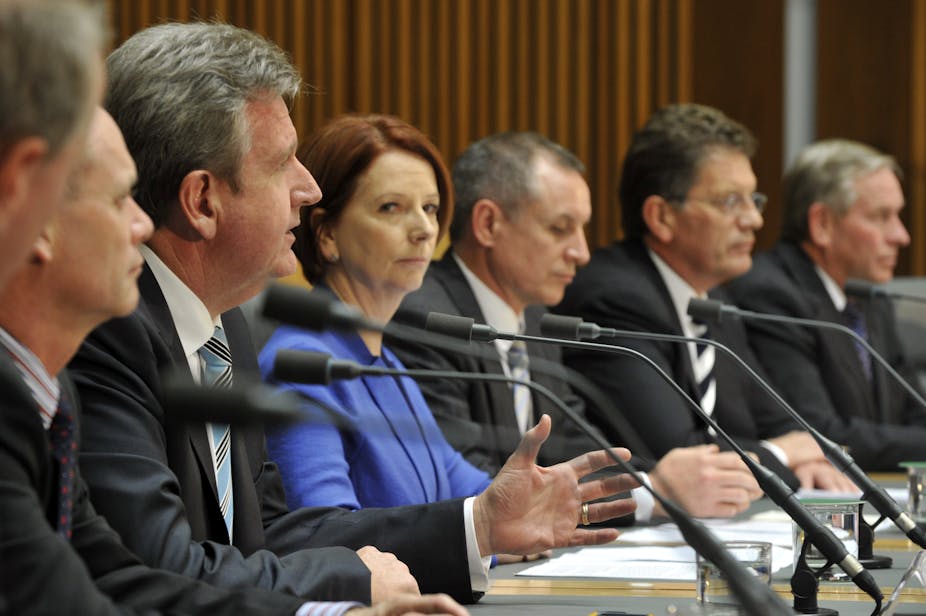
A lot of smoke and very little illumination came out of yesterday’s Council of Australian Governments (COAG) discussions about how the National Disability Insurance Scheme (NDIS) will be funded.
All sides of politics claim reform is needed to improve the existing crisis-ridden, inefficient and underfunded system of disability support. All sides say support is non-partisan and not about politics. Yet when it comes to paying for it, we get a political bun fight.
The split at COAG was most definitely along political lines, with two Labor states (Tasmania and South Australia) and the ACT “winning” the bid to host launch sites for the NDIS trial. The Liberal states bowed out, refusing to put up enough extra money to supplement the Commonwealth government’s $1bn announced in the last budget.
The Commonwealth and states have effectively said to most of the 400,000 Australians living with serious disability, “we can’t work together so you’ll have to continue shouldering the burden on your own”.
Why we need an NDIS
Disability reform is not about extras, it’s about basic needs that should already be met in a civilised and advanced society.
Informal care arrangements are already unable to cover the massive shortfall in services for people living with disability. Going forward, the Productivity Commission’s (PC) disability services report warns of a huge surge in liabilities for governments as carers age and their children live longer.
A properly funded and administered NDIS would get rid of existing costly inefficiencies and spread the costs of disability thinly among all Australians. It would guarantee basic levels of respite, therapy, and personal care – as well as basic equipment needs and options for long-term accommodation – for anyone affected by a catastrophic accident or born with a serious disability.
A fully-funded NDIS would also benefit the economy. Analysis by Deloitte Access Economics found that increasing employment rates of people with disability by just one-third would increase GDP by A$43bn over the next ten years. But first, people with disabilities need more support.
Funding options
Given that the COAG outcome was all about funding, what are the options for funding the NDIS?
The PC’s preferred approach is that the Commonwealth government takes full responsibility, with funding coming from a legislated contribution from consolidated revenue. The PC says the Commonwealth government has “a unique capacity to raise efficient and sustainable taxes of the magnitude required”; this would also avoid the debacle we’ve seen at COAG.
States and territories currently fund about $4.7bn of disability services. So to offset their reduction in commitment to disability, they would be expected to cut inefficient state and territory taxes. The pooled funding approach adopted by COAG is the PC’s less preferred approach, as it’s much less likely to be secure and sustainable. Yesterday’s COAG meeting certainly demonstrates this point.
A report by Deloitte Access Economics into funding options recommends the introduction of a Commonwealth payroll tax. Unlike income tax, a payroll tax wouldn’t tax capital and would “give[s] access to a new growth tax”.
The Deloitte report points out that states and territories rely heavily on inefficient taxes, including state payroll taxes that have many exemptions and thresholds, for 30% to 43% of their tax revenues. Replacing these with a federal payroll tax would increase the efficiency of the tax system, and it would “only need to be 1.81% to raise the required $11.2 billion”.
Other options for NDIS funding include increasing personal income tax, raising the GST and reintroducing the fuel excise indexation (but the last two have been ruled out by the Commonwealth government).
A federal payroll tax would meet the PC’s requirements of a broad-based, efficient tax to fund the legislated contribution to the NDIS from consolidated revenue. It would also meet the need for a “quid pro quo” for the states and territories to reduce their inefficient taxes.
But equity sits alongside efficiency in a well-designed tax system. A payroll tax will end up being paid by consumers, along with existing GST. This has the disadvantage of being regressive, falling more heavily on families with low incomes.
A broad-based progressive personal income tax is more equitable, placing a heavier burden on those who can afford to pay more. There is broad acceptance of the Medicare levy, though it doesn’t generate anywhere near enough money to fully fund health costs - it’s essentially an increase in income tax with a good public relations image.
The NDIS could be funded in a similar way, with payroll and other state taxes reformed, as the PC’s suggested “quid pro quo”. Either way, the funding must be legislated for continuity and stability, and it must be adequate.
Time to reach further
The Commonwealth government’s $1bn commitment to the NDIS was always inadequate, with a four year allocation of just 26% of what the Productivity Commission’s report said was necessary. This would cover just 5% of people in need, with no real plans to extend the scheme.
It’s important we maintain momentum around disability reform. If people not touched by disability think that the disability box has been ticked, governments risks losing support for increased investment. And aborted or failed trials will have devastating personal consequences for an already vulnerable and exploited group.
It’s been 38 years since a federal government had a serious proposal to tackle disability funding: under Gough Whitlam in 1974. This was stymied by funding and lack of agreement on how it should be implemented. I’m not sure people with disabilities and their families can wait much longer for real disability reform.