




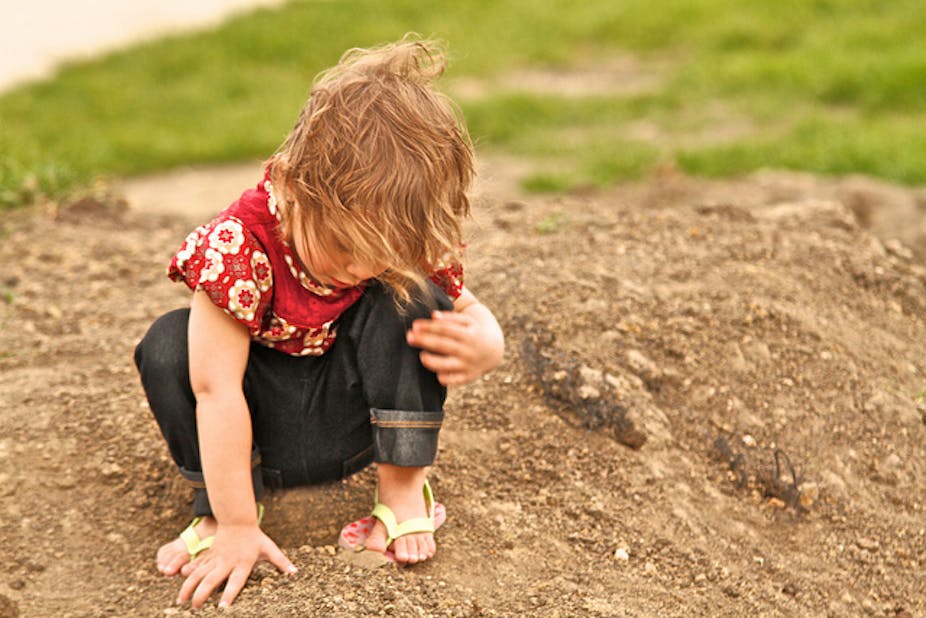
Lead exposure continues to be an important public health issue for Australian children, with as many as 100,000 children under five years of age estimated to have blood lead levels high enough to cause heath and behavioural problems.
The current goal is that all Australians should have blood lead less than 10 µg/dL (micrograms per decilitre), a level that was originally established in 1993. But since then, compelling evidence has shown that lead levels 80% lower than the current goal pose an increased risk to health.
It’s time to lower the accepted blood lead goal and aim for population exposure levels below 1 µg/dL.
Health impacts of lead exposure
The effects of lead exposure are greatest in unborn children and those aged under five years. This age group is most susceptible because their growing nervous and skeletal systems require high levels of calcium.
Calcium is an essential element for the proper development and function of the brain. Because lead (Pb2+) mimics calcium (Ca2+), children living in a lead-rich environment can be absorbing larger amounts of lead in place of calcium. This can interfere with the critical development of a child’s nervous system. The impacts of exposure on the developing neurological system are irreversible.
The United States Environmental Protection Agency’s (US EPA) 2012 Integrated Science Assessment for Lead concluded that the evidence shows lead exposure in children above 2 µg/dL can affect neurocognitive functioning and learning (IQ, verbal skills, memory, visuospatial processing) and neurobehaviours (such as the development of attention deficit hyperactivity disorder – ADHD – and delinquent behaviours).
Lead exposure is associated with delayed onset of puberty and adverse reproductive and development effects in young adults who have mean blood levels less than 5 µg/dL.
Adults are not immune, with lead exposure having been shown to increase blood pressure and hypertension. Toxicological evidence also shows that exposure reduces semen quality and extends the time to pregnancy. The US EPA also concluded there was a causal relationship between lead exposure and cancer.
While all of these (and more) exposure effects may be confounded by other social, economic, genetic and environmental factors, another major 2012 US review conducted by the National Toxicology Program – Monograph on Health Effects of Low-Level Lead – also supports these findings.
Australian action levels
After being introduced in 1993, Australia’s blood lead goal of 10 µg/dL was later reaffirmed by the National Health and Medical Research Council’s (NHMRC) 2009 review. The NHMRC concluded that:
“The nature of the ‘dose-response’ relationship between lead exposure and children’s intellectual abilities and behaviour is also contentious.”
However, importantly, the NHMRC also noted in its information paper that:
“No threshold of lead exposure below which any exposure might be considered ‘safe’ in respect of cognitive abilities has ever been identified.”
With respect to managing childhood lead exposure in Port Pirie, SA Health noted in 2006 that where the blood lead level of a child at six months of age exceeded 6 μg/dL, case management would be instigated.
In response to the 2007 lead pollution event in Esperance, Western Australian Health used 5 µg/dL in children under five as its action level.
The evidence of lead’s dose-response effect on children’s intellect and behaviour is now overwhelming and no longer contentious. It is clear Australia needs to respond quickly.
Types of exposure
Absorption, inhalation and oral ingestion are the primary lead exposure pathways. Of these, oral ingestion is the most problematic because lead is more easily absorbed into the body from the gastrointestinal tract. The amount of lead absorption is also greater in young children. Such exposures are a particular concern where homes are close to mines and smelters that generate significant concentrations of lead-rich dust.
Lead exposure from soils and dusts in Australian communities is dominated by three sources: mining and smelting emissions, lead paint, and leaded petrol.
In mining-affected areas, the original contaminant load is sourced primarily from smelter fallout, dust from spoil heaps or tailings that have been transported deliberately or inadvertently into, and dispersed across, human and natural environments. The release of such contaminants can pose a significant potential environmental and human health threat to people living, working and recreating in or near to such environments.
Lead levels in paint were up to 50% by weight before 1965, but thereafter several reductions were mandated, bringing the allowable concentration to 0.1% in 1997.
Unleaded petrol for road vehicles was introduced in Australia in 1996, with the content of leaded petrol declining from 0.84 g/L in 1990 to 0.2 g/L in 1996, until it was finally banned in 2002.
The consequences of the use of lead in petrol have been significant over the 70-year period it was in use. National assessments of petrol lead emissions show 3,842 tonnes of lead were emitted in Australian capital cities in 1976 and 2,388 tonnes of lead were emitted in 1998, despite mandated reductions of allowable lead in petrol. As a result, many of the older, larger inner city areas of Australia have been heavily contaminated with tens if not hundreds of thousands of tonnes of lead.
In contrast, smaller rural towns with significantly lower vehicle use and no mining and smelting industries do not have such a legacy of environmental lead exposure.
Need for up-to-date data
There is relatively little data on Australians’ exposure to chronic low levels of lead – we have not completed a national survey of children’s blood lead levels since 1995. This is concerning because evidence from the US indicates that the relative impact of exposure on intelligence and academic performance is proportionately greater at concentrations less than 10 µg/dL than above it.
By contrast, in one of the few ongoing continuous assessments, the US’s [National Health and Nutrition Examination Survey](http://www.cdc.gov/nchs/nhanes/about_nhanes.htm](http://www.cdc.gov/nchs/nhanes/about_nhanes.htm) collects data on around 5,000 people every year. These surveys provide robust information about a range of health indicators including blood lead levels.
In the US, approximately 7.4% of children aged 12 months to five years have a blood lead level above 5 µg/dL. Applying this rate to Australian children under five years of age, around 100,000 Australian children may have a blood lead level that has adverse consequences for health and behaviour.
International reviews
Health agencies in Germany and the US have moved to revise their lead goals and intervention levels. Health Canada has reviewed its current policy and is due to issue its new guidance levels shortly. And the World Health Organization (WHO) has accepted that neurobehavioural damage can occur when blood lead levels are below 5 µg/dL.
In 2010, the WHO also concluded that a previously established tolerable intake of lead in a person’s diet – 25 parts per billion, per week – could no longer be maintained, based on its effect on neurological development in children and hypertension in adults. The WHO was unable to set a new level so there is now no tolerable level of lead in dietary sources.
In 2010, the German Federal Environment Agency moved to the term “reference value” and set its value based on the 95th percentile of blood lead levels from national blood lead surveys as its new trigger levels for action, arriving at 3.5 μg/dL for children.
In January 2012, a report of the US Center for Disease Control and Prevention (CDC) Advisory Committee on Childhood Lead Poisoning Prevention recommended the term “level of concern” be eliminated. It also recommended a reference value of 5 μg/dL be used to identify children who have an elevated blood lead level, based on the 97.5 percentile for children aged 12 months to five years.
These recommendations were subsequently accepted by the US CDC. This new blood lead reference level should trigger lead education, parental advice on nutrition, environmental investigations, and, if warranted, additional health surveillance.
Next steps
Many of the lead hot spots in Australia are well known (Port Pirie, Mount Isa, Broken Hill, Cockle Creek Newcastle) and these have well-established lead risk education programs. In these locations exposures continue to remain too high due to elevated concentrations of lead in air, soil and dust. In other locations, diffuse sources associated with old inner-city housing and industries where lead exposure may occur still need to be identified.
The focus now should be on identifying sources, assessing risks and eliminating or minimising exposures, with the fundamental aim of primary prevention.
The NHMRC website was updated on November 2, 2012 to announce it is reviewing the level at which sources of exposure to lead should be investigated. The review will consider the recommendations and evidence provided to the US CDC and therefore it is a review of a review. The NHMRC review will be completed by late 2013 or early 2014.
It is difficult to understand what extra insight the NHMRC can conclude from the US CDC review, or other relevant documentation, and why it will take so long.