Egg cases of sharks and rays can be found washed up on the shore. Citizen science data helps scientists understand the life cycles of these marine animals and how to best conserve them.
A new report has found the marine reserve covering the Heard and McDonald islands must urgently be expanded.
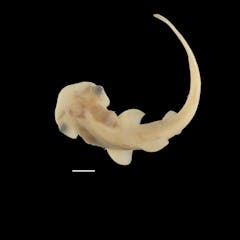
The characteristic hammer-shaped head is just becoming visible in this image of an embryonic bonnethead shark. Scale bar = 1 cm.
Steven Byrum and Gareth Fraser, Department of Biology, University of Florida
Because hammerhead sharks give birth to live young, studying their embryonic development is much more complicated than harvesting some eggs and watching them develop in real time.
Photo of the megamouth that was found off East Africa. Wildlife Conservation Society, Tanzania Marine Programme.
Trophy fishing is a big threat to some of the most threatened species of fish, but there are ways to adapt the sport with marine conservation in mind.
A paleontologist wears a T-shirt showing Strophodus rebecae, a shark species with flat teeth that lived millions of years ago.
Juan Pablo Pino/AFP via Getty Images
A new initiative is pinpointing areas in the world’s oceans that are key habitats for sharks and their relatives, so that governments can consider protecting these areas.
Rather than a tracking tag telling scientists where this shark traveled, its violent removal let them observe an unexpected regeneration process.
Josh Schellenberg
After scientists’ GPS tracking tag was violently removed from one shark’s dorsal fin, they were in for a surprise: The wound didn’t just heal, but the missing tissue grew back.
A scene from Steven Spielberg’s 1975 movie, Jaws.
Screen Archives/Getty Images
Peter Benchley’s classic 1974 ‘man versus beast’ blockbuster novel doubled as a scathing critique of 1970s America. Spielberg’s film made its characters likeable – and its tone into a ‘grand adventure’.
A school of grunts on a sunken World War II German submarine in the Atlantic Ocean off North Carolina.
Karen Doody/Stocktrek Images via Getty Images
Scientists found PFAS hot spots in Miami’s Biscayne Bay where the chemicals are entering coastal waters and reaching the ocean. Water samples point to some specific sources.
Archaeologists have discovered two 7,000-year-old tiger shark teeth that were once part of ritual or fighting blades on the Indonesian island of Sulawesi.
Scalloped hammerheads pose no risk to us – but we pose enormous risk to them. Our discovery of a large new aggregation gives us an opportunity to protect these animals.
White sharks are migrating to survive. Morne Hardenberg.
South Africa’s white shark population is not in decline but migrating to survive.
Tim Flannery with a model set of jaws of a megalodon at the Australian Museum, and, on right, a megalodon tooth.
Photos: Text Publishing, Wikimedia Commons
Megalodons are having a cultural moment. What do we know about them? And might further scientific discoveries reveal more about the true shape and size of these creatures?
Open ocean sharks are globally threatened with extinction. Knowing where they are helps us protect them. Here, new research into silky sharks reveals priorities for conservation.
Some baby sharks eat their unborn siblings in utero, while others spend 100 years in childhood. Sink your teeth into the weird world of these juvenile wonders of the deep.
Marine Biologist, South African National Parks (SANParks); Honorary Research Associate, South African Institute for Aquatic Biodiversity (SAIAB), South African Institute for Aquatic Biodiversity