
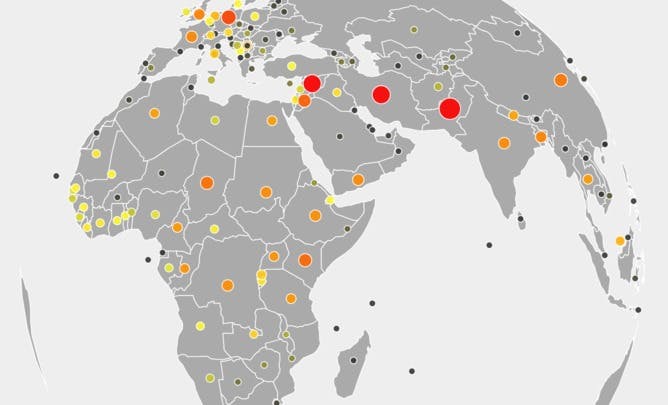
Welcome to our new infographic, displaying global populations of refugees from 1975-2010, as part of The Conversation’s expert panel on asylum seekers.
Using UNHCR data compiled by the United Nations Refugee Agency, the graphic highlights refugee populations across the world over time: where refugees settled, and where they came from. Every population the UNHCR has counted over 35 years is charted on this spinning globe.
Click the image above to launch the application: spin the globe, stop the clock and focus on an individual country to read its refugee story.
Note the UNHCR data does not include refugees who were resettled in Australia, only those who arrived in Australia as asylum seekers and were found to be refugees.
An earlier version of this infographic relied on a misinterpretation of the UNHCR data. The population estimates were misinterpreted as refugee arrivals per year. This infographic corrects these errors.
Read the rest of The Conversation’s asylum seeker coverage:
Asylum seekers and Australia: the evidence
The Conversation panel on asylum seekers: meet the experts
What does the Australian public really think about asylum seekers?
Refugee intake starts in the region: making a difference in regional burden sharing
Refugees and asylum seekers in Malaysia: the good, the bad and the unexpected
Resettling refugees: the evidence supports increasing our intake
What role does Australia play in accepting the world’s refugees?
Who are Australia’s ‘boat people’, and why don’t they get on planes?
Uncomfortable truths: busting the top three asylum seeker myths
There’s no evidence that asylum seeker deterrence policy works
There’s more to regional collaboration than the Malaysia Arrangement
How immigration policy harms asylum seekers' mental health
Asylum seekers in Indonesia: why do they get on boats?
Preventing deaths at sea: asking the experts on asylum seekers
Ron Hoenig
logged in via Facebook
The figure 3.5 million refugees is much higher than any I have previously seen. That would indicate that 15 percent of Australia's population consits of refugees, when the figures for Australia's toital migrant population is some 28%. Unless you mean refugees and their offspring/descendants, I would seriously doubt the figure. Even then, that figure is enormous. The Refugee Council states that 'During 2009-10, Australia passed the 750,000 mark in its intake of refugees and humanitarian entrants since nationhood."http://www.refugeecouncil.org.au/resources/intakesub/2011-12_IntakeSub_ExecSummary.pdf
Bruce Waddell
logged in via LinkedIn
I have assumed it includes family reunion figures.
Megan Clement
Deputy Editor, Politics + Society at The Conversation
Hi Bruce and Ron,
We are investigating the origin of the figure. We will be back to you soon with more information.
Best wishes,
Megan
Dalit Prawasi
Auditor, Accountant, Trade Teacher
Australia's real refugees are the indigenous and and they have nowhere to go.
Peter Ormonde
Peter Ormonde is a Friend of The Conversation.
Farmer
Dalit, is that your actual real name? It's just that I know quite a few folks in India - quite a few Dalits actually - and have never ever come across anyone with the name Dalit and would be most surprised to do so.
There is a hebrew and Arabic name Dalit however but given your interest is protesting Indian "colonialism and imperialism" I'm assuming you are from Kashmir ... I find your posts and tweets most difficult to understand.
Please explain what and where you are talking about.
Tom Rainey
Research Fellow at Queensland University of Technology
I had an error when I tried to load the interactive map. Is there some software I need to install to make it run? Interesting article.
Bruce Waddell
logged in via LinkedIn
I like TC because it is able to add rationality to debate. I was pleasantly surprised to discover just how many immigrants we have welcomed since the 1970's. I also found the KNALIJ site's illustration of people movement just as interesting in the number of people who returned (presumed) to their homeland.
As a result I have a question with 2 parts. Is the hysteria we are experiencing with boat people a collective fatigue of new faces, or is it an aversion to desperate refugees taking responsibility for their own lives?
Peter Ormonde
Peter Ormonde is a Friend of The Conversation.
Farmer
What a clever thing ... puts things into perspective doesn't it?
Great effort!
Anthony Nolan
Ruminant
Reuniting science and humanism.
Good one mate.
alexander j watt
logged in via Twitter
Fascinating to see Pakistan and Iran as big destination countries. Paints the issue in a different light. Didn't expect Germany so be the major destination in Europe.
Alan Finkel
logged in via LinkedIn
Alan Finkel from KNALIJ here. For the next day or so, try using Google Chrome to log into the Refugee Movement App. We'll be running smoothly on Firefox and IE soon. Thanks.
Alan Finkel
logged in via LinkedIn
Everything is working beautifully with the App now. I love watching how the refugee movements change through the years. Truly amazing and informative.
JM John Armstrong
logged in via Facebook
I posted this on Facebook and had a query from a friend about the accuracy of 100 million refugees from Afghanistan - can you confirm that this is the correct total please.
Misha Ketchell
Managing Editor at The Conversation
Hi John,
We're still researching this, but it looks as though the UNHCR annual data doesn't record movements as such, it's an estimate of the refugee population in a country at that time. Which means that adding it up to arrive at a cumulative figure is wrong, and the Afghanistan figure will be wrong.
Thanks for flagging this. My sincere apologies.
JM John Armstrong
logged in via Facebook
Thanks Misha
Dalit Prawasi
Auditor, Accountant, Trade Teacher
A error in numbers or transcribing. it should be above one million and less than two million.
Please refer to UNHCR 2011 reporUNHCR report.
I do not trust it with an Indian colonial parasite (a description I do not like to use but explains the nature) heading it.
Asef Hussain
Consultant
I still doubt comparability of presented numbers. Refugee population sampling in Australia shows only refugees pending their naturalization, once naturalized they don't appear in Australian refugee statistics. On the other hand for example refugee policies in Pakistan don't provide any aid or benefits, don't allow citizenship, owning business etc. Once arrived as refugees they stay as refugees till they leave or die. Naturally their numbers in these countries remain high over many years. It is also unfair to compare numbers in Pakistan or Iran, which don't provide any care to refugees, simply right to stay, to Australia, where refugees get all kinds of financial and social benefits and rights, most importantly right to become a citizen within short period of time.
Ann Davie
logged in via Facebook
I've tried viewing in Firefox and Safari with no luck. Looks like somethings load in Safari, but can't view the map. Would love to see what's there.
Steve Melnikoff
Physicist at University of Melbourne
Hi Ann, thank you for your comment. Since you mentioned Safari, I am assuming you are on a Mac/osx machine. The infographic is built using html5 technologies, and, basically you need a 'latest' version of your browser to see the map.Here are the versions of Safari and Firefox I used to test against: Safari 5.1.7 and Firefox 10.0.1. Anything newer than that should work as well, along with Chrome 20+ and IE 9+ .
Hope that helps.
Dalit Prawasi
Auditor, Accountant, Trade Teacher
Great piece of software.
Shows that where the real refugees are and what our obligations should be for those who are not living off or getting other benefits from Australian refugee and asylum seeker business that runs in to hundreds of million dollars.
Peter Ormonde
Peter Ormonde is a Friend of The Conversation.
Farmer
Not sure of your point Dalit.
Economically the money received by asylum seekers would all get spent here ... it is helping to create jobs, make the shops better off, keep the local butcher in business. It is not a problem.
But if you are saying Australia can and should do more to ease the effects of millions of refugees in camps in places like Pakistan, Kenya and Ethiopia awaiting resettlement - then yes I couldn't agree more.
Dalit Prawasi
Auditor, Accountant, Trade Teacher
I am talking about the immigration, refugee and asylum-seeker business in Australia.
Since privatisation of immigration in Australia the immigration is a multi-billion dollar business.
A simple skill migration about $ 10k, 547 visa 10-50 k or more, International worker-student to PEEE RRRR anything from 20K to 100K or more.
Reugee asylum business is a branch of this immigration business and could be few hundred million dollars worth.
I am not talking about what the refugees and asylum seekers get. If we are fair dinkum we should ask them to pay back what they are given when they start earning like our HECS.
Should we ask our banks to give them a loan and that will definitely stop the boats and dry out the refugee and asylum seeker business.
Comment removed by moderator.
John Coochey
Mr
Then no doubt you will be able to tell me how money spent in Australia in any way helps Australia any more than what amounts to fiduciary issue overseas which only has value to the owner once it is spent in Australia.
Peter Ormonde
Peter Ormonde is a Friend of The Conversation.
Farmer
Sure John, domestic spending on refugees works just like pensions, unemployment and other tax transfer payments through the welfare system ... it maintains effective demand - even stimulates it... and with newly arrived families setting up house it doesn't go anywhere other than to slosh about creating jobs, returning taxes and eventually profits.
Don't know why you would be concerned with "fiduciary" nature of such payments - meaning they are not attached to the gold reserve... you wanna go back to the gold standard or somesuch? No tax transfers are backed by gold, John ... haven't been since god knows when. 1931 from memory.
I understand some libertarian types like the idea of a return to some sort of modern gold standard set-up - largely on the basis that it would restrict government spending.
I read somewhere you once worked for the Industries Assistance Commission. What did you actually do for us?
John Coochey
Mr
I will try and explain this in very simple terms so you might understand it. From time to time Cuba bans the circulation of US Dollars in its economy, this is not because it hates Uncle Sam but because it realizes that the pieces of paper circulating in Cuba have cost the US no more than the cost of printing, until they are cashed in to the US economy when the US must give goods or services in exchange for the pieces of paper. From the US position the more countries which hold on to Dollars in general circulation the better because they are in effect un cashed IOU's. The same occurs with Australian Dollars spent overseas and is one advantage of being a reserved currency. While at the IAC I helped reduce tariffs so the cost of your car has halved in the last twelve years and while at Defence I found cheaper ways to kill people and on every second weekend trained RAN boarding parties.
Comment removed by moderator.
Peter Ormonde
Peter Ormonde is a Friend of The Conversation.
Farmer
Incidentally here's why Cuba banned US dollar transactions briefly in 2004 - nothing whatsoever to do with gold standards.
http://news.bbc.co.uk/2/hi/americas/3953291.stm
Gee you must be reading some seriously right wing swill John.
John Coochey
Mr
Actually trimming involved the reduction of tariffs from effective rates of one hundred per cent to effective rates of five, I assume you know the difference between nominal and effective rates.The article in question in now way rebuts the elementary economics I tried to explain to you, obviously a failure
Peter Ormonde
Peter Ormonde is a Friend of The Conversation.
Farmer
And you achieved this miracle of reduced tariffs all by yourself John? Come on what did you actually do while you were at the IAC? I can't find any work with your name on it.
John Coochey
Mr
And your own personal contribution to the Common Wield?
Peter Ormonde
Peter Ormonde is a Friend of The Conversation.
Farmer
Oh very minor John, certainly nothing that would lead me to boast about my role in say reducing tariffs for example... few million extra for homeless kids and housing ... that sort of thing but hardly all my own work,
But I do know some economics John, so let us all know what your actual role was in this Great Tariff Struggle ... like I suggested above, I've never heard of you, despite a decade or so kicking around amongst Canberra economic circles, including crossing swords with the IAC on occasion - we used to call it the Industries Assassination Commission back then. And had you played such a prominent role as you suggest I'm sure I would have, as would we all.
So what were you doing at the IAC John that they would have need of a bloke advocating a return to the gold standard?
John Coochey
Mr
Now answer the question
Nick Parr
Associate Professor in Demography at Macquarie University
Steve,
What a great graphic! Perfect for a demography lecture!
John Coochey
Mr
Very interesting and the point is?
John Coochey
Mr
When are we actually going to get any sort of erudite input from the so called expert panel? So far we have seen childish abuse substituting for debate and no salient facts or ideas at all from them
Marie Burton
Resident
I wonder how many are genuine and as far as last year goes only 1 out of 5 were working after being here for 5 years. I have heard several brag how good it is to have a government look after you while one was going to Iran stating he had a business there and was going to check it out while living here courtesy of fortnighly payments from Centerlink. Some however have really tried hard to become first class citizens. How do you tell the difference as there is no check on them? Take for instance the head smuggler living in Canberra plus all his family with really nice houses while we have families living in cars in garages and caravan parks and people going to bed early to keep warm. What about those who choose to do it the proper way and are pushed further back on the list because of some people? Some even do it legally with their lives in danger. At least with the expert panel members coming up with some ideas now things might improve.