


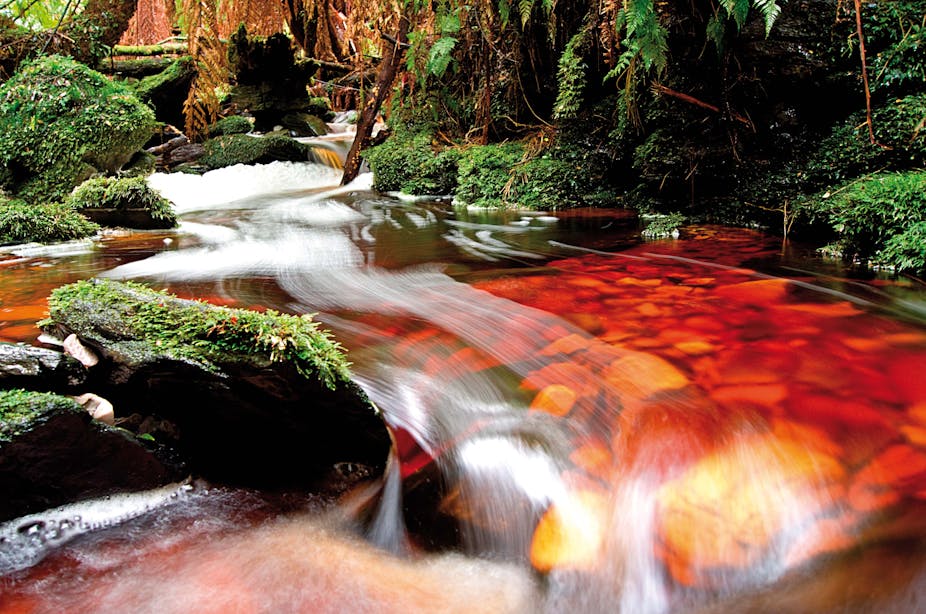
Tasmania’s Tarkine is now instantly recognisable, evoking ancient forests and environmental controversy. It hasn’t always been so, however, with research and celebration building over the past 40 years, as people come to understand its importance as a place, wilderness and habitat.
History of an idea
In 1967, in response to ongoing development pressure, the Circular Head Council enlisted volunteers to prepare a case for a Norfolk Range National Park. The volunteers proposed an area of 38,850 ha of the Norfolk Range and southern Tarkine coast.
Their survey work highlighted its primitive qualities, intact rainforest, sedgeland, dune coast environments and archaeological values. None of this had been previously documented. Their aspiration, which failed, was to combine the area with the declared Pieman River Scenic Reserve to the south and preserve its wilderness qualities.
Twenty-eight years later debate escalated around land use in the area. The Tasmanian Conservation Trust mounted a case for recognition as National Estate for its biological, physical and wilderness values.
The Tarkine began to be described as a distinctive wilderness landscape, an undisturbed habitat capable of sustaining ongoing evolutionary processes. It was during this time that the natural values of the Tarkine as a complete landscape were recognised and 300,000 ha were entered into the Interim List of the Register of the National Estate.
(The now defunct National Estate system has been replaced by National Heritage, of which the western edge of the Tarkine was recently made a part.)
In 2004 a collaboration between photographers and poets celebrated the Tarkine’s unique aesthetics and natural values. The photos found their home on coffee tables around Australia, showcasing the remote forests, wind swept coasts and button grass plains. These images created the visual material for emerging tourism branding and the notion of the Tarkine as a place was born.

Hidden treasures
Today the Tarkine is often informally recognised as the largest area of cool temperate rainforest in Australia. One of the most distinctive forests in the Tarkine is callidendrous rainforest (meaning “beautiful tree”), named for its open park-like habit. The Tarkine represents 6% of Tasmania’s land area, but contains 63% of Tasmania’s callidendrous forest.
Rarer still is a particular type of this forest growing on basalt soil. Seventy per cent of this type has been cleared, and the Tarkine holds 84% of the remainder. Only 11% of this is held in formal reserves, protected from mining. In the centre of the Tarkine is the largest continuous area of this type of forest.
When considered with the Tasmanian Wilderness World Heritage Area, the Tarkine forests are the second largest tract of mature coastal temperate rainforest in the Southern Hemisphere.
It is not just the forests that are distinctive. Underneath and on the edges of the callidendrous rainforest are rare magnesite karst systems, making the Tarkine a site of national significance for geoconservation.
Above ground the Tarkine is habitat for 117 threatened species of flora and fauna, and 30 priority species. Among these are tiny invertebrates called Pauropods dwelling in the moss and the bark of trees.
The Tarkine is even a hotspot for lichens. The endangered lichen Erioderma sorediatum is found only in the Tarkine. The area is one of three remaining sites where Bunodophoron notatum is found, after it became extinct in other areas due to logging in 2003. The full extent of the Tarkine’s natural values are still unknown.
In 2011 a new species of lichen (Cladia sp.) was discovered on the Meredith Range. In the same study Baeomyces rufus was recorded for the first time in Australia. Most remarkably the lichen Rimularia intercedens was found in the Tarkine, otherwise only known from the British Isles and Scandinavia.
Lichens are just the beginning. A full inventory of fungi in the Tarkine will likely take decades or more.
Debate continues around the importance of the Tarkine as a natural landscape and wild place. Investigations will be ongoing as communities try to understand the depth and breadth of its wilderness and natural values and their role in nurturing its scientific value into the future.