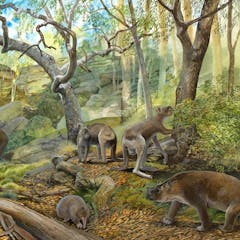
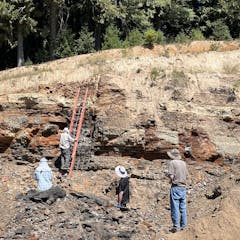
By examining fossilized bone tissue, a new study finds rapid growth was an asset for survivors of the Great Dying 250 million years ago, Earth’s largest mass extinction event.
People have collected fossil horses throughout North America for centuries.
Florida Museum/Mary Warrick
Horse fossils are abundant and widespread across North America. Scientists often use their long history to illustrate how species evolve in response to a changing environment.
A herd of the duckbill Minqaria bata wander along the shore of what is now Morocco.
Raul Martin
If the climate warms by more than 7 degrees, the likelihood of extinction for a species increases, regardless of its other traits.
A replica fossil of the titanosaur Patagotitan, one of the largest dinosaurs ever discovered. It would have weighed about 70 tons (63.5 metric tons.)
Spencer Platt/Getty Images News via Getty Images
Some of these giant vegetarians were as tall as a 3-story building. Microscopic analysis of their teeth, bones and eggshells reveals how they grew, what they ate and even their body temperature.
Details of a silicified fern fossil.
Geoff Thompson/Queensland Museum
Millions of years ago, widespread volcano eruptions in eastern Australia buried entire forests. Today, these time capsules reveal stunningly fossilised plants.
For decades, the sandstone in central Australia yielded tantalising segments of some sort of fossil fish. Now, we have finally pieced together a complete picture of this remarkable species.
An artist’s impression of the new pterosaur species, Cheoptera
Mark Witton/Natural History Museum
While NASA rovers on the surface of Mars look for hints of life, researchers back on Earth are studying ‘echoes of life’ from ancient basins – hoping that the two sites might be similar.
Artist reconstruction of Alienacanthus malkowskii, a 365-million-year-old placoderm fish from Poland and Morocco.
(Beat Scheffold & Christian Klug)
What paleontologists had believed to be spiny fins turned out to be elongated jaws. New examination of fossils that were 365 million years old revealed a fish with a remarkable lower jaw.
Ediacaran life as imagined by scientists in the 1980s.
Ryan Somma/Wikimedia
Fossil traces of the oldest complex ecosystems are found in precious few locations worldwide, including Australia. Newly dated fossils from Wales now join the ranks.
Artist’s impression of a group of Gigantopithecus blacki in a forest in southern China.
Garcia/Joannes-Boyau (Southern Cross University)