
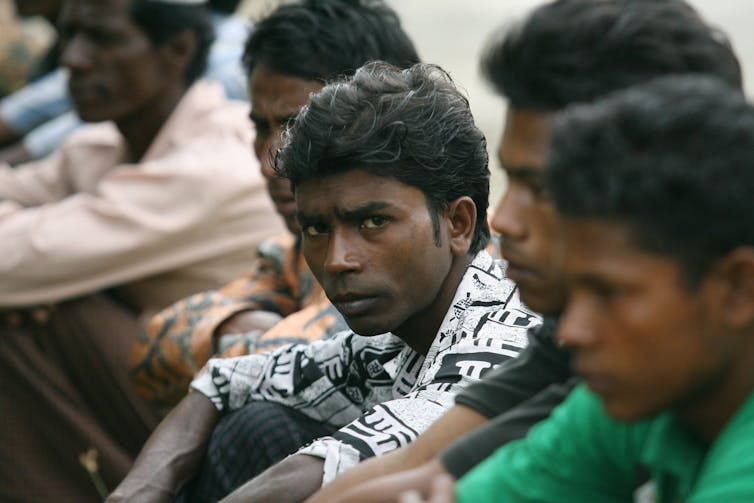
Indonesia is the last country of departure of most of the asylum seekers who arrive in Australia by boat. At the end of 2007, a team of researchers and I commenced a research project looking at the circumstances of asylum seekers and refugees in Indonesia. The fieldwork was conducted in the period October 2008 to November 2009.
The risk of return
The most important protection refugees need is protection from what is known as refoulement (i.e. return to a place of danger). This is a protection which state parties to the Refugee Convention, such as Australia, are legally bound to provide. Although Indonesia is not a party to the Refugee Convention, we found that Indonesia does not engage in deliberate refoulement, but there is a risk of the return of individuals who are refugees, but not identified as such.
Refugee status determination in Indonesia is undertaken by UNHCR. Our research found asylum seekers experienced difficulty in accessing UNHCR, delays all the way through the determination process, and refugee status determination which fell short of minimum standards of procedural fairness. All this gave rise to the risk of protection claims remaining unidentified or being wrongly rejected.
Indonesian detention
Most asylum seekers and refugees in Indonesia are present irregularly. Most enter without authorisation. Others remain after their visa has expired. Visas are usually issued for very short periods but status determination and the wait for resettlement can take years.
Both the Indonesian Immigration Law of 1992, which applied at the time of our fieldwork, and Immigration Law 2011 which applies now, provide for such individuals to be placed in immigration detention. There is discretion to make exceptions. But that discretion appears more constrained under the new law, and is not uniformly applied.
The conditions experienced by detainees vary greatly between different places of detention and even within the same place of detention can vary for different categories of detainee. However, generally speaking, the conditions would not be tolerated in Australia. Conditions aside, the fact of detention is of course a human rights concern in itself.
Life in limbo
The living conditions of asylum seekers and refugees at liberty in the Indonesian community differ depending on their sources of support. Officially, asylum seekers and refugees are not allowed to work nor do they have access to social support from the Indonesian government. Some receive assistance from UNHCR (through its implementing partner, Church World Service), the International Organization for Migration (pursuant to an arrangement with Australia), or local charities, but others have to fend for themselves.
Most of the individuals we interviewed were receiving assistance from UNHCR or IOM. The subjective perception of many of these interviewees was that the assistance they received was inadequate, although its value in fact exceeded the minimum local wage and, in most cases, the estimated cost of living in the locality concerned. Those who, for whatever reason, were unable to make ends meet on assistance received or who were receiving no assistance at all were working illegally with all of the potential for exploitation that entailed.
Our most significant finding, however, was that material living conditions were not the greatest concern of the individuals we interviewed. Rather most of their very real suffering and despair was caused by:
- being deprived of the sense of purpose and dignity which work provides,
- seeing their children miss out on education and hence the opportunities which education provides, and
- the sense of being trapped in a homeless limbo: unable to return to their country of origin, having no prospect of settling lawfully in Indonesia (an option which many would have chosen if it had been available), and having little prospect of being resettled in a third country.
Why do refugees get on boats?
The profoundly negative impact which life in limbo has on mental health leads some to start thinking that returning to the dangers of their home country would be preferable to their existence in Indonesia.
For example, one refugee woman told us,
If I die in my country it’s better for me. Because here I die and in my country die and it’s the die not change. But in my country you can die quickly by gun. Somebody kill you like this. Here by step!
Others start thinking that attempting to reach Australia by boat is the least horrible option available to them. It is very easy to understand why. From their perspective, all they are risking is their bodies, not their lives. Their lives have already been lost.
Why Australia? Because Australia is one of the very few countries in the Asia-Pacific region which presently provides refugees with effective protection and offers them a new home in the fullest sense of that word.
If our only concern is to stop the boats, one obvious option is to ensure that the treatment those who arrive on boats experience in Australia is far worse than the treatment they will receive in any other country in the region. That may work. Of course, we would have to sink so low we would not be able to keep up even the pretence of caring about human rights and the rule of law. Perhaps some will think that is a small price to pay. I do not, and nor should the government.
Read the rest of The Conversation’s asylum seeker coverage:
Asylum seekers and Australia: the evidence
The Conversation panel on asylum seekers: meet the experts
Infographic: global refugee populations 1975-2010
Refugee intake starts in the region: making a difference in regional burden sharing
Refugees and asylum seekers in Malaysia: the good, the bad and the unexpected
What does the Australian public really think about asylum seekers?
Resettling refugees: the evidence supports increasing our intake
What role does Australia play in accepting the world’s refugees?
Who are Australia’s ‘boat people’, and why don’t they get on planes?
Uncomfortable truths: busting the top three asylum seeker myths
There’s no evidence that asylum seeker deterrence policy works
There’s more to regional collaboration than the Malaysia Arrangement
How immigration policy harms asylum seekers' mental health
Preventing deaths at sea: asking the experts on asylum seekers
Jim Wright
Retired Civil/Structural Engineer, IT Consultant/Contractor
Looking back on the huge amounts of money spent on the various 'solutions' to the problem of asylum seekers, would it not have been more effective to have our own offices in places where refugees gather so that they can be processed at points closer to their countries of origin? It would be easier to investigate their credentials, their position in 'the queue' would be more explicit and the huge amounts asylum seekers pay to find their way to Australia could be better spent on more comfortable and direct transport or to help them become established in Australian society.
Marilyn Shepherd
pensioner
We already do that but the purpose is so we don't have to accept anyone except if we are the country of last choice.
And the fact is that asylum seekers can only apply for PROTECTION in the countries that have ratified the refugee convention and PROTECTION is defined as the right to live the same as nationals, the right to work and education and support without further punishement.
http://www.immi.gov.au/visas/humanitarian/
Read moreThe offshore component of the Refugee and Humanitarian Program…
Sean Lamb
Science Denier
Pakistan is engaging in refoulement on a massive scale - 2 million strong I think.
Since we pretty much run Afghanistan we could easily set up camps there where Afghani refugees could be absolutely safe from persecution.
The UNHCR could then process their applications, and on the plus side, if they ever did feel it was safe to venture out, they would be able to keep in touch with their families.
"Of course, we would have to sink so low we would not be able to keep up even the pretence of caring…
Read moreMarilyn Shepherd
pensioner
But we are not doing it to alleviate anyone from suffering, we are doing it on the pretext that helping 0.0001% of the world's refugees helps anything at all.
We waste $1.2 billion per annum to keep people out, another $1.2 billion to lock them up if they get here and our current aid level to the Afghans is $3.65 per person per annum
Joseph Bernard
Director
Compasion is a double edge sword here,
we help those that manage to get here, which just encourages more people to risk their lives to get here and brave the shady world of the people smugglers.
The people smugglers would probably be contributing to greens to promote business..
this is a complex issue and there must be other approaches here.. surely..
for example.. if education is an issue then steting up infrastructure for online courses and consulting to afghans and investment for initiatives may help them build a life for themselves in their own country.. after all they can not all move here
Felix MacNeill
Environmental Manager
Joseph, you can follow the rest of the sheep and repeat that canard about the Greens encouraging people smugglers but, to do so, you have to completely ignore the very significant body of expert opinion that the off-shore processing alternatives suggested by both Labor and Liberal are very probably ineffective and waste large amounts of money doing little more than brutalising the refugees involved without fixing anything, and you also have to ignore that fact that the Greens have advanced reasonable…
Read moreJoseph Bernard
Director
"Compasion is a double edge sword"
@Felix.. can you see for one moment that people smugglers are making a shit load of money and that they are probably promoting a dream to suck people into these risky attempts journeys!
Yes we must be compassionate but is that helping this situation..
please offer some food for thought here or are you just going to insist that we encourage more people to risk their lives and give people smugglers a bigger market opportunity?
Marilyn Shepherd
pensioner
There are no smugglers doing anything, there are simply refugees paying for transport and even if some of the transport is dodgy there are no gangs running around kidnapping refugees and forcing them to leave their homes at gunpoint. People leave because of what is happening in their countries, not because they want to go on a joy ride.
This people smuggling crap only came into being under Ruddock and our worthless media are too lazy to look at the massive body of evidence that shows it is not…
Read moreFelix MacNeill
Environmental Manager
Joseph you have completely failed to respond to anything I actually said and merely demonstrated your refusal or inability to examine the matter rationally.
Did I at any point deny that there may well be people making money out of 'people smuggling?' NO
Did I suggest that all that was needed to fix the problem was compassion? NO
I did offer food for thought - i.e. the suggestion that people actually examine the Greens policy dispassionately and note that it was based on reason and evidence and offered an alternative - and that, therefore, even if one disagrees, it should not be glibly dismissed as encouraging people smugglers - particularly as the case that offshore processing 'stopped boats' is highly contestable.
Predictably, you have put words in my mouth - AT NO POINT did I suggest that 'we should encourage more people to risk their lives and give people smugglers a bigger market opportunity'. I find that sugestion every bit as offensive as it is false and irrational.
Joseph Bernard
Director
I really do not care to discuss the pro and cons of the greens policy..
lets stick to the topic of what is infront of us here.. get off your green soap box and consider that:
"Compasion is a double edge sword"
Felix MacNeill
Environmental Manager
Joseph, it's quite obvious that you really do not care to discuss anything rationally, merely repeat a few cliches and some vague pseudo-gnomic statement: 'compassion is a double edge sword'...about as meaningful as saying 'bananas are yellow fruit'.
I am not on a green soap box - all I suggested was that any reasonable being weighing up the policy alternatives offered by the three main parties, on the basis of evidence, would conclude that claims by both the Coalition and Labor that off-shore processing would effectively stop people smugglers and dangerous boat trips were at best dubious and that alternatives, such as those proposed by the Greens, were perfectly reasonable and deserving of open-monded consideration - not just knee-jerk abuse and dismissal via the glib repeating of emotive slogans.
Peter Ormonde
Peter Ormonde is a Friend of The Conversation.
Farmer
Excellent piece.
My goodness me there is a lot of confusion about who refugees actually are and what they are fleeing... why they get on these leaky boats to come here. They seem to regard them as economic migrants like our grandparents. But this desire for a more comfortable material life does not get one into the refugee classification. You have got to be running away from something... something damned serious.
Only people who have never suffered - who do not understand or care what happens to minorities or the vulnerable - can hold such views... particularly the self-serving notion that they only want to come here because of the hand-outs and comforts afforded. They don't get accepted.
John Harland
bicycle technician
Our economists hammer us about the need for "growth" to the extent that Peter Costello was preaching about the "need" to raise our national birthrate.
The miners in Western Australia want to import labour.
Where is the problem with welcoming refugees to help build our country again, as we did in the 1950s?
I am grateful that Australia provided a home for my mother in 1946.
Philip Dowling
IT teacher
Skilled labour.
OH and S demands English.
Bruce Waddell
logged in via LinkedIn
I'm finding it difficult to understand why there is so much pessimism in Australia at present. With the pessimism comes intolerance and headlines such as, "Stop the boats!" This article needs to be read by the nay sayers and the whole country needs to lighten up or our fear will become our new reality.
And I'll join my voice with Malcolm Fraser and say we need to work more with UNHCR.
Philip Dowling
IT teacher
In this explanation, I am puzzled with a few details.
Visas for example.
Please be advised that Indonesian entry and visa procedures may be inconsistently applied at different ports of entry, and when faced with making a decision, Indonesian authorities usually make the more conservative, restrictive decision.
Read morehttp://travel.state.gov/travel/cis_pa_tw/cis/cis_2052.html#entry_requirements
While Iran is on the visa on arrival list, Pakistan, Afghanistan and Sri lanka do not get a guernsey.
Thus…
Frederika Steen
logged in via Facebook
Thank you for a useful contribution!
As a modern, wealthy nation built on immigration, who are we to look for an "Indonesian Solution" , who are we to expect a sovereign nation with its own enormous challenges to make up for our dereliction of duty in relation to people seeking protection?
End mandatory indefinite detention of asylum seekers and redirect the millions to supporting integration where possible and helping UNHCR with resettlement of mandated refugees, because "genuine" refugees will continue to flee the persecution, and why not seek asylum in Australia? .