


AUSTRALIA IN ASIA: In the fourth part of our series, Deakin University’s Matthew Clarke examines why more Australian aid to Asia would improve regional security.
Australians are a generous lot. On a per capita basis, public donations to help those affected by natural disasters are amongst the highest in the world. And the government provides a substantial aid budget too, although its motives may include more than just seeking to reduce poverty.
Public donations
Studies show that it doesn’t hinge on where emergencies occur or what type they are, Australians will respond to appeals for aid. It doesn’t even matter how long it has been since the last public appeal. Where a need exists, Australians will answer the call.
Non-government organisations receive around $1 billion a year from the public, with nearly one in twenty Australians donating on a monthly basis to child sponsorship or similar fund-raising schemes.
AusAid’s budget
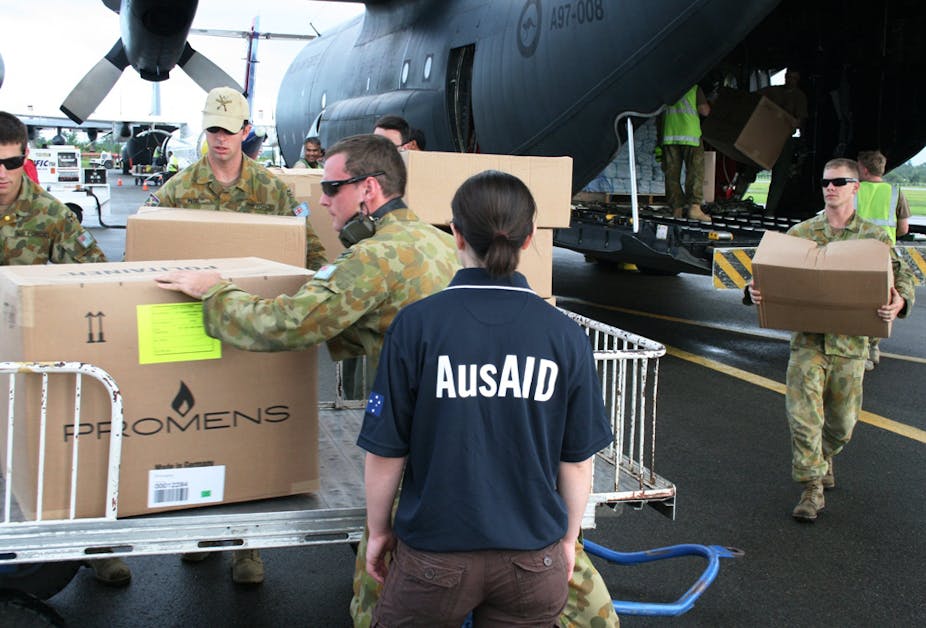
In a similar vein, the Australian Government also has a very generous international aid program, administered by AusAID. Currently it provides around $4.5 billion in official development assistance, predominantly to developing countries in the Asia-Pacific region.
This is the 13th largest aid program amongst OECD countries. And it’s slated to increase to around 0.5 of gross national income by 2015, pushing it up on the OECD list of generous nations.
Aid in this program is largely targeted towards the achievement of the Millennium Development Goals so focuses on poverty reduction, education, women and children’s health as well as water and sanitation.
Size isn’t everything
Of course, it’s not the size of the aid program that ultimately matters – but rather its effectiveness.
While examples of failed interventions will always be found, the recent Independent Review of Aid Effectiveness found that the Australian aid program was “good”. The most indicator being whether the program has achieved that it set out to do.
While the primary purpose of aid is to reduce poverty and achieve sustainable development, it is important to realise that the Australian government makes clear that those goals also serve Australia’s own national interest.
Aid in the national interest
Aid that improves regional security is not just of benefit to local communities, but also to Australians travellers and companies doing business in the region.
Poverty is a major source of insecurity, so while it may be easy to be cynical about the aid program serving Australian interests first and foremost, our national interest does neatly synchronise with poverty reduction in the region.
The building of mosques to support moderate Islamic schools in Indonesia, the focus on education and health programs in Papua New Guinea, and the building of community buildings in Afghanistan result in both enhanced opportunities for local communities as well as promoting Australia’s needs. These activites are important as they address real needs for these communities.
Risks of aid
Of course, aid can of course be utilised in a manner in which national interests are given primacy over poverty reduction.
When economic resources are scarce within developing countries, aid can ease this scarcity and subsequently can enhance Australia’s standing within the recipient country.
A generous aid program that allows local communities or leaders to access resources that would normally not exist does deliver influence and support in other forums.
A cynical view would understand this as abuse of aid. A realist would see it being used more as a tool of diplomacy.
Striking the balance
We shouldn’t shy away from the reality that aid can serve two goals. The importance is of course getting the balance right.
As the Australian aid program continues to expand, there may be increased pressures to use it first and foremost to support our diplomatic endeavors.
As an adjunct to our efforts of diplomacy, this is appropriate if the aid mutually addressed real humanitarian needs.
If it fails this test, then we can no longer consider it aid.
This is the fourth part of our Australia in Asia series. To read the other parts, follow these links:
- Part one: Is Australia ready for the “Asian Century”
- Part two: Australia in Asia: How to keep the peace and ensure regional security
- Part three: The lucky, lazy country shows how not to win friends in Asia
- Part four: How Australian aid in Asia can benefit those at home
- Part five: Learning to live in the Asian Century
- Part six: Colombo plan: An initiative that brought Australia and Asia together
- Part seven: Why Australia’s trade relationship with China remains at ground level
- Part eight: Finding the balance between India and China in the Asian ‘concert of powers’