Cruel slaughter of Australian animals in countries where abattoir workers face poor economic conditions can only be stopped with the long-term ban of live exports.
Flickr/Joe Shlabotnik
In Enid Blyton’s Magic Faraway Tree, Jo, one of the child adventurers, has a spell cast upon him that forces him to walk upside down on his hands in Topsy Turvy land. Jo survives the ordeal as most humans…
It makes sense to exercise caution when we’re fiddling with genes in food.
Food Ethics Council
Most genetically modified (GM) crops are based on moving DNA from one organism to another to introduce a new protein. Now a growing number of genetically modified crops are based on intentionally changing…
Around the world, there are more than 20,000 bee species: this is Australia’s blue banded bee.
Louise Docker
Honeybees are in trouble – a stressful lifestyle and an unhealthy diet are being compounded by mite attacks – but we needn’t panic about pollination. Australia has many native bee (and other pollinator…
Vaccination has a lot more uses than you may know.
Stephen Mitchell
Approximately 140 vaccines are registered for use in livestock and companion animals in Australia. Many more animals are vaccinated each year than humans.
Vaccines are used in farm animals:
to protect…
Incidents of major agricultural run-off, like the recent Queensland floods, certainly affect Great Barrier Reef water quality, but systems are in place to reduce their effect.
AAP Image/Twitter, ISS, Chris Hadfield
The Great Barrier Reef (GBR) is both a national marine park and a World Heritage Area. But next to the reef, a catchment of 400,000km2 is almost completely developed for agriculture, predominantly beef…
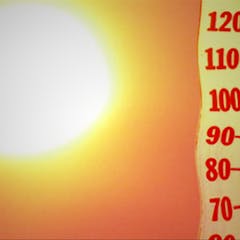
More and longer heat waves are coming, so researchers are making sure our crops are ready.
Amy Mergard
Australia broke its “hottest day” record this week, and heat waves are becoming more common in Australia. Heat waves are projected to increase in duration and intensity with global warming and climate…
Christmas is a time of plenty – but to ensure we keep eating well in the future, it’s time to rethink the way we buy and produce food.
Barbeque image from www.shutterstock.com
As we gather to share a meal with friends and family this festive season, it is the ideal time to reflect on our relationship with food, including our dependence on those who grow it for us.
Australians…
Foresters and farmers have an 8000-year history of dealing with climate variation and providing food and provisions – they may have climate change solutions.
Ollivier Girard/CIFOR
By Peter Holmgren, Centre for International Forestry Research
The UNFCCC COP-18 in Doha worked overtime to finally agree not to disagree. The Secretariat was quick to make a release that declares success and highlights four results:
Amendment of the Kyoto Protocol…
As any barramundi fisher will tell you, northern Australia’s water isn’t going to waste.
Justin Friend
With increasing pressure on Australia’s water resources, many have looked to northern Australia to provide water for agriculture, urban development and other human needs.
Much of northern Australia is…
Australia’s food chain has among the lowest rates of antibiotic resistance, but new threats call for stronger monitoring.
Eli Duke
Australia has some of the world’s most conservative restrictions on using antimicrobial drugs in livestock. Possibly as a consequence, we have some of the lowest rates in the world of antibiotic resistance…
Everyone seems nervous to talk about changing our diets.
Sumlin/Flickr
Reducing your carbon footprint by eating less red meat rarely gets attention. This strategy has been recommended by the UN’s Food and Agriculture Organization, epidemiologists writing in The Lancet and…
It may not be a silver bullet, but biochar has a lot to offer farmers (and the atmosphere).
sillypucci/Flickr
Evelyn Krull, a research scientist at the CSIRO, asked in these pages whether biochar could save the planet. Eighteen months have passed and although research efforts continue, still no meaningful quantities…
Overuse of nitrogen fertiliser can have nasty environmental consequences.
eutrophication&hypoxia/Flickr
Planet Earth has boundaries for its biophysical subsystems. By 2009, we had already exceeded three of the boundaries – climate change, biodiversity loss, and the nitrogen cycle.
Climate change is a top…
Flooding risk is often used as an argument against greater environmental flows for the Murray-Darling, but graziers would benefit greatly from floods.
Richard Kingsford
The history of our development of the Murray-Darling Basin is one of constraining and constricting its rivers’ flows. Many of the basin’s floods are now captured in dams for later constrained release to…
Phasing out live exports may be the only way to save Australia’s northern cattle industry.
AAP Image/Dave Hunt
Temporary bans on live cattle and sheep export have undermined confidence in the industry, driving property prices down and diminishing banks' willingness to lend for long-term improvement. If the industry…
Killing starfish one by one is no long-term solution.
Paul Cizek
A recent report on coral loss from the Great Barrier Reef has pointed the finger at cyclones and Crown of Thorns starfish. The real culprit is human activity, and until we reduce port activity and pollution…
Brigalow trees are vital for soil health and erosion control. They’re only just recovering from 19th century clearing. Why does the Queensland Government have it in for them?
Arthur Chapman
The Queensland State Government has recently proposed changes to the Vegetation Management Act 1999.
Under the planned reforms, landowners will be able to clear and thin out vegetation using self-assessable…
A river at Cubbie Station, southwest Queensland, in 2004.
AAP/Supplied
Until the recent bid from a Chinese-Japanese consortium Shandong RuYi for megafarm Cubbie Station, it appeared the property would limp along under locally-based administration.
But then the opportunity…
Sensible Australian farmers don’t object when foreign investors want to buy their problematic assets.
AAP Image/Cubbie Group
Controversy surrounding the recent sale of Cubbie Station in Queensland near the New South Wales border to (mainly) Chinese interests is not unexpected. Fears about foreign ownership in Australia are long…
Some of the biggest water-energy-food integration challenges are on better soils close to major population centres; in this case, Adelaide.
Andrew Campbell
Rural research is vital. It is about 10% of our national innovation system. Annual investment exceeds $1 billion, according to the Rural Research and Development Council. The rural sector and farm-dependent…
Methane-capture technology in Grantham, Queensland, could earn carbon credits through Australia’s Carbon Farming Initiative.
AAP/Alan Skerman
Today, nearly 1.3 billion people – almost a fifth of the world’s population – live on “fragile” agricultural land. Just one-third of the rural poor in developing countries live on productive agricultural…
With so many vested interests, opposition to the plan will likely last a long time yet.
SA Eco Images Pty Ltd
As the final version of the Murray-Darling Plan heads to Parliament there seems little doubt that the debate will continue. The sticking point remains the volume of water to be returned to the environment…
Time to get our eyes back on the prize: the pragmatic, results-focused, multi-sector research effort of recent decades has stalled.
Welcome to Part Two of Professor Andrew Campbell’s special report on the troubling plight of irrigation research and development in Australia.
In part one, Professor Campbell argued that despite an unprecedented…
Efficient water use is ever more important, yet budgets for vital irrigation R&D are declining.
A. Campbell
Welcome to a two-part special on the troubling plight of irrigation R&D, by Professor Andrew Campbell of Charles Darwin University. Research into the smartest, most efficient and sustainable ways to…
The rains came too late for these Texas wheat crops, which are stunted and thin. But there’s more to rising food prices than bad weather.
Flickr/agrilifetoday
Not so long ago, things were looking good. The UN’s Food and Agriculture Organization (FAO) had announced on the 5th of July that the FAO food price index had been falling for the third consecutive month…
It would be smarter to use perennial native grasses for cereal grains instead of relying on a handful of farming-intensive annual crops. Shown here is Curly Mitchell grass (Astrebla lappacea), common in northern Australia.
Ian Chivers
Any investment manager will tell an investor to spread risks, to have a diverse portfolio, to engage with many sectors of the local economy, to invest in other parts of the globe, to hedge your bets, a…
Harvest time: Asia’s rising incomes and demand for food are no guarantee of a mining-style payday for Australian farmers.
AAP/EPA/Raminder Pal Singh
In recent weeks Australia’s PM, a shadow minister, and a state premier have heralded the opportunities for Australian farmers to capitalise on a global food-shortage and, in particular, rising demand for…
Community gardens in Melbourne: urban food production is increasingly important but obstacles are heaped in its way.
AAP/Julian Smith
Food security has typically been framed as an issue of global concern, concentrated within developing countries. The UN Food and Agriculture Organisation defines food security in terms of the availability…
Climate change is only one of many pressures farmers will have to adapt to.
Pete Hill
Opinions on anthropogenic climate change vary greatly across society, and it appears that Australia’s farmers remain largely sceptical about the causes of climate change.
Recent surveys show that only…
For most farmers, it will take more than money to get them involved in carbon farming.
Drew Bandy
The Carbon Farming Initiative (CFI) and Biodiversity Fund, two new Australian government initiatives, could help private landholders generate income while benefiting both climate change abatement and biodiversity…
Genetically modified crops have allowed pesticide spraying to be reduced by almost half a million kilograms in the last 15 years.
Eric Constantineau
Recent news reports claim one in ten Australians believe the world will end on December 21, 2012, based largely on internet gossip about the meaning of ancient stone carvings from the Mayans of Central…
Farmers are adept at using science to deal with all kinds of challenges, but they have their doubts about climate change.
Jeff Pang
Farmers are some of the most innovative Australians – since 1970 they have lost 7.5% of arable land, but they’ve found ways to increase production by 220%. They’re also some of the most conservative, expressed…
Irrigation infrastructure, buy-backs, environmental flows, agricultural communities: lobbyists will say anything to win the Murray-Darling war of lies.
Eco Images Pty Ltd
When the water planning process for the Murray-Darling Basin first commenced, an experienced colleague of mine noted that this was shaping up to be a lying contest between farmers and environmentalists…
Decades of work to reduce rhino poaching has achieved little. Farming rhino is one alternative, but what happens to a species when it’s domesticated?
Jim Epler
When we talk of conserving an animal species what do we actually mean? We are likely to have in mind a vision of a rhinoceros (or any other species, for that matter) being given the opportunity to pursue…
Consumers have an image of animal agriculture which is getting further and further from the truth.
State Records NSW
It has once again been left to an advocacy group, Animals Australia, to highlight the cruel practices involved in cattle slaughter in Indonesia. Under new rules put in place by the Federal Department of…
Food is an emotional topic. Everyone cares about what they eat. Food often has a strong cultural, religious or even political meaning attached to it. Organic food is no different in that respect. People…
The point of planting trees is to create ecosystems; we need science to tell us which trees work.
Cyron Ray Macey
One of my most vivid and lasting memories as an ecologist dates back to 1997. I was in the office of the then Environment Minister. I was told by the Minister and his minders that “we already knew everything…
Guardian animals, a environmentally friendly and adorable way to protect our livestock.
Karen Rodgers
True innovation is rare in agriculture. Most farmers are willing to improve the way they work, but these improvements are typically small adjustments to established practice, rather than fundamental changes…
Biodiversity and farming are uneasy bedfellows: a lonely tree in a canola field in Western Australia.
Flickr/augustusoz
Biodiversity and farming go head to head in two R&D projects that I have a hand in. The struggles to both feed the swelling ranks of humanity and save our continent’s natural splendour are so often…
Our thinly spread efforts to prop up the environment are failing and it is time for tough decisions about what we can realistically preserve.
Flickr/rexboggs5
Australian farmers take pride in their efficient and productive farming systems, competing in the global economy and without many of the large subsidies given to their counterparts in Europe and North…
Grain agriculture devastates ecosystems, but who is the grain grown for?
Peter Castleton
More and more, the animals we kill for food are dining at the human table. Increasingly, we feed them on grain, soybeans and fish meal.
Recently, Professor Mike Archer published an article on The Conversation…
Working with farmers, Australian researchers have come up with technology and methods to make farming kinder to the environment.
Chesapeake Bay Program
The misconception of Australian agriculture being inefficient and unsustainable is deeply concerning for me. Images of dusty ploughed fields and dying sheep and trees are misleading. On the contrary, if…
Chocolate supply can’t keep up with demand and smallholder farmers and the environment are losing out.
Nestle
Chocolate – from the humble confectionery bar to single-origin gourmet dark chocolate – is enjoyed by most Australians as a readily available treat. However, chocolate manufacturers are worried that cocoa…
How do farmers cope with the cycle of floods and droughts?
recoverling/Flickr
It has been a summer of flooding for farmers in northeast Victoria and NSW. Reporters talk about the effect on crops, pastures and yields. But what about the effect on farming households? How do they cope…
2012 is the Australian Year of the Farmer. This initiative aims to increase knowledge and understanding of the role Australian agribusiness plays in food security, technological innovation and the nation…
The carpet of sludge and debris left by 2011’s tsunami wreaked havoc on paddyfields.
AAP
By Darren Plett, Australian Centre for Plant Functional Genomics
Japan’s tsunami of March 11 2011 brought a wall of water laden with debris up to 5 kilometres inland from the sea. After the surge receded, the surrounding farming area was left covered in debris and…
Manure is a great source of phosphorus, but we’ve largely removed it from agriculture.
Flickr/Amy Alana Star
By Stuart White, University of Technology, Sydney and Dana Cordell, University of Technology, Sydney

Without phosphorus we cannot produce food. Yet even as pressure mounts on this critical non-renewable resource, there is a startling lack of global governance of its use and supply. If no one takes responsibility…
Will we see another lobby group leader who genuinely wants solutions?
AAP
When was the last time the head of a national lobby group led a national initiative in the national interest, way beyond the comfort zone of the majority of their constituency?
Where are the national…
We take for granted cheap and plentiful fruit and vegetables and “forget” about shortages.
AAP
How should we consider the potential broader ramifications of Coles’ recent promise to reduce by 50% the price of fresh fruit and vegetables?
In the face of cheap fruit and vegetables, it is hard to take…
Are fruit and vegetable producers being caught up in the pricing war between Coles and Woolworths?
Supplied
Amid tough trading conditions and intense competition, Coles has fired the latest salvo in its ongoing supermarket war with Woolworths, announcing it will reduce the price of some fruit and vegetables…
We need to think about the benefits of locally grown food before signing off on suburban sprawl.
avlxyz/Flickr
In 1947 the Sydney Basin produced “three quarters of the State’s lettuces, half of the spinach, a third of the cabbages and a quarter of the beans; seventy percent of the State’s poultry farms were in…
As the days get warmer, cool-climate wineries like those in McLaren Vale SA, are bound to struggle.
Dave Clarke
As the climate gets warmer, growing conditions and ripening times of crops will be affected. This raises all kinds of challenges for food security, but as we hit the festive season you may also be wondering…
The “prices are down and staying down” mentality doesn’t support sustainable agriculture.
Kolya
There is no doubt that the greatest challenge currently facing agriculture is our capacity to feed an anticipated population of 9 billion by 2050.
Not only is there an increasing demand for food, but…
A Green Climate Fund could help African livestock farmers.
International Livestock Research Institute
DURBAN CLIMATE CHANGE CONFERENCE: With a backdrop of global financial woes and the European Union’s debt crisis, the Conference of the Parties at Durban convened with lower expectations but high stakes…
When discussing animal welfare, it’s hard to look at it from the animal’s perspective.
phik
Which is the greater deprivation for an animal: to live a good-quality life abbreviated at less than its natural term by painless slaughter for meat, or to never live at all? How much of an animal’s life…
Farm yields in Australia rely on phosphorus, but we could be using it more efficiently.
p3anut
Phosphorus fertiliser might not spring to mind as highly important to our everyday lives in Australia, but it is critical for our grazing and cropping farms. This is because the majority of Australian…
Where do eggs – and chicken meat – come from? Not where they used to.
Jane Rawson
When my mother was a young girl, she – like most families in the country – kept a few chickens in the back yard. Once a day she went out and gave them household scraps, and they rushed over to greet her…
Increasing population and climate change will make it even harder for the world to feed itself.
Gates Foundation
The world’s population has just hit seven billion and nearly one billion people do not get enough to eat. Agricultural land is being degraded at the rate of 12 million hectares a year and the world faces…
Farmers have been shocked to find coal seam exploration companies can enter their property.
kateausburn
All over Australia, landowners are fighting to keep mining companies off their property.
From the Darling Downs to the Liverpool Plains, farmers have been locking out coal seam gas extraction companies…
Rain is encouraging kangaroos to breed, and making farmers nervous.
Wombalano
Spokespeople for the Kangaroo Industry Association of Australia and some other pastoralist organisations, are warning that in the current land of “flooding rain”, landholders will be overwhelmed by burgeoning…
Understandably, farmers get worried when they think their water is under threat.
Phil Schubert
There are many good reasons why the general public, and in particular farmers, are concerned about coal seam gas (CSG) extraction. There are major gaps in our knowledge about the future impacts of CSG…
First step: address under-investment in agricultural research and development.
AAP
CHOGM: As the leaders of Commonwealth nations meet in Perth, The Conversation is examining the role of the biennial Commonwealth Heads of Government (CHOGM) Meeting.
Daniel Rodriguez from the University…
Hot, dry Australia isn’t a great place to grow wheat.
AAP
The agricultural use of genetically modified (GM) plants has been a subject of disagreement, debate and bitter conflict around the globe. Sectors of Australian science experienced this recently when field…
Beef processing contributed to Cargill’s $US2.7 billion in earnings this year.
AAP
Welcome to “The most powerful companies you’ve never heard of” – an ongoing series from The Conversation that sheds light on big companies with low profiles. Today, The University of Queensland’s Clive…

Canola is one of two GM crops approved in Australia.
Ngarkat
The Conversation recently published an article looking at the myths about genetic modification. This article is a rejoinder to that piece, and a contribution to the ongoing debate about whether there is…
Could more CO₂ in the atmosphere mean faster-growing crops?
Jose Cabezas/AFP
Life is woven out of air by light – Jacob Moleschott
Before starting to write this article, I asked my eight-year-old boy what he knew about how plants grow.
He answered: “Plants take food from the air…
Iron-rich rice helps feed the poor: could we do it without patenting?
Jane Rawson
By Michael Gilbert, Australian Centre for Plant Functional Genomics
Rice is the primary source of food for roughly half the world’s population. But it falls well short of providing enough iron, zinc and pro-vitamin A to meet daily nutritional requirements.
Iron deficiency…
Grape growers are already suffering emotional stress because of climate change.
ryanovineyards/Flickr
Mental health has been an issue in rural areas for the past few decades. Climate change will only add more stress to the lives of rural people.
While a report by the Climate Institute shows broad scale…
In India, species decline when they have to share land with agriculture.
flickrPrince
So, we have to feed an extra 2.5 billion people by 2050. For those of us interested in the future of biodiversity on this planet, this poses an uncomfortable challenge. It is also the topic of a recent…
GM is not being used to make fishbread Frankenfoods.
Dave Lifson/Flickr
The Conversation asked CSIRO scientist, Richard Richards, to look at the top five myths about genetic modification (GM), and correct the public record.
Myth one: GM is just haphazard, imprecise cross…
Your cafe breakfast was brought to you by phosphorus, but we’re running out.
caccamo/Flickr
By Dana Cordell, University of Technology, Sydney; Stuart White, University of Technology, Sydney, and Tim Prior, University of Technology, Sydney
Take a moment to think about your next meal. It will contain phosphorus. You contain phosphorus. In fact, you can’t survive without phosphorus: it’s in our DNA and our cell membranes. Nothing can survive…
Environmental activists have targeted palm oil – an industry crucial to Indonesia’s development.
AAP
In 1990 there were about 400 international environmental groups. Today, this number is more like 1.4 million.
So why is the world apparently in a worse state now? Have environmental groups paid too much…
The benefits of lifting the import ban on bananas outweigh the risks.
Maxey
The ban on importing apples from New Zealand was lifted earlier this month, bringing to an end a restriction established in 1921.
With this long history of protection from imports, it is not unexpected…
Despite attacks, CSIRO isn’t giving up on genetic research.
AAP
Just as medical researchers work to unlock the role our human genes play in disease, CSIRO investigates how plant genes can be used to boost the health benefits of food, increase crop yields and prevent…
Farmers are worried about their land and water, but governments want their gas.
AAP
Food security and energy security are paramount to the survival and growth of Australia. Food security so that we may feed ourselves (and a hungry world), and energy security for transport, heating, lighting…
Greenpeace’s wanton destruction of scientific research is a threat to farmers.
AFP PHOTO/HO/GREENPEACE
Early yesterday morning Greenpeace Activists broke into a CSIRO research farm and destroyed a field trial of genetically-modified wheat.
I was appalled.
“But it was only a field trial,” I can hear some…
More than just a patch of dirt: the clean energy plan should help us get the most out of our land.
bfick/flickr
The Australian government’s plan for a Clean Energy Future contains a number of measures aimed at supporting farmers and land managers to provide emissions offsets.
The plan consists of a mix of market…
Funding for agricultural research and development has to come from somewhere.
AAP
Food security is on the agenda for Australia. I wrote on this recently, pointing out that while we currently grow enough to feed 60m people, we are not immune to food security pressures.
Wealthier nations…
Smaller farmers face increasing competition and struggle to break into institutional markets.
AAP
Agriculture in Australia is at the crossroads. Not only must smallholder farmers contend with the adverse impacts of global climate change, a strong Australian dollar and greater deregulation in the market…
Welfare standards adopted as part of the ban being lifted fall short of public expectations.
AAP
When it comes to the live animal export industry, the government’s knee-jerk reactions leave it open to criticism that it dances to whichever group, industry or the animal activists, plays the loudest…
If farmers aren’t exempt, times could get even tougher.
Big Grey Mare/Flickr
The recent announcement that a carbon tax would not be levied on petrol for cars or light vehicles used by motorists, tradespeople and small businesses is an interesting political statement.
But this…
Greens leader Bob Brown’s concern over acquisitions by China’s Shenhua Watermark Coal of farms on NSW’s Liverpool Plains is but the latest flurry in a gathering storm of controversy over mining developments…
Planting trees on farmland can offset emissions, but does it add up?
Fabio Strozzi/flickr
Planting trees in cleared agricultural landscapes is one way for the land use sector to help offset emissions of atmospheric carbon dioxide. But will it displace agriculture?
Establishing trees is a robust…
It costs extra, but where is the money going?
Flickr/EricMagnuson
That “fair trade” sticker on a bar of chocolate or bag of coffee beans might make you feel better, but there’s no guarantee it’s helping poor farmers. In fact, it may be making their lives worse.
When…
Can trade regulation enhance – or block – improvements to animal welfare?
AAP
The suspension of live cattle exports to Indonesia will also have significant implications on Australian cattle farmers, Australian and Indonesian domestic markets, and on the trade relationship between…
Livestock may also face mistreatment without leaving Australian shores.
AAP
Throughout the heated debate around live animal exports over the past week, there has been an implicit assumption that the mistreatment of Australian cattle only ever begins after the animals have left…
Irrigators say they like the Windsor Inquiry, but are they looking after their own interests?
AAP
The Windsor Inquiry has handed down its report on the Murray-Darling Basin Plan. It recommends a halt to water buybacks, more investment in irrigation efficiency and a new governance model for the Basin…
Indonesian abattoirs should agree to stun cows before they’re slaughtered.
AAP
The Federal Government’s move to ban live cattle exports to a handful of Indonesian abattoirs will not, in the long term, end the inhumane slaughtering practices revealed in Monday’s Four Corners report…
Peak coffee or no peak coffee, it’s the farmers that end up empty handed.
AAP
Coffee prices are rising again, and you might be wondering how much more you’ll soon pay for your morning coffee.
Although coffee prices are fickle the fluctuations affect most of us very little compared…
It doesn’t look like much, but a lot of hopes rest on biochar.
Flickr/visionshare
In our efforts to address climate change by avoiding or sequestering CO₂, we have shown a lot of interest in “engineering” solutions (such as carbon storage through pumping and storing CO2 underground…
She’ll be apples – or will she?
flickr/Andy Polaine
Victoria now has a Minister for Food Security and the Federal coalition too has rebranded its shadow minister Minister for Agriculture and Food Security.
Food security is a notion that over the last three…
Farmers are fired up, but it’s not as bad as they think.
AAP
Reports of the death of the Murray Darling Basin food bowl are grossly exaggerated, to borrow a phrase from Mark Twain.
Farmers have been up in arms about plans to give more water to the environment…
Publicly funded scientists have a responsibility to the public.
AAP
Australian science institutions and scientists must retain the confidence of the public and Australian governments. By blurring facts, disrespecting other institutions' research processes and turning their…
It’s blue skies for some parts of the Basin, but others are left wanting.
AAP
The controversy over the Murray Darling Basin Guide centres on the need to strike a balance between the social, economic and environmental uses of water.
The difficulties in undertaking this task are…
Buying up farmland in developing countries may be the only answer.
ILRI/flickr
FOOD SECURITY – You don’t hear about it as much, but global food security is a major issue, probably of more concern than climate change.
It is driven by increasing population, changes in diet, increasing…
We need to preserve and conserve our soils to protect our food supply.
NateLove on Flickr
FOOD SECURITY – Soils can help us solve two of the most pressing problems of the coming decades: climate change and food shortage.
There is more fresh water in the world’s soils than in all its lakes…
Weeds can reduce wheat production by a third.
Flickr/wombalano
FOOD SECURITY – With a global population tipped to exceed 9.2 billion by 2050, the security of the world’s food supplies is more fraught now than ever. But can we do more to protect the food we have…
FOOD SECURITY – Agriculture is one of the few industries in the world in which emissions must rise.
The carbon footprint of farming will become larger over the next 40 years as we feed a rapidly growing…
The world’s population will be 9 billion by 2100. How will we feed ourselves?
Herry Lawford/Wikimedia Commons
FOOD SECURITY – Here’s how things stand.
More than 500 million farmers produce crops and livestock that can feed nearly 7 billion people, and yet 1 billion still go hungry.
It’s estimated that the world…
FOOD SECURITY – The World Bank has warned rising food prices have risen 36% in the last year, reaching dangerous levels and pushing millions into poverty.
The unrest in the Middle East, Africa and Haiti…
Cattle grazing in Alpine National Park is not supported by science.
foxypar4 on flickr
In January, 400 cattle were released into Victoria’s Alpine National Park as part of a research trial to investigate the influence of strategic grazing as a tool to reduce fuel loads and bush fire risk…